
Engineering Sciences
GATE XE format:mcq PYQs
Build your understanding with focused practice from past exam papers.
Questions 301–310 of 959. Imported answers require independent review unless marked reviewed.
Question 33
Open questionXE-BMCQ2 marksNeeds review
For a potential flow, the fluid velocity is given by
. The slope of the potential line at
isYour answerChoose one option.
Log in to check the answer
You can attempt this question now. Sign in to view the answer key, explanations and discussion.Log in to check answerQuestion 34
Open questionXE-BMCQ2 marksNeeds review
Consider steady incompressible flow of a Newtonian fluid over a horizontal flat plate, as shown in the figure. The boundary layer thickness is proportional to
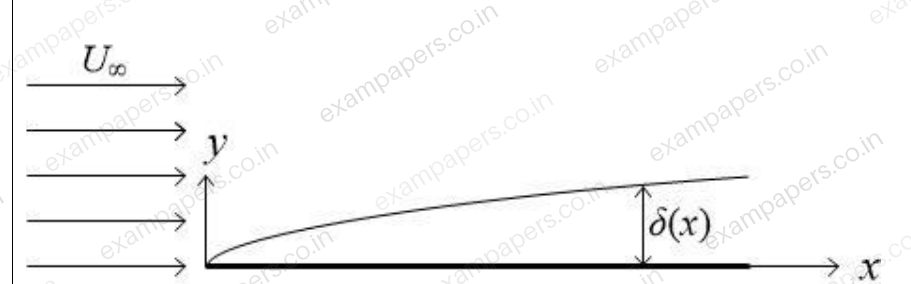
Your answerChoose one option.
Log in to check the answer
You can attempt this question now. Sign in to view the answer key, explanations and discussion.Log in to check answerQuestion 44
Open questionXE-CMCQ1 markNeeds review
In age-hardening of an aluminium alloy, the purpose of solution treatment followed by quenching is to
Your answerChoose one option.
Log in to check the answer
You can attempt this question now. Sign in to view the answer key, explanations and discussion.Log in to check answerQuestion 45
Open questionXE-CMCQ1 markNeeds review
The magnetization (M) – magnetic field (H) curves for four different materials are given below. Which one of these materials is most suitable for use as a permanent magnet?
Your answerChoose one option.
Log in to check the answer
You can attempt this question now. Sign in to view the answer key, explanations and discussion.Log in to check answerQuestion 46
Open questionXE-CMCQ1 markNeeds review
The band gap of a semiconducting material is ∼ 2 eV. Which one of the following absorption (A) vs. energy (in eV) curves is correct?
Your answerChoose one option.
Log in to check the answer
You can attempt this question now. Sign in to view the answer key, explanations and discussion.Log in to check answerQuestion 47
Open questionXE-CMCQ1 markNeeds review
Figures (i) and (ii) show a binary phase diagram and the corresponding Gibbs free energy (
) vs. composition (
) diagram, respectively. Figure (ii) corresponds to which one of the temperatures shown in Figure (i)? 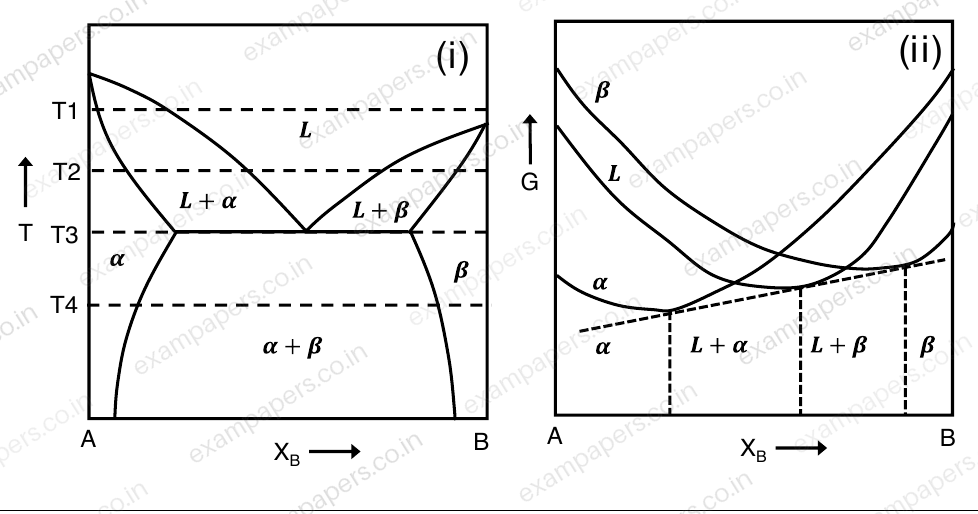
Your answerChoose one option.
Log in to check the answer
You can attempt this question now. Sign in to view the answer key, explanations and discussion.Log in to check answerQuestion 48
Open questionXE-CMCQ1 markNeeds review
Aliovalent doping of
in
leads to the formation of defects. Which one of the following is the correct defect reaction?Your answerChoose one option.
Log in to check the answer
You can attempt this question now. Sign in to view the answer key, explanations and discussion.Log in to check answerQuestion 53
Open questionXE-CMCQ2 marksNeeds review
A student performed X-ray diffraction experiment on a FCC polycrystalline pure metal. The following
values were calculated from the diffraction peaks.
However, the student was negligent and missed noting one of the peaks. Which one of the following Miller indices corresponds to the missing peak?
Your answerChoose one option.
Log in to check the answer
You can attempt this question now. Sign in to view the answer key, explanations and discussion.Log in to check answerQuestion 54
Open questionXE-CMCQ2 marksNeeds review
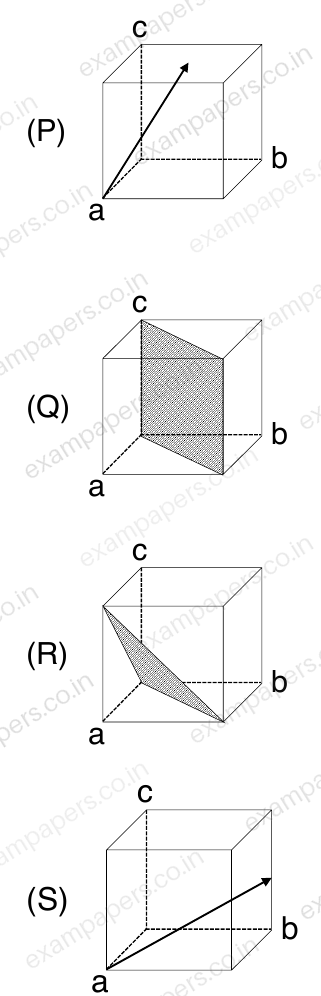
Match the lattice planes and directions (in Column I) with the corresponding Miller indices (in Column II):
Column I: (P), (Q), (R), (S); Column II: 1.
; 2.
; 3.
; 4.
.
Your answerChoose one option.
Log in to check the answer
You can attempt this question now. Sign in to view the answer key, explanations and discussion.Log in to check answerQuestion 55
Open questionXE-CMCQ2 marksNeeds review
Match the hardness test (in Column I) with its indenter type (in Column II).
Column I: (P) Brinell; (Q) Rockwell; (R) Vickers.
Column II: 1. Diamond pyramid; 2. Diamond cone; 3. Tungsten carbide sphere; 4. Steel sphere
Your answerChoose one option.
Log in to check the answer
You can attempt this question now. Sign in to view the answer key, explanations and discussion.Log in to check answer