
Engineering Sciences
GATE XE format:mcq PYQs
Build your understanding with focused practice from past exam papers.
Questions 331–340 of 959. Imported answers require independent review unless marked reviewed.
Question 100
Open questionXE-EMCQ2 marksNeeds review
Match the following:
Thermodynamic function/equation | Expression |
|---|---|
A1 Helmholtz function (a) | B1 |
A2 Gibbs function (g) | B2 |
A3 T-ds equation | B3 |
A4 Clapeyron-Clausius equation | B4 |
Your answerChoose one option.
Log in to check the answer
You can attempt this question now. Sign in to view the answer key, explanations and discussion.Log in to check answerQuestion 110
Open questionXE-FMCQ1 markNeeds review
Which one of the monomers given is used in the synthesis of cellulose?
Your answerChoose one option.
Log in to check the answer
You can attempt this question now. Sign in to view the answer key, explanations and discussion.Log in to check answerQuestion 111
Open questionXE-FMCQ1 markNeeds review
A copper wire upon loading instantaneously increases in length to l, and then continues to elongate gradually. Upon unloading, the wire retracts to length l. According to the Maxwell model, which one of the options given correctly relates the total strain E, the applied stress S, the modulus G, the material’s resistance to flow η, and the elapsed time t between loading and unloading?
Your answerChoose one option.
Log in to check the answer
You can attempt this question now. Sign in to view the answer key, explanations and discussion.Log in to check answerQuestion 112
Open questionXE-FMCQ1 markNeeds review
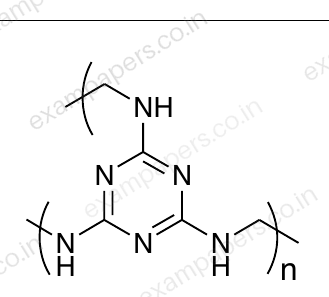
Consider the structure of a crosslinked polymer shown in the figure. From the options given, identify the monomers that are used in the synthesis of the polymer.
Your answerChoose one option.
Log in to check the answer
You can attempt this question now. Sign in to view the answer key, explanations and discussion.Log in to check answerQuestion 113
Open questionXE-FMCQ1 markNeeds review
Among the options given, choose the most suitable compatibilizer for blending Polyvinylidene fluoride (PVDF) and Acrylonitrile butadiene styrene (ABS).
Your answerChoose one option.
Log in to check the answer
You can attempt this question now. Sign in to view the answer key, explanations and discussion.Log in to check answerQuestion 114
Open questionXE-FMCQ1 markNeeds review
A high molecular weight polymer passes through different zones from the hopper to the die in an extruder. Among the options given, identify the correct match between the zones and their key functions.
Zones: P — Metering zone; Q — Compression zone; R — Feed zone; S — Working zone.
Key functions: 1 — High shear forces for effective mixing; 2 — Receives the charge or feed; 3 — Melts the charge or feed through heat conducted by the heating element; 4 — The charge or feed acquires a constant flow rate imparted by the helical flight of the screw.
Your answerChoose one option.
Log in to check the answer
You can attempt this question now. Sign in to view the answer key, explanations and discussion.Log in to check answerQuestion 115
Open questionXE-FMCQ1 markNeeds review
Polymer wetting is improved by the addition of fillers with functional groups. In a typical case-study, natural-clay was modified with hydroxyl groups and compounded with Nylon 6 along with an antioxidant. The resulting composite exhibited poor mechanical properties. Which one among the options given explains this observation?
Your answerChoose one option.
Log in to check the answer
You can attempt this question now. Sign in to view the answer key, explanations and discussion.Log in to check answerQuestion 116
Open questionXE-FMCQ1 markNeeds review
Among the options given, identify the correct match between the polymers and their glass transition temperatures (T_g).
Polymer: P — High density polyethylene; Q — Poly(vinyl carbazole); R — Polymethyl methacrylate; S — Polycarbonate.
Glass transition temperature (°C): 1 — >200; 2 — 145 to 155; 3 — -100 to -80; 4 — 90 to 100.
Your answerChoose one option.
Log in to check the answer
You can attempt this question now. Sign in to view the answer key, explanations and discussion.Log in to check answerQuestion 117
Open questionXE-FMCQ1 markNeeds review
What is the correct order of decreasing crystallinity of the given polymers?
P — atactic-Polypropylene; Q — syndiotactic-Polystyrene; R — Nylon 6; S — Polyethylene terephthalate
Your answerChoose one option.
Log in to check the answer
You can attempt this question now. Sign in to view the answer key, explanations and discussion.Log in to check answerQuestion 118
Open questionXE-FMCQ1 markNeeds review
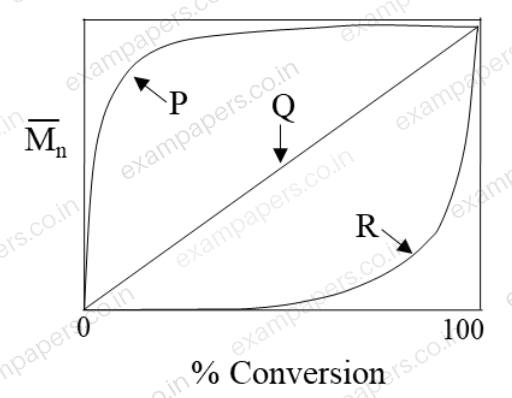
Choose the correct option that best correlates the graphs with the polymerization methods.
Your answerChoose one option.
Log in to check the answer
You can attempt this question now. Sign in to view the answer key, explanations and discussion.Log in to check answer