
Engineering Sciences
GATE XE format:mcq PYQs
Build your understanding with focused practice from past exam papers.
Questions 381–390 of 959. Imported answers require independent review unless marked reviewed.
Question 22
Open questionXE-BMCQ1 markNeeds review
A heavy horizontal cylinder of diameter
supports a mass of liquid having density
as shown in the figure. Find out the vertical component of force exerted by the liquid per unit length of the cylinder if
is the acceleration due to gravity. 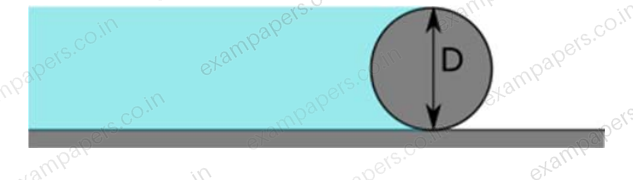
Your answerChoose one option.
Log in to check the answer
You can attempt this question now. Sign in to view the answer key, explanations and discussion.Log in to check answerQuestion 23
Open questionXE-BMCQ1 markNeeds review
The figure shows the developing zone and the fully developed region in a pipe flow where the steady flow takes place from left to right. The wall shear stress in the sections A, B, C, and D are given by
, and
, respectively. Select the correct statement. 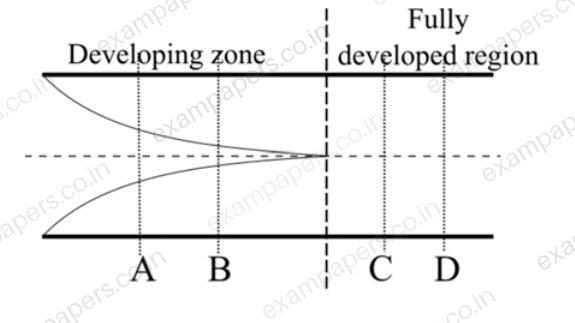
Your answerChoose one option.
Log in to check the answer
You can attempt this question now. Sign in to view the answer key, explanations and discussion.Log in to check answerQuestion 24
Open questionXE-BMCQ1 markNeeds review
The left hand column lists some non-dimensional numbers and the right hand column lists some physical phenomena. Indicate the correct combination
| |
|---|---|
1. Reynolds number | i. Wave drag |
2. Froude number | ii. Compressible flow |
3. Mach number | iii. Viscous drag |
4. Weber number | iv. Spray formation |
Your answerChoose one option.
Log in to check the answer
You can attempt this question now. Sign in to view the answer key, explanations and discussion.Log in to check answerQuestion 31
Open questionXE-BMCQ2 marksNeeds review
Consider an inviscid flow through a smooth pipe which has a pitot-static tube arrangement as shown. Find the centre-line velocity in the pipe. Consider that the density of the fluid is 1000 kg/m³, acceleration due to gravity is 10 m/s², and the specific gravity of the manometric fluid is 11.
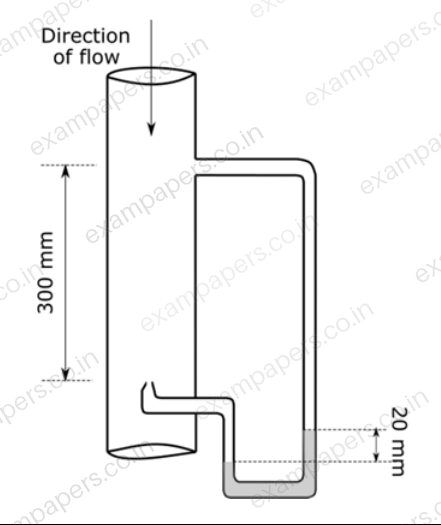
Your answerChoose one option.
Log in to check the answer
You can attempt this question now. Sign in to view the answer key, explanations and discussion.Log in to check answerQuestion 32
Open questionXE-BMCQ2 marksNeeds review
The speed of propagation,
, of a capillary wave depends on the density of the fluid,
, the wavelength of the wave,
, and the surface tension,
. If the density and wavelength remain constant, halving the surface tension would lead to a new velocity,
, given byYour answerChoose one option.
Log in to check the answer
You can attempt this question now. Sign in to view the answer key, explanations and discussion.Log in to check answerQuestion 33
Open questionXE-BMCQ2 marksNeeds review
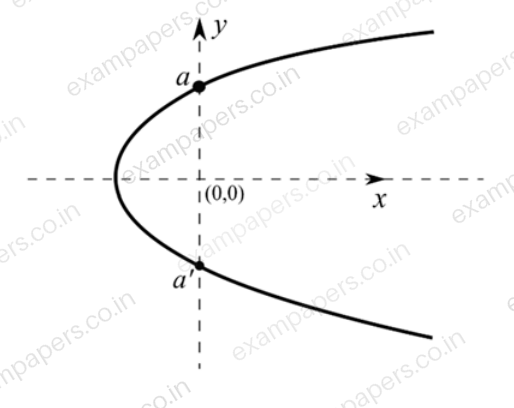
A two-dimensional flow field is described by a combination of a source of strength
at the origin and a uniform flow,
, in the positive
-direction such that the velocity potential is given by
The stagnation streamline is shown in the figure. Find the distance
. 
Your answerChoose one option.
Log in to check the answer
You can attempt this question now. Sign in to view the answer key, explanations and discussion.Log in to check answerQuestion 34
Open questionXE-BMCQ2 marksNeeds review
A typical boundary layer over a flat plate has a linear velocity profile with zero velocity at the wall and freestream velocity,
, at the outer edge of the boundary layer. What is the ratio of the momentum thickness to the thickness of the boundary layer?Your answerChoose one option.
Log in to check the answer
You can attempt this question now. Sign in to view the answer key, explanations and discussion.Log in to check answerQuestion 44
Open questionXE-CMCQ1 markNeeds review
Number of atoms per unit area of the (110) plane of a body centered cubic crystal, with lattice parameter 'a', is
Your answerChoose one option.
Log in to check the answer
You can attempt this question now. Sign in to view the answer key, explanations and discussion.Log in to check answerQuestion 45
Open questionXE-CMCQ1 markNeeds review
Match the following materials with their corresponding bonding types.
Material | Bonding |
|---|---|
P: Cu₀.₅Al₀.₅ | 1: Ionic |
Q: ZnS | 2: Covalent |
R: Na₂O | 3: Metallic |
S: Li₄SiO₄ | 4: Mixed |
Your answerChoose one option.
Log in to check the answer
You can attempt this question now. Sign in to view the answer key, explanations and discussion.Log in to check answerQuestion 46
Open questionXE-CMCQ1 markNeeds review
In an ideal rubber, the primary factor responsible for elasticity up to small strains is
Your answerChoose one option.
Log in to check the answer
You can attempt this question now. Sign in to view the answer key, explanations and discussion.Log in to check answer