
Engineering Sciences
GATE XE format:mcq PYQs
Build your understanding with focused practice from past exam papers.
Questions 411–420 of 959. Imported answers require independent review unless marked reviewed.
Question 79
Open questionXE-DMCQ2 marksNeeds review
A rectangular plate of uniform thickness having initial length
and width
is placed between two rigid immovable walls. The temperature of the plate is increased by
. The plate is free to expand along the
and
directions. The mid-surface of the plate remains in the
-plane. The Poisson’s ratio is
and the coefficient of thermal expansion is
. Assuming that the plate is initially free of stresses, the change in length of the plate after the increase in temperature is given by 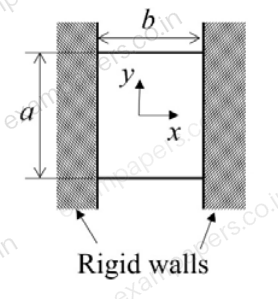
Your answerChoose one option.
Log in to check the answer
You can attempt this question now. Sign in to view the answer key, explanations and discussion.Log in to check answerQuestion 80
Open questionXE-DMCQ2 marksNeeds review
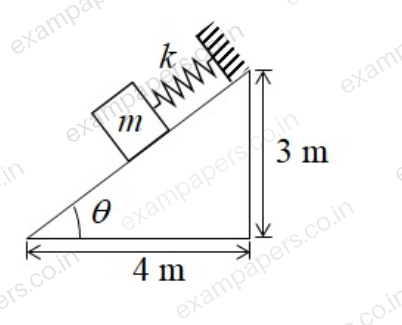
A mass
kg is attached to a spring as shown in the figure. The coefficient of friction between the mass and the inclined plane is 0.25. Assume that the acceleration due to gravity is 10 m/s
and that static and kinetic friction coefficients are the same. Equilibrium of the mass is impossible if the spring force is
Your answerChoose one option.
Log in to check the answer
You can attempt this question now. Sign in to view the answer key, explanations and discussion.Log in to check answerQuestion 88
Open questionXE-EMCQ1 markNeeds review
The energy equation for a reversible non-flow process can be expressed as
, where
is the heat transfer per unit mass,
is the internal energy per unit mass,
is the pressure, and
is the mass specific volume. This energy equation is not in exact differential form. It can be made exact differential by multiplying with the following integrating factor: (T is the absolute temperature)Your answerChoose one option.
Log in to check the answer
You can attempt this question now. Sign in to view the answer key, explanations and discussion.Log in to check answerQuestion 89
Open questionXE-EMCQ1 markNeeds review
An air standard Diesel cycle consists of four processes: 1-2 (isentropic compression), 2-3 (constant pressure heat addition), 3-4 (isentropic expansion) and 4-1 (constant volume heat rejection).
is the temperature (in K) attained at the end of isentropic expansion (3-4) before constant volume heat rejection. The constant volume heat rejection process (4-1) is replaced by a constant pressure heat rejection process (4a-1) such that
is the temperature (in K) reached at the end of isentropic expansion (3-4a), and the state point 1 remains the same. ThenYour answerChoose one option.
Log in to check the answer
You can attempt this question now. Sign in to view the answer key, explanations and discussion.Log in to check answerQuestion 90
Open questionXE-EMCQ1 markNeeds review
Gas in a cylinder-piston device expands from state 1
to state 2
. The expansion process is polytropic, i.e.,
. Assuming the ideal gas behaviour, the expression for the work done,
by the system is given byYour answerChoose one option.
Log in to check the answer
You can attempt this question now. Sign in to view the answer key, explanations and discussion.Log in to check answerQuestion 91
Open questionXE-EMCQ1 markNeeds review
The temperature of the working fluid in a real heat engine cycle changes during heat addition and heat rejection processes. The maximum and minimum temperatures of the cycle are
and
, respectively. If
is the thermal efficiency of a Carnot engine operating between these temperature limits, then the thermal efficiency,
of the real heat engine satisfies the relationYour answerChoose one option.
Log in to check the answer
You can attempt this question now. Sign in to view the answer key, explanations and discussion.Log in to check answerQuestion 97
Open questionXE-EMCQ2 marksNeeds review
One of the Maxwell equations is expressed as
, where
is the entropy per unit mass,
is the mass specific volume,
is the pressure, and
is the temperature. In this expression,
is a continuous function of
and
. The derivatives of
are also continuous. Let
be specific heat capacity at constant volume for a gas. Then,
can be written asYour answerChoose one option.
Log in to check the answer
You can attempt this question now. Sign in to view the answer key, explanations and discussion.Log in to check answerQuestion 98
Open questionXE-EMCQ2 marksNeeds review
The general relation among the properties
,
and
at any state point can be expressed as
. If
,
and
are continuous functions and
,
is the Joule-Thomson coefficient, then
isYour answerChoose one option.
Log in to check the answer
You can attempt this question now. Sign in to view the answer key, explanations and discussion.Log in to check answerQuestion 99
Open questionXE-EMCQ2 marksNeeds review
An air-conditioning system consists of an insulated rigid mixing chamber designed to supply air at 24 °C to a building. The mixing chamber mixes two air streams: (i) a cold air stream at 10 °C and mass flow rate
(kg/s), and (ii) a stream of fresh ambient air at 30 °C and mass flow rate
(kg/s). Assume air to be an ideal gas with constant specific heat (
kJ/(kg K),
). Neglect change in kinetic and potential energies as compared to change in enthalpy. Under the steady state condition, the ratio of the mass flow rates of the two streams (
) isYour answerChoose one option.
Log in to check the answer
You can attempt this question now. Sign in to view the answer key, explanations and discussion.Log in to check answerQuestion 100
Open questionXE-EMCQ2 marksNeeds review
An ideal gas mixture consists of 80% N₂ and 20% O₂ on mass basis. If the total pressure is 300 kPa, then the partial pressure of N₂ (in kPa) is
(Molecular weights of N₂ = 28 kg/kmol and O₂ = 32 kg/kmol)
Your answerChoose one option.
Log in to check the answer
You can attempt this question now. Sign in to view the answer key, explanations and discussion.Log in to check answer