
Engineering Sciences
GATE XE format:nat PYQs
Build your understanding with focused practice from past exam papers.
Questions 171–180 of 668. Imported answers require independent review unless marked reviewed.
Question 124
Open questionXE-FNAT2 marksNeeds review
If a given poly(ethylene) sample with specific volume,
shows:
specific volume of the crystalline fraction,
and
specific volume of the amorphous fraction,
,
then the % crystallinity (based on mass fraction) of the poly(ethylene) sample is ______ % (rounded off to the nearest integer).Log in to check the answer
You can attempt this question now. Sign in to view the answer key, explanations and discussion.Log in to check answerQuestion 125
Open questionXE-FNAT2 marksNeeds review
The glass transition temperature (
) of poly(2,6-dimethyl-p-phenylene oxide) (PPO) is 206 °C and the
of poly(styrene) (PS) is 90 °C. The
of a 50/50 (wt/wt) miscible blend of PPO/PS is ______ °C (rounded off to the nearest integer).Log in to check the answer
You can attempt this question now. Sign in to view the answer key, explanations and discussion.Log in to check answerQuestion 126
Open questionXE-FNAT2 marksNeeds review
A unidirectional composite is prepared using 70% by volume of epoxy matrix and 30% by volume of carbon fibre. The elastic modulus of the epoxy matrix is 3.5 GPa and the elastic modulus of the carbon fibre is 350 GPa. The longitudinal elastic modulus of the composite is ______ GPa (rounded off to the nearest integer).
Log in to check the answer
You can attempt this question now. Sign in to view the answer key, explanations and discussion.Log in to check answerQuestion 127
Open questionXE-FNAT2 marksNeeds review
Polyamide 66 is prepared by the condensation polymerization of 0.08 mol of hexamethylene diamine with 0.08 mol of adipic acid. At the end of the polymerization reaction, the reaction product contained 0.002 mol of unreacted carboxylic acid groups. The molecular weight of the repeat unit of polyamide 66 is 226 g mol
. The number-average molecular weight (
) of the polyamide 66 in the reaction product is ______ g mol
(rounded off to the nearest integer).Log in to check the answer
You can attempt this question now. Sign in to view the answer key, explanations and discussion.Log in to check answerQuestion 128
Open questionXE-FNAT2 marksNeeds review
A monodisperse polymer sample of molecular weight 10,000 g mol
is mixed with another monodisperse sample of the same polymer of molecular weight 50,000 g mol
. The total mass of the mixture is 1,000 g and the total number of moles of the polymer in the mixture is 0.04 mol. The weight-average molecular weight (
) of the polymer mixture is ______ g mol
(rounded off to the nearest integer).Log in to check the answer
You can attempt this question now. Sign in to view the answer key, explanations and discussion.Log in to check answerQuestion 129
Open questionXE-FNAT2 marksNeeds review
For a polymer solution, the dependence of viscosity (
) on shear rate (
) is described by the three-parameter Carreau model given by
where,
,
, and
are the three parameters of the model. Here, all three parameters are positive quantities. As the shear rate increases from 1 s
to 100 s
, the viscosity of the polymer solution decreases by a factor of 10. For a polymer solution with
and
Pa s, the value of the parameter
is ______ s (rounded off to two decimal places).Log in to check the answer
You can attempt this question now. Sign in to view the answer key, explanations and discussion.Log in to check answerQuestion 130
Open questionXE-FNAT2 marksNeeds review
The dilute solution viscometry data for two samples of a polymer with two different molecular weights are shown in the figure, where
has been plotted against
. Here,
is the specific viscosity and
is the mass concentration of the polymer solution. The slopes and intercepts of the plots for both the samples are shown in the figure. The plotted data for both samples are described by the Huggins equation of dilute solution. The value of the Mark-Houwink constant ‘a’ for both polymer samples is 0.5.
The ratio of the viscosity-average molecular weight (
) of polymer sample 1 to that of polymer sample 2, i.e.,
, is ______ (rounded off to two decimal places). 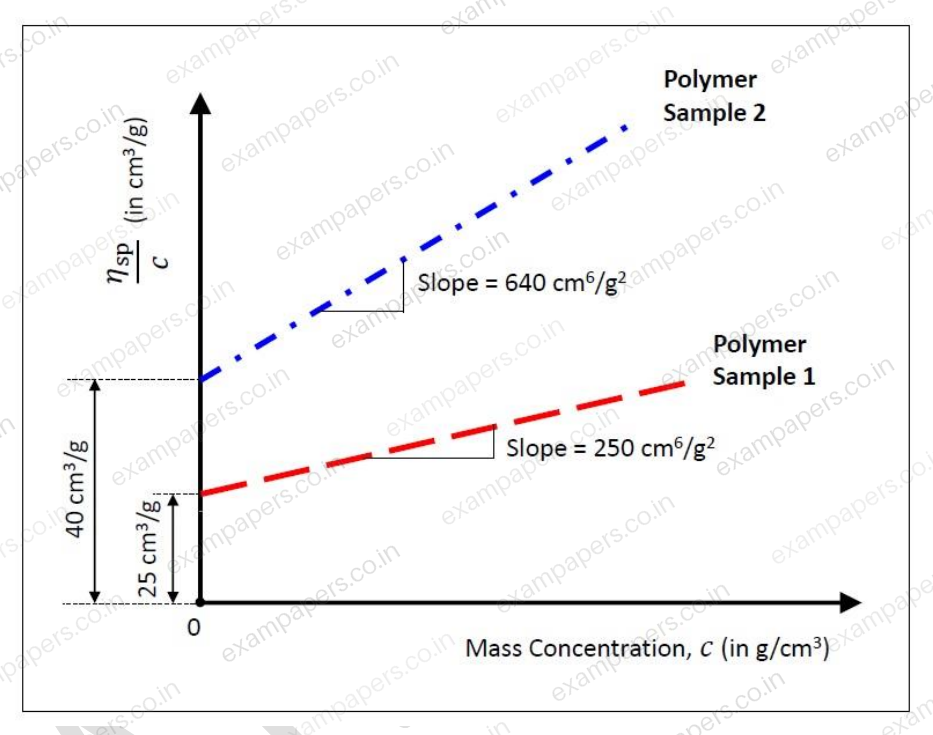
Log in to check the answer
You can attempt this question now. Sign in to view the answer key, explanations and discussion.Log in to check answerQuestion 131
Open questionXE-FNAT2 marksNeeds review
The linear viscoelastic behavior of a polymer is described by the Kelvin-Voigt model consisting of a spring element of elastic modulus 10 MPa in parallel with a dashpot of viscosity 3.6 × 10
Pa s. A fixed stress of 40 MPa is suddenly applied to the polymer and maintained thereafter. The value of the strain after one hour from the sudden application of the stress is ______ (rounded off to two decimal places).Log in to check the answer
You can attempt this question now. Sign in to view the answer key, explanations and discussion.Log in to check answerQuestion 140
Open questionXE-GNAT1 markNeeds review
Thermal resistance constant (z-value) is defined as the change in temperature required to reduce the decimal reduction time of a microorganism by __________ percent (Answer in integer).
Log in to check the answer
You can attempt this question now. Sign in to view the answer key, explanations and discussion.Log in to check answerQuestion 151
Open questionXE-GNAT2 marksNeeds review
A 10 kg tomato pulp is concentrated from an initial moisture content of 90% (wet weight basis) to 35% (wet weight basis). The weight of the concentrate in kg is __________ (round off to 2 decimal places).
Log in to check the answer
You can attempt this question now. Sign in to view the answer key, explanations and discussion.Log in to check answer