
Engineering Sciences
GATE XE Integral Analysis for a Control Volume PYQs
Build your understanding with focused practice from past exam papers.
How to practice Integral Analysis for a Control Volume
Attempt a question, record the concept and assumptions, then check the available answer. Rework mistakes after revising the relevant concepts. Topic tags can overlap; review the question context.
Questions 1–10 of 18. Imported answers require independent review unless marked reviewed.
Question 36
Open questionXE-BMSQ2 marksNeeds review
A vertical jet of diameter
strikes a horizontal plate with a velocity
, as shown in the figure. The plate has a hole of diameter
concentric to the flow through which a portion of fluid passes with the same velocity
. The remaining fluid moves radially outward along the plate. If
is the force acting vertically upward to hold the horizontal plate at its initial place, which of the following statements is/are true? 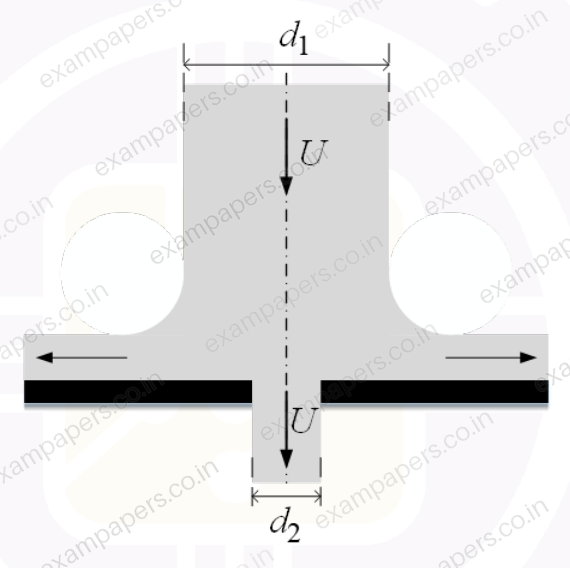
Your answerSelect all correct options. You can choose more than one.
Log in to check the answer
You can attempt this question now. Sign in to view the answer key, explanations and discussion.Log in to check answerQuestion 25
Open questionXE-BMCQ1 markNeeds review
Statement of Reynolds Transport Theorem is given below with three blanks.
The rate of change of ______ extensive property can be calculated by summing the rate of change of the amount of same property in the ______ and the rate at which the property is ______ the surface of the control volume.
Which one of the following options correctly fills the blanks by using its comma-separated phrases in sequence?
Your answerChoose one option.
Log in to check the answer
You can attempt this question now. Sign in to view the answer key, explanations and discussion.Log in to check answerQuestion 40
Open questionXE-BNAT2 marksNeeds review
A fixed control volume has four one-dimensional boundary sections (1, 2, 3, and 4). For a steady flow inside the control volume, the flow properties at each section are tabulated below:
Boundary Section | Type | Density (kg/m ) | Surface Normal Velocity (m/s) | Cross-sectional Area (m ) | Specific Energy (J/kg) |
|---|---|---|---|---|---|
1 | Inlet | 1000 | 10 | 0.5 | 200 |
2 | Inlet | 1000 | 2 | 3.0 | 50 |
3 | Outlet | 1000 | 5 | 1.0 | 100 |
4 | Outlet | 1000 | 4 | 1.5 | 80 |
The rate of change of energy of the system which occupies the control volume at this instant is
J/s. The value of
(rounded off to 2 decimal places) is ________Log in to check the answer
You can attempt this question now. Sign in to view the answer key, explanations and discussion.Log in to check answerQuestion 26
Open questionXE-BMCQ1 markNeeds review
Let
,
, and
be position vector, velocity vector, and mass, respectively in a control mass system. Which one of the following properties is considered as conserved extensive property in Reynolds Transport Theorem to obtain the angular momentum equation?Your answerChoose one option.
Log in to check the answer
You can attempt this question now. Sign in to view the answer key, explanations and discussion.Log in to check answerQuestion 38
Open questionXE-BNAT2 marksNeeds review
A circular water jet of diameter 50 mm impinges with a velocity of 18 m/s normal to a plate. The density of water is 1000 kg/m
and gravity force is neglected. 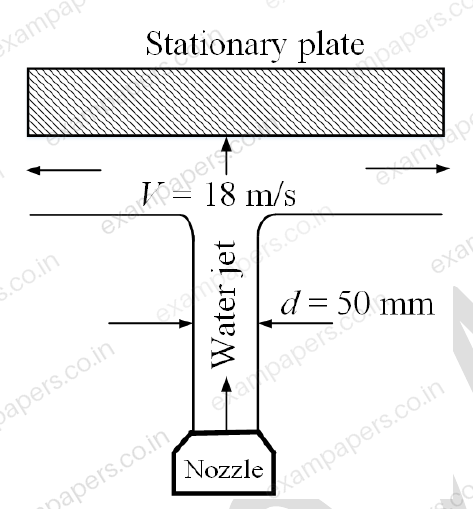
The magnitude of net force (in N, rounded off to two decimal places) imparted by the jet on the stationary plate is ______________.
Log in to check the answer
You can attempt this question now. Sign in to view the answer key, explanations and discussion.Log in to check answerQuestion 39
Open questionXE-BNAT2 marksNeeds review
Consider the steady, incompressible flow of water in a horizontal pipe of constant diameter 1 m with an inlet velocity of 12 m/s.
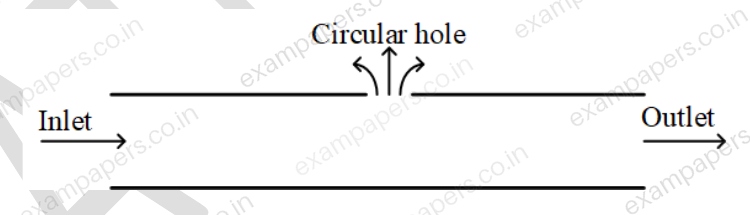
As shown in figure, water is lost through a circular hole of diameter 0.6 m at the rate of 4.53 m
/s. The outlet velocity (in m/s, rounded off to two decimal places) of water in the pipe is ______.Log in to check the answer
You can attempt this question now. Sign in to view the answer key, explanations and discussion.Log in to check answerQuestion 36
Open questionXE-BNAT2 marksNeeds review
A water jet (density = 1000 kg/m
) is approaching a vertical plate, having an orifice at the center, as shown in the figure. While a part of the jet passes through the orifice, remainder flows along the plate. Neglect friction and assume both the inlet and exit jets to have circular cross-sections. If
m/s,
mm and
mm, magnitude of the horizontal force (in N, rounded off to one decimal place) required to hold the plate in its position is __________. 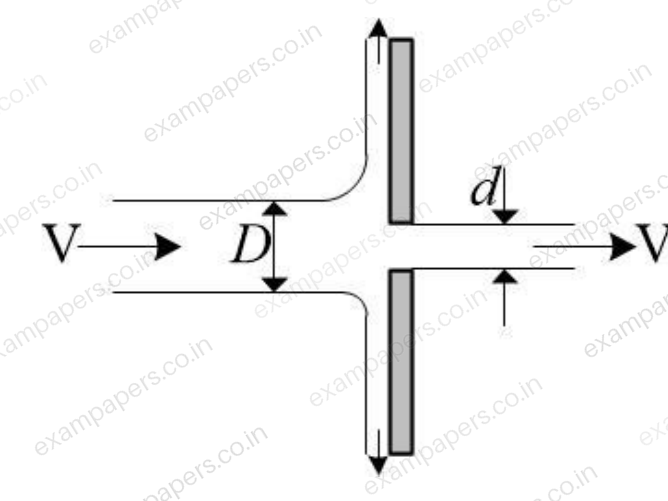
Log in to check the answer
You can attempt this question now. Sign in to view the answer key, explanations and discussion.Log in to check answerQuestion 37
Open questionXE-BNAT2 marksNeeds review
Water (density = 1000 kg/m
) and alcohol (specific gravity = 0.7) enter a Y-shaped channel at flow rates of 0.2 m
/s and 0.3 m
/s, respectively. Their mixture leaves through the other end of the channel, as shown in the figure. The average density (in kg/m
) of the mixture is ______. 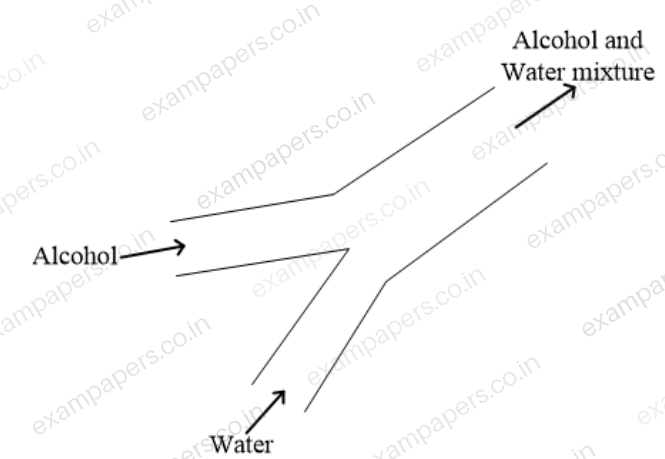
Log in to check the answer
You can attempt this question now. Sign in to view the answer key, explanations and discussion.Log in to check answerQuestion 30
Open questionXE-BNAT1 markNeeds review
A 10 kg mass placed on an infinitely long horizontal massless flat platform is to be supported by a steady vertical water jet as shown in the figure. The diameter of the jet is 5 cm. What minimum average velocity is required to hold the mass in place? Assume
,
and
. Neglect friction. (Round off to two decimal places) 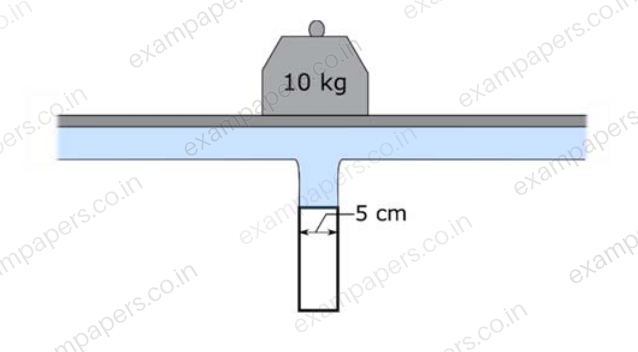
Log in to check the answer
You can attempt this question now. Sign in to view the answer key, explanations and discussion.Log in to check answerQuestion 39
Open questionXE-BNAT2 marksNeeds review
Consider a lawn sprinkler with horizontal arms of radius,
cm which has water introduced vertically through the centre, as shown in the figure. The exit area of the jet is 25 cm
and the jet velocity is 1 m/s. The water is ejected orthogonal to the sprinkler arm and the jet makes an angle of 60° with the horizontal plane. Find the torque (in N-m) required to hold the sprinkler stationary.
Consider water density 1000 kg/m
. Neglect the effects of friction and gravity.
(Round off to two decimal places) 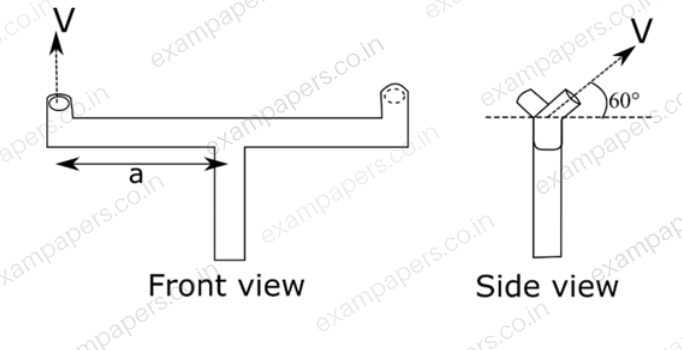
Log in to check the answer
You can attempt this question now. Sign in to view the answer key, explanations and discussion.Log in to check answer