
Engineering Sciences
GATE XE kind:question PYQs
Build your understanding with focused practice from past exam papers.
Questions 1011–1020 of 1772. Imported answers require independent review unless marked reviewed.
Question 5
Open questionXE-FMCQ1 markNeeds review
Which one of the following is an example of a biodegradable polymer?
Your answerChoose one option.
Log in to check the answer
You can attempt this question now. Sign in to view the answer key, explanations and discussion.Log in to check answerQuestion 6
Open questionXE-FMCQ1 markNeeds review
Polymer crystals show a range of melting points in contrast to single melting point of crystals of small molecules, because ________.
Your answerChoose one option.
Log in to check the answer
You can attempt this question now. Sign in to view the answer key, explanations and discussion.Log in to check answerQuestion 7
Open questionXE-FMCQ1 markNeeds review
When the rate of cooling is increased during the solidification process, the glass transition temperature of a polymer ________.
Your answerChoose one option.
Log in to check the answer
You can attempt this question now. Sign in to view the answer key, explanations and discussion.Log in to check answerQuestion 8
Open questionXE-FMCQ1 markNeeds review
Equal and opposite forces of a constant magnitude
are applied at the two ends of a thin elastomeric rod, which is held at a temperature
(
), where
and
are the glass transition temperature and melting temperature respectively. If the temperature is increased to
(
and
), the rod will ____________.Your answerChoose one option.
Log in to check the answer
You can attempt this question now. Sign in to view the answer key, explanations and discussion.Log in to check answerQuestion 9
Open questionXE-FMCQ1 markNeeds review
The size of a coiled polymer chain in a dilute solution is
in a good solvent,
in an ideal solvent and
in a poor solvent. Select the correct ordering of sizes.Your answerChoose one option.
Log in to check the answer
You can attempt this question now. Sign in to view the answer key, explanations and discussion.Log in to check answerQuestion 10
Open questionXE-FMCQ2 marksNeeds review
Match the Additive to its Function.
Additive | Function |
|---|---|
P. Triotyl phosphate | 1. Couping Agent |
Q. Triethoxy vinyl silane | 2. Antioxidant |
R. Azoisobutyronitrile | 3. Plasticizer |
S. 4-Methyl-2,6-di-t-butyl phenol | 4. Blowing Agent |
Your answerChoose one option.
Log in to check the answer
You can attempt this question now. Sign in to view the answer key, explanations and discussion.Log in to check answerQuestion 11
Open questionXE-FMCQ2 marksNeeds review
Match the polymer processing operation with respect to its typical range of shear rate.
Processing Operation | Shear rate (s⁻¹) |
|---|---|
P. Compression Moulding | 1. 1000 - 10000 |
Q. Extrusion | 2. 100 - 1000 |
R. Calendering | 3. 1 - 10 |
S. Injection Moulding | 4. 10 - 100 |
Your answerChoose one option.
Log in to check the answer
You can attempt this question now. Sign in to view the answer key, explanations and discussion.Log in to check answerQuestion 12
Open questionXE-FMCQ2 marksNeeds review
Shear stress (
) and shear viscosity (
) are plotted as functions of the shear rate,
, for idealized “solid-like with yielding (1)” and “liquid-like (2)” materials.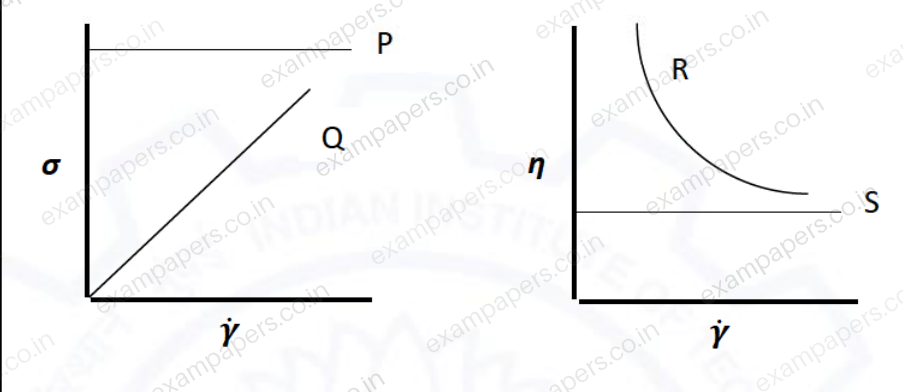
Associate the shear stress and viscosity plots with the appropriate material responses.
Your answerChoose one option.
Log in to check the answer
You can attempt this question now. Sign in to view the answer key, explanations and discussion.Log in to check answerQuestion 13
Open questionXE-FNAT2 marksNeeds review
The plateau modulus of polystyrene has a value of 0.2 × 10⁶ Pa at 150 °C. Given, the density of polystyrene is 1.05 g/cm³, the universal gas constant,
= 8.3 J K⁻¹ mol⁻¹, and the monomer molecular weight is 104 g/mol. The molecular weight between entanglements (rounded off to the nearest integer) of polystyrene chains is ______ g/mol.Log in to check the answer
You can attempt this question now. Sign in to view the answer key, explanations and discussion.Log in to check answerQuestion 14
Open questionXE-FNAT2 marksNeeds review
A unidirectional composite of epoxy and carbon fiber of 50% by volume is made. The elastic modulus of epoxy and carbon fiber are 3.5 GPa and 350 GPa, respectively. The ratio (rounded off to one decimal place) of the modulus of the composite to the matrix modulus is ______.
Log in to check the answer
You can attempt this question now. Sign in to view the answer key, explanations and discussion.Log in to check answer