
Engineering Sciences
GATE XE kind:question PYQs
Build your understanding with focused practice from past exam papers.
Questions 111–120 of 1772. Imported answers require independent review unless marked reviewed.
Question 111
Open questionXE-FMCQ1 markNeeds review
The stress-strain profiles in the figure were obtained following longitudinal tensile loading for a brittle polymer, glass fibre, and a composite lamina consisting of unidirectional continuous glass fibres and the polymer matrix. Assume that the matrix is free of voids, there is perfect bonding between glass fibres and the matrix, and there are no residual stresses in the composite lamina.
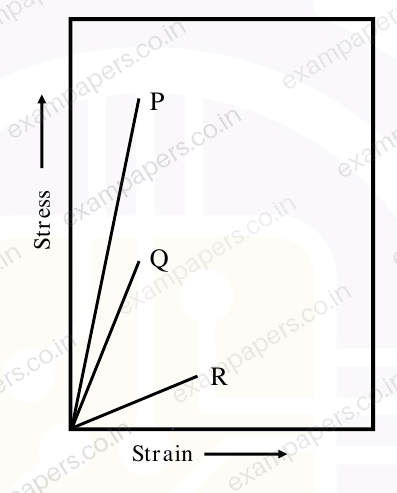
Identify the correct stress-strain profile for the polymer matrix, glass fibre, and their composite lamina from the above figure.
Your answerChoose one option.
Log in to check the answer
You can attempt this question now. Sign in to view the answer key, explanations and discussion.Log in to check answerQuestion 112
Open questionXE-FMCQ1 markNeeds review
Norrish-Smith effect or Trommsdorff effect during free radical bulk polymerization at high conversion is characterized by________________.
Your answerChoose one option.
Log in to check the answer
You can attempt this question now. Sign in to view the answer key, explanations and discussion.Log in to check answerQuestion 113
Open questionXE-FMCQ1 markNeeds review
For a polydisperse polymer, the viscosity-average molecular weight (
) becomes equal to the weight-average molecular weight (
), when the Mark–Houwink constant a is _________________.Your answerChoose one option.
Log in to check the answer
You can attempt this question now. Sign in to view the answer key, explanations and discussion.Log in to check answerQuestion 114
Open questionXE-FMCQ1 markNeeds review
Which one of the following is NOT a rotational rheometer?
Your answerChoose one option.
Log in to check the answer
You can attempt this question now. Sign in to view the answer key, explanations and discussion.Log in to check answerQuestion 115
Open questionXE-FMCQ1 markNeeds review
Select the correct option to match the Product with the most appropriate Processing technique from the table given below:
Product | | Processing technique | |
|---|---|---|---|
P | Fibre-reinforced pressure vessel | I | Rotomoulding |
Q | Overhead water tank | II | Thermoforming |
R | Blister package for medicine | III | Filament winding |
S | Plastic carry bag | IV | Blown film extrusion |
Your answerChoose one option.
Log in to check the answer
You can attempt this question now. Sign in to view the answer key, explanations and discussion.Log in to check answerQuestion 116
Open questionXE-FMSQ1 markNeeds review
Which of the following is/are the most appropriate compatibilizer(s) for the polypropylene/Nylon 6 blend?
Your answerSelect all correct options. You can choose more than one.
Log in to check the answer
You can attempt this question now. Sign in to view the answer key, explanations and discussion.Log in to check answerQuestion 117
Open questionXE-FMSQ1 markNeeds review
Which of the following polymers is/are prone to hydrolytic degradation?
Your answerSelect all correct options. You can choose more than one.
Log in to check the answer
You can attempt this question now. Sign in to view the answer key, explanations and discussion.Log in to check answerQuestion 118
Open questionXE-FNAT1 markNeeds review
An insulating polymer is used as a dielectric medium between two capacitor plates. The dielectric constant of the polymer is 5.0 and the permittivity of vacuum is
F/m. The permittivity of the polymer is ______________ ×
F/m (rounded off to two decimal places).Log in to check the answer
You can attempt this question now. Sign in to view the answer key, explanations and discussion.Log in to check answerQuestion 119
Open questionXE-FMCQ2 marksNeeds review
Select the correct option to match the Polymer to its Major polymeric constituent from the table given below:
Polymer | | Major polymeric constituent | |
|---|---|---|---|
P | Natural rubber | I | Polyisobutylene |
Q | Gutta percha | II | Polychloroprene |
R | Neoprene | III | trans-1,4-polyisoprene |
S | Butyl rubber | IV | cis-1,4-polyisoprene |
Your answerChoose one option.
Log in to check the answer
You can attempt this question now. Sign in to view the answer key, explanations and discussion.Log in to check answerQuestion 120
Open questionXE-FMCQ2 marksNeeds review
Resol is produced by reaction of ____________________.
Your answerChoose one option.
Log in to check the answer
You can attempt this question now. Sign in to view the answer key, explanations and discussion.Log in to check answer