
Engineering Sciences
GATE XE kind:question PYQs
Build your understanding with focused practice from past exam papers.
Questions 1541–1550 of 1772. Imported answers require independent review unless marked reviewed.
Question 10
Open questionXE-FMCQ2 marksNeeds review
Match the following:
| |
|---|---|
P. Butyl rubber | 1. Metallocene polymerization |
Q. Cold SBR | 2. Cationic polymerization |
R. Poly(ethylene terephthalate) | 3. Redox polymerization |
S. Polypropylene | 4. Condensation polymerization |
Your answerChoose one option.
Log in to check the answer
You can attempt this question now. Sign in to view the answer key, explanations and discussion.Log in to check answerQuestion 11
Open questionXE-FMCQ2 marksNeeds review
Match the following:
| |
|---|---|
P. Polyaramid | 1. Baby-feeding nipple |
Q. Polytetrafluoroethylene | 2. Optical glasses |
R. Polycarbonate | 3. Non-stick cookware |
S. Poly(dimethyl siloxane) | 4. Bullet-proof jacket |
Your answerChoose one option.
Log in to check the answer
You can attempt this question now. Sign in to view the answer key, explanations and discussion.Log in to check answerQuestion 12
Open questionXE-FMCQ2 marksNeeds review
Flexble PVC tubes are used for watering. If some organic solvents are passed through this tube, it becomes stiff. This is due to the fact that the organic solvents
Your answerChoose one option.
Log in to check the answer
You can attempt this question now. Sign in to view the answer key, explanations and discussion.Log in to check answerQuestion 13
Open questionXE-FMCQ2 marksNeeds review
Match the following:
| |
|---|---|
P. Plastic egg container | 1. Injection molding |
Q. Water tank | 2. Extrusion |
R. Chair | 3. Rotational moulding |
S. Cable | 4. Thermoforming |
Your answerChoose one option.
Log in to check the answer
You can attempt this question now. Sign in to view the answer key, explanations and discussion.Log in to check answerQuestion 14
Open questionXE-FMCQ2 marksNeeds review
Match the following:
| |
|---|---|
P. Flame retardant | 1. 4-Methyl-2,6-di-t-butyl phenol |
Q. UV absorber | 2. Azocarbonamide |
R. Blowing agent | 3. Phenyl salisylate |
S. Antioxidant | 4. Aluminium trihydrate |
Your answerChoose one option.
Log in to check the answer
You can attempt this question now. Sign in to view the answer key, explanations and discussion.Log in to check answerQuestion 15
Open questionXE-FMCQ2 marksNeeds review
A plot of strain (%) versus time of a polymer is given below. Based on this plot and the properties as mentioned below, find out the correct combination.
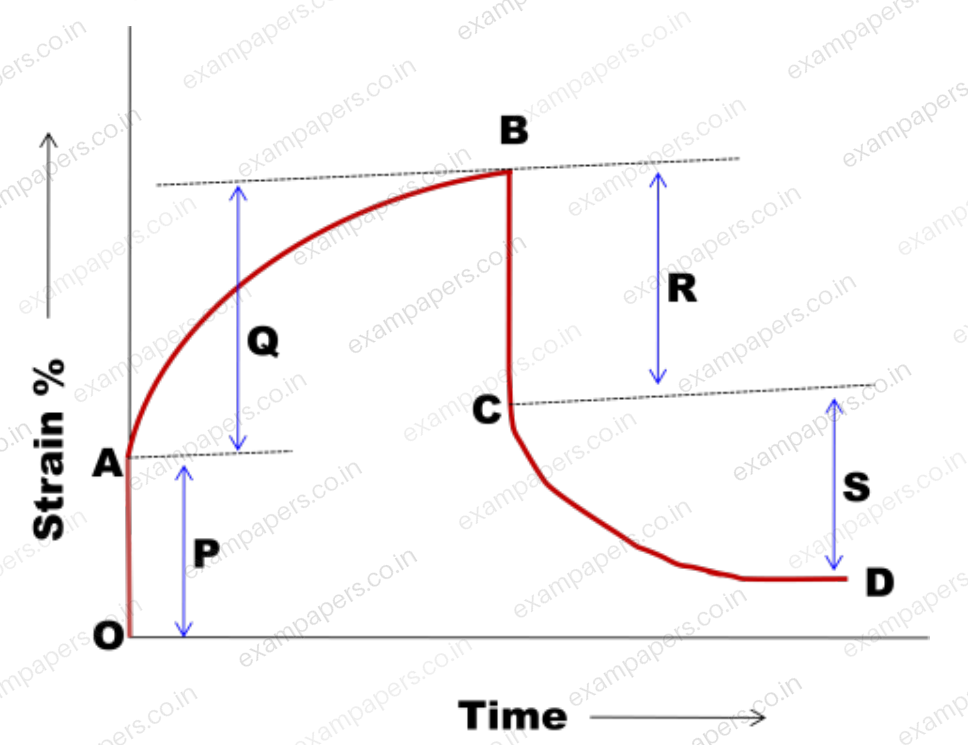
1 = Viscoelastic deformation; 2 = Elastic deformation
3 = Viscoelastic recovery; 4 = Elastic recovery
Your answerChoose one option.
Log in to check the answer
You can attempt this question now. Sign in to view the answer key, explanations and discussion.Log in to check answerQuestion 16
Open questionXE-FMCQ2 marksNeeds review
The plot shows apparent viscosity versus shear rate of Newtonian, Dilent and Pseudoplastic fluids. Based on this plot and the fluid behavior as mentioned below, find out the correct combination.
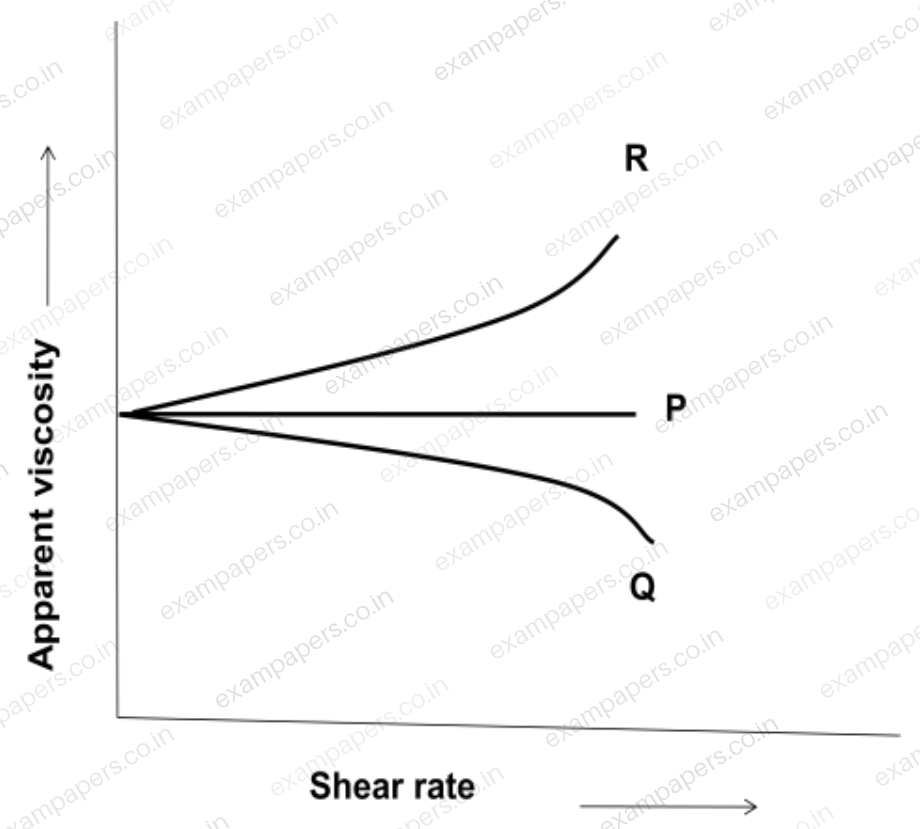
1 = Dilent fluid; 2 = Newtonian fluid; 3 = Pseudoplastic fluid
Your answerChoose one option.
Log in to check the answer
You can attempt this question now. Sign in to view the answer key, explanations and discussion.Log in to check answerQuestion 17
Open questionXE-FMCQ2 marksNeeds review
Plot of the modulus versus temperature of different types of polymers is given below. Based on this plot and the nature of the polymers as mentioned below, find out the correct combination.
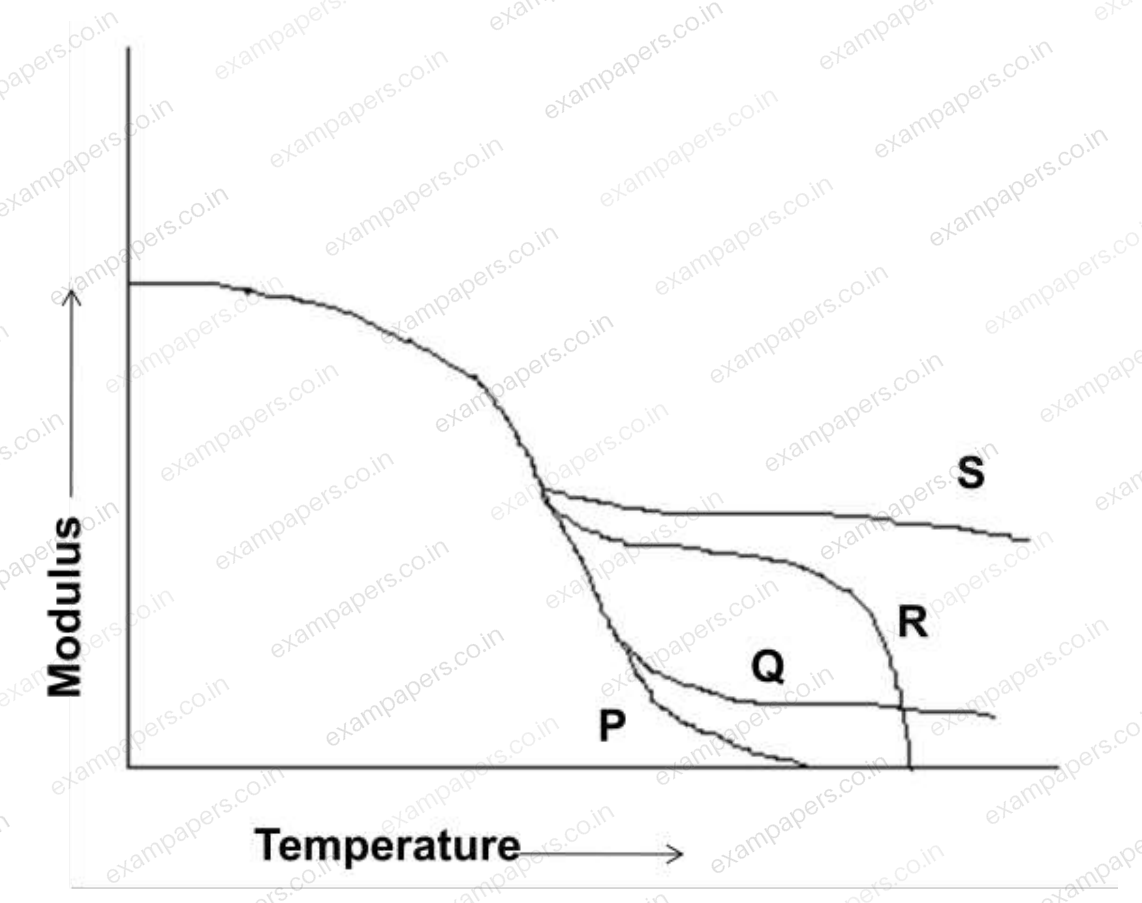
1 = An amorphous polymer of high molecular weight having entanglements
2 = An amorphous polymer of moderate molecular weight
3 = Highly crosslinked polymer
4 = Semi-crystalline polymer
Your answerChoose one option.
Log in to check the answer
You can attempt this question now. Sign in to view the answer key, explanations and discussion.Log in to check answerQuestion 18
Open questionXE-FNAT2 marksNeeds review
The
of homopolymers of A and B are +100 °C and −70 °C respectively. The
of a random copolymer of A and B having 40 wt% A and 60 wt% B is _______ °C.Log in to check the answer
You can attempt this question now. Sign in to view the answer key, explanations and discussion.Log in to check answerQuestion 19
Open questionXE-FNAT2 marksNeeds review
The number average molecular weight of a polymer prepared from HO(CH
)
COOH is 24,000 g/mol. The conversion of the monomer required to reach the above molecular weight is________%. (C = 12, H = 1, O = 16 g/mol).Log in to check the answer
You can attempt this question now. Sign in to view the answer key, explanations and discussion.Log in to check answer