
Engineering Sciences
GATE XE kind:question PYQs
Build your understanding with focused practice from past exam papers.
Questions 431–440 of 1772. Imported answers require independent review unless marked reviewed.
Question 59
Open questionXE-CMSQ2 marksNeeds review
Which of the following figures schematically represent(s) either the Frenkel defect or the Schottky defect in ionic solids?
Your answerSelect all correct options. You can choose more than one.
Log in to check the answer
You can attempt this question now. Sign in to view the answer key, explanations and discussion.Log in to check answerQuestion 60
Open questionXE-CMSQ2 marksNeeds review
Given that k is the first order reaction rate constant and T is the temperature in absolute scale, the temperature dependence of rate constant is/are represented by
Your answerSelect all correct options. You can choose more than one.
Log in to check the answer
You can attempt this question now. Sign in to view the answer key, explanations and discussion.Log in to check answerQuestion 61
Open questionXE-CMSQ2 marksNeeds review
For chemical vapour deposition (CVD) process, which of the following statements is/are correct?
Your answerSelect all correct options. You can choose more than one.
Log in to check the answer
You can attempt this question now. Sign in to view the answer key, explanations and discussion.Log in to check answerQuestion 62
Open questionXE-CNAT2 marksNeeds review
At room temperature, the electrical conductivity and electron mobility for aluminium are 3.8 × 10^7 (Ω m)^−1 and 0.0012 m^2 (V s)^−1, respectively. Density of free electrons for aluminium at room temperature is (in units of m^−3) ______ × 10^27 (rounded off to nearest integer).
Given: Electrical charge on an electron is 1.6 × 10^−19 C.
Log in to check the answer
You can attempt this question now. Sign in to view the answer key, explanations and discussion.Log in to check answerQuestion 63
Open questionXE-CNAT2 marksNeeds review
A 2 mm thick palladium sheet of 1000 mm
cross section is used as a diffusional membrane to purify hydrogen. The hydrogen concentration is maintained at a steady state with
kg m
and
kg m
on the two sides of the membrane as shown in the figure below.
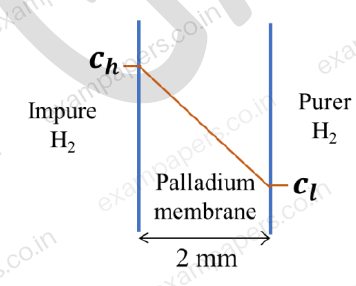
The rate of hydrogen purification is (in units of kg hr
) ______ × 10
(rounded off to one decimal place).Given: The diffusion coefficient of hydrogen in palladium is 1.0 × 10
m
s
Log in to check the answer
You can attempt this question now. Sign in to view the answer key, explanations and discussion.Log in to check answerQuestion 64
Open questionXE-CNAT2 marksNeeds review
In X-ray powder diffraction pattern obtained from a face centered cubic (FCC) metal, the first five reflections are at θ = 21.65°, 25.21°, 37.06°, x and 47.58°. The Bragg angle, θ of the fourth reflection is missed out and is represented by x. The value of x is (in degree) __________ (rounded off to one decimal place).
Log in to check the answer
You can attempt this question now. Sign in to view the answer key, explanations and discussion.Log in to check answerQuestion 65
Open questionXE-CNAT2 marksNeeds review
Consider a unidirectionally aligned continuous glass fiber reinforced epoxy composite with 40 vol. % reinforcement. The elastic modulus of the composite along the fiber direction is (in units of GPa) ________ (rounded off to one decimal place).
Given: Elastic modulus of epoxy is 6.9 GPa and that of glass fibre is 69 GPa.
Log in to check the answer
You can attempt this question now. Sign in to view the answer key, explanations and discussion.Log in to check answerQuestion 66
Open questionXE-DMCQ1 markNeeds review
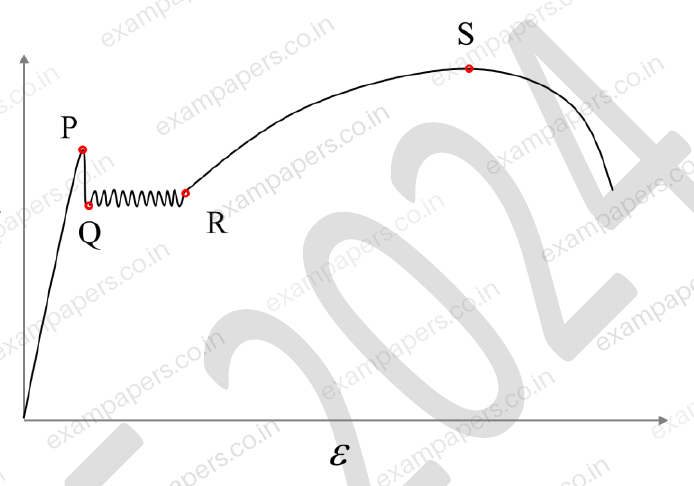
The engineering stress (σ) vs. engineering strain (ε) curve obtained by conducting uniaxial tension test on a steel specimen is shown in the figure (the sketched curve is not to the scale). The specimen exits cup-and-cone failure within its gage length. Which point on the curve corresponds to the beginning of necking in the test specimen?
Your answerChoose one option.
Log in to check the answer
You can attempt this question now. Sign in to view the answer key, explanations and discussion.Log in to check answerQuestion 67
Open questionXE-DMCQ1 markNeeds review
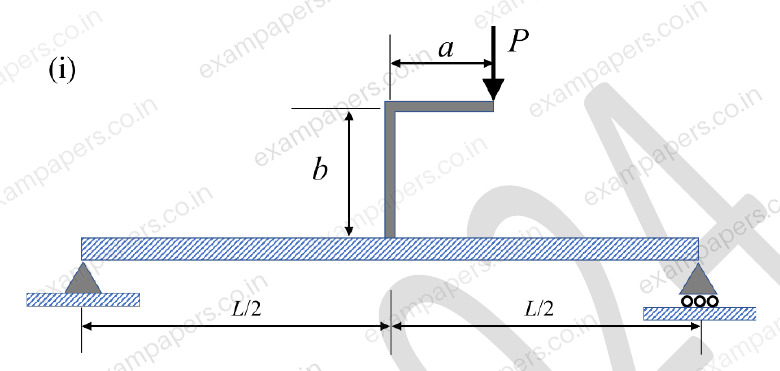
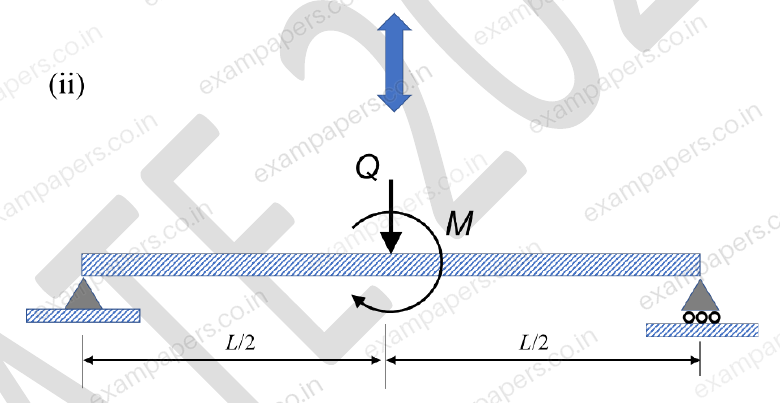
An L-shaped rigid member is fixed at the midpoint of a simply-supported beam, as shown in figure (i). The member is subjected to a vertically downward force P at its free end. In an equivalent system, the member along with the applied load is replaced with a force Q = P and a moment M (see figure (ii)). Which of the following statements is correct?
(Negelect the mass of the beam and of the rigid member)
Your answerChoose one option.
Log in to check the answer
You can attempt this question now. Sign in to view the answer key, explanations and discussion.Log in to check answerQuestion 68
Open questionXE-DMCQ1 markNeeds review
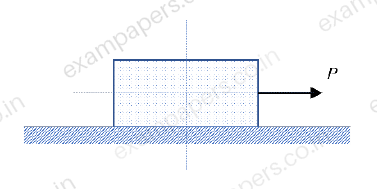
A block of weight W, placed on a surface, is subjected to a horizontal force P as shown in the figure. The line of action of force P passes through the center-of-gravity of the block. The magnitude of P is such that the block remains at rest. If N is the resultant normal reaction exerted by the surface, and F is the frictional force acting on the bottom surface of the block, then which of the following represents the correct free body diagram of the block?
Your answerChoose one option.
Log in to check the answer
You can attempt this question now. Sign in to view the answer key, explanations and discussion.Log in to check answer