
Engineering Sciences
GATE XE kind:question PYQs
Build your understanding with focused practice from past exam papers.
Questions 801–810 of 1772. Imported answers require independent review unless marked reviewed.
Question 79
Open questionXE-DMCQ2 marksNeeds review
A rectangular plate of uniform thickness having initial length
and width
is placed between two rigid immovable walls. The temperature of the plate is increased by
. The plate is free to expand along the
and
directions. The mid-surface of the plate remains in the
-plane. The Poisson’s ratio is
and the coefficient of thermal expansion is
. Assuming that the plate is initially free of stresses, the change in length of the plate after the increase in temperature is given by 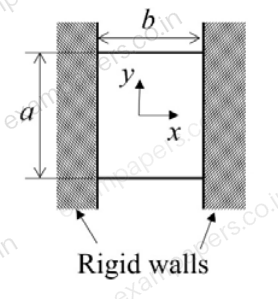
Your answerChoose one option.
Log in to check the answer
You can attempt this question now. Sign in to view the answer key, explanations and discussion.Log in to check answerQuestion 80
Open questionXE-DMCQ2 marksNeeds review
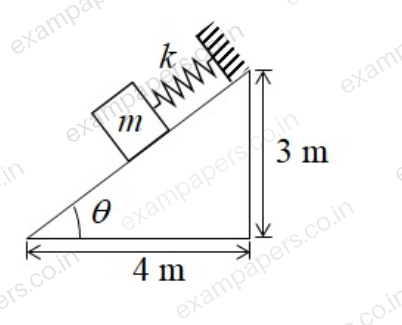
A mass
kg is attached to a spring as shown in the figure. The coefficient of friction between the mass and the inclined plane is 0.25. Assume that the acceleration due to gravity is 10 m/s
and that static and kinetic friction coefficients are the same. Equilibrium of the mass is impossible if the spring force is
Your answerChoose one option.
Log in to check the answer
You can attempt this question now. Sign in to view the answer key, explanations and discussion.Log in to check answerQuestion 81
Open questionXE-DNAT2 marksNeeds review
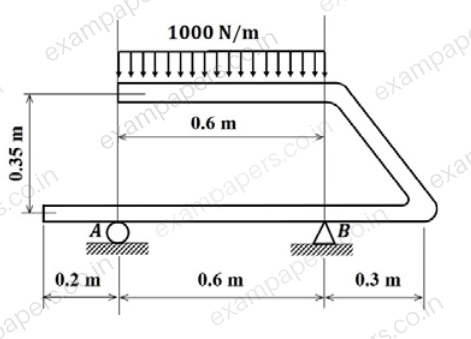
The frame shown in the figure is subjected to a uniformly distributed load of 1000 N/m over a distance of 0.6 m. Neglecting the weight of the frame, the maximum shear force (in N) in the region between the supports
and
of the frame is
______.
Log in to check the answer
You can attempt this question now. Sign in to view the answer key, explanations and discussion.Log in to check answerQuestion 82
Open questionXE-DNAT2 marksNeeds review
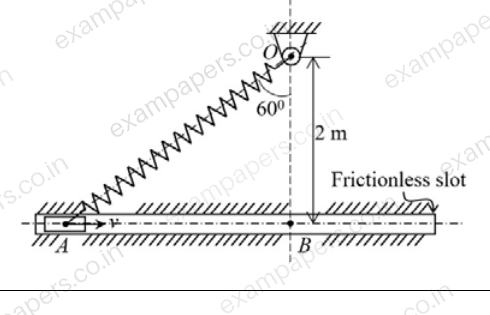
A slider moving in a frictionless slot is connected with a linear spring
as shown in the figure. The following is known: stiffness of the spring = 2 kN/m, mass of the slider = 10 kg, and the unstretched length of the spring = 1 m. If the slider is released from rest at
the magnitude of its velocity (in m/s) when it passes through point
is __________ (rounded off to the nearest integer)
Log in to check the answer
You can attempt this question now. Sign in to view the answer key, explanations and discussion.Log in to check answerQuestion 83
Open questionXE-DNAT2 marksNeeds review
A sphere
of mass
is thrown into the air at 50 m/s along a direction
up from the horizontal. At the topmost point of its trajectory, it has a central (non-oblique) collision with another sphere
which is at rest on top of a vertical pole. Sphere
has a mass of
. Acceleration due to gravity is 10 m/s
. Neglect contact friction and air-resistance. If the coefficient of restitution is 0.3, then the speed (in m/s) of sphere
immediately after the collision is ________ (rounded off to one decimal place)Log in to check the answer
You can attempt this question now. Sign in to view the answer key, explanations and discussion.Log in to check answerQuestion 84
Open questionXE-DNAT2 marksNeeds review
The truck shown in the figure is moving on a horizontal road at a speed of 20 m/s. It is carrying a box of mass 100 kg, which is simply placed on the truck platform. The coefficient of friction between the truck platform and the box is 0.25. Take acceleration due to gravity as 10 m/s
. Assume uniform deceleration during braking, and the coefficients of static and kinetic friction to be the same. The shortest distance in meters in which the truck can be brought to rest without the box slipping is
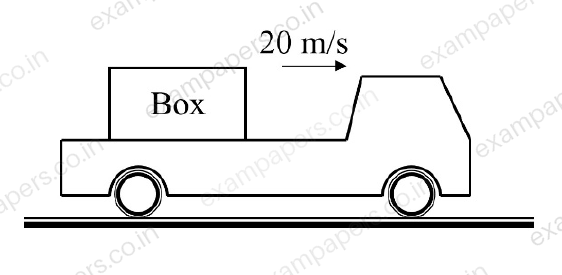
______(round off to the nearest integer)
Log in to check the answer
You can attempt this question now. Sign in to view the answer key, explanations and discussion.Log in to check answerQuestion 85
Open questionXE-DNAT2 marksNeeds review
The stepped rod of length 2 m, shown in the figure, is fixed at both ends (A and C). The area of cross-section of portion AB is 200 mm
and that of portion BC is 100 mm
. Force
is applied at section B such that the section is displaced by 0.1 mm in the direction of the force. Young’s modulus of the rod is 200 GPa. The applied force
in N is
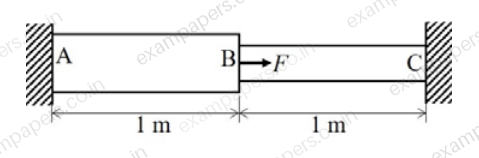
______ (round off to the nearest integer)
Log in to check the answer
You can attempt this question now. Sign in to view the answer key, explanations and discussion.Log in to check answerQuestion 86
Open questionXE-DNAT2 marksNeeds review
A cantilever beam has a span of 1 m and carries a uniformly distributed load of
N/m over a portion as shown. A force
N acts at a distance
from the fixed end. The distance
is such that the bending moment at the fixed end is zero. The beam has a rectangular cross-section of depth 20 mm and width 24 mm. For this loading, the magnitude of the maximum bending stress in the beam in MPa is
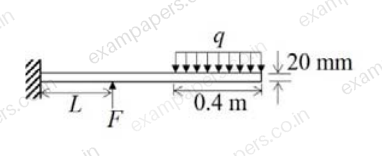
______________ (round off to the nearest integer)
Log in to check the answer
You can attempt this question now. Sign in to view the answer key, explanations and discussion.Log in to check answerQuestion 87
Open questionXE-DNAT2 marksNeeds review
The figure shows two identical mass-less beams AB and CD, each clamped at one of their ends. The left end of beam CD rests on the right end of beam AB such that the ends of the beams are just in contact. The beams are unstressed before the application of load. Assume no friction at the contact. Now, if a uniformly distributed load of 800 N/m is applied on beam CD, the bending moment at the end B of beam AB in N.m is __________ (rounded off to the nearest integer)
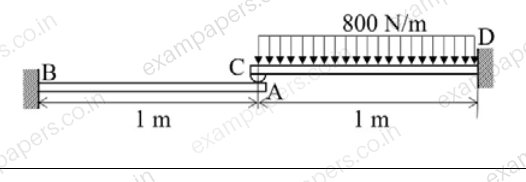
Log in to check the answer
You can attempt this question now. Sign in to view the answer key, explanations and discussion.Log in to check answerQuestion 88
Open questionXE-EMCQ1 markNeeds review
The energy equation for a reversible non-flow process can be expressed as
, where
is the heat transfer per unit mass,
is the internal energy per unit mass,
is the pressure, and
is the mass specific volume. This energy equation is not in exact differential form. It can be made exact differential by multiplying with the following integrating factor: (T is the absolute temperature)Your answerChoose one option.
Log in to check the answer
You can attempt this question now. Sign in to view the answer key, explanations and discussion.Log in to check answer