
Engineering Sciences
GATE XE Mechanics of rigid bodies PYQs
Build your understanding with focused practice from past exam papers.
Questions 21–30 of 72. Imported answers require independent review unless marked reviewed.
Question 86
Open questionXE-DNAT2 marksNeeds review
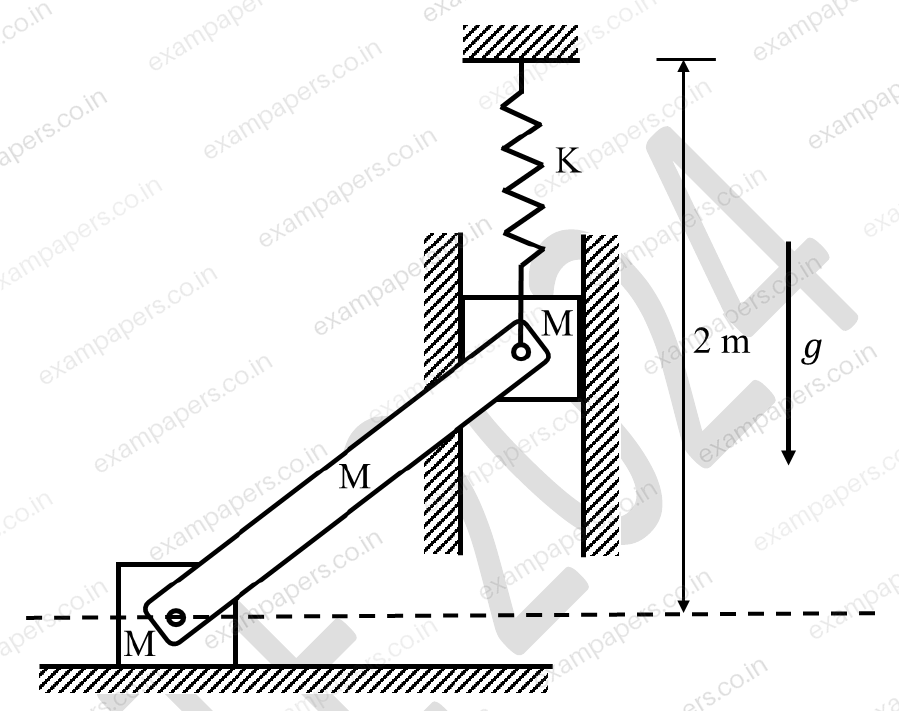
The system shown in the figure is in static equilibrium. The spring is massless and has a spring constant of K=1 kN/m. The free length of the spring is 1 m. All bodies in the system except the spring are rigid and have mass of M=1 kg. All surfaces are frictionless and pin joints are ideal. The elongation of the spring (in mm, rounded off to the nearest integer) in this configuration is _____. Take the acceleration due to gravity
m/s
.
Log in to check the answer
You can attempt this question now. Sign in to view the answer key, explanations and discussion.Log in to check answerQuestion 87
Open questionXE-DNAT2 marksNeeds review
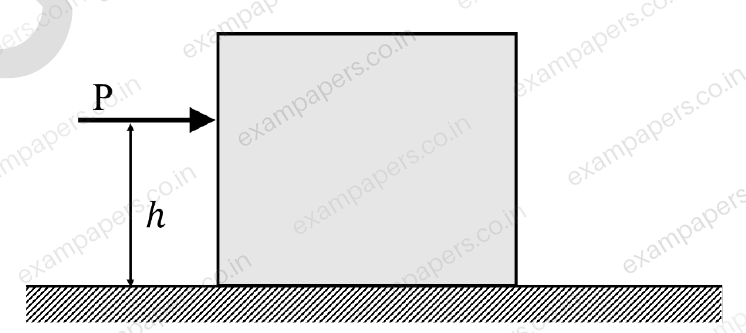
A square block of side 1 m and mass 10 kg is resting on a horizontal surface. The coefficient of static friction between the block and the surface is 0.75. A horizontal force P acts on the block as shown in the figure. The force P is gradually increased from zero until the block either slides or topples. The maximum value of
(in m, rounded off to two decimal places) for which the block slides without toppling is _____. Take the acceleration due to gravity
m/s
.
Log in to check the answer
You can attempt this question now. Sign in to view the answer key, explanations and discussion.Log in to check answerQuestion 66
Open questionXE-DMCQ1 markNeeds review
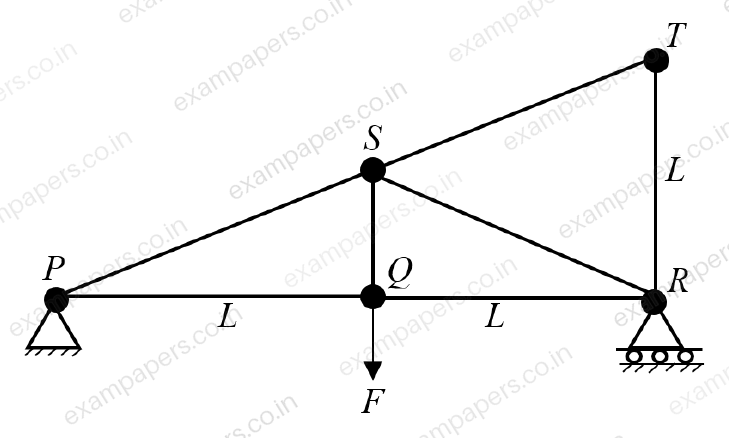
A plane truss is simply supported at P and R as shown. A downward force F is applied at hinge Q. The axial force developed in member PS is
Your answerChoose one option.
Log in to check the answer
You can attempt this question now. Sign in to view the answer key, explanations and discussion.Log in to check answerQuestion 67
Open questionXE-DMCQ1 markNeeds review
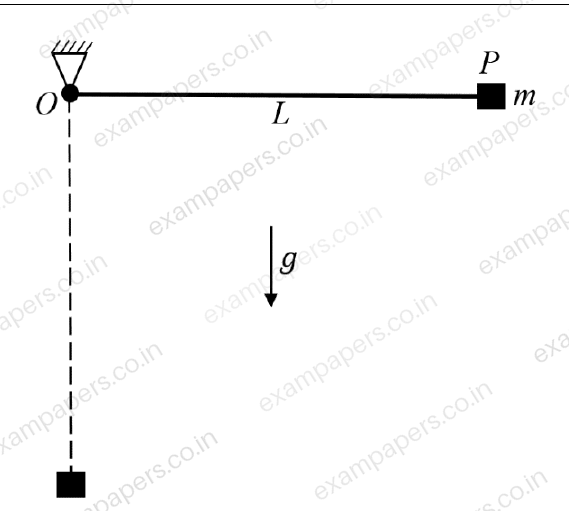
A massless rigid rod OP of length L is hinged frictionlessly at O. A concentrated mass m is attached to end P of the rod. Initially, the rod OP is horizontal. Then, it is released from rest. There is gravity as shown. The rod acquires an angular velocity as it swings. The clockwise angular velocity of the rod, when it first reaches the vertical position as shown, is
Your answerChoose one option.
Log in to check the answer
You can attempt this question now. Sign in to view the answer key, explanations and discussion.Log in to check answerQuestion 72
Open questionXE-DNAT1 markNeeds review
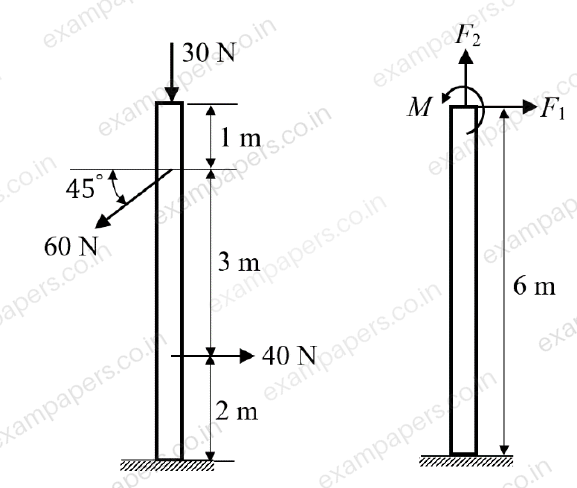
A rod is subjected to three forces as shown in the figure on the left. An equivalent force system with forces
,
and moment
is shown in the figure on the right. The value of M (in N-m) is ______ (rounded off to one decimal place).
Log in to check the answer
You can attempt this question now. Sign in to view the answer key, explanations and discussion.Log in to check answerQuestion 75
Open questionXE-DMCQ2 marksNeeds review
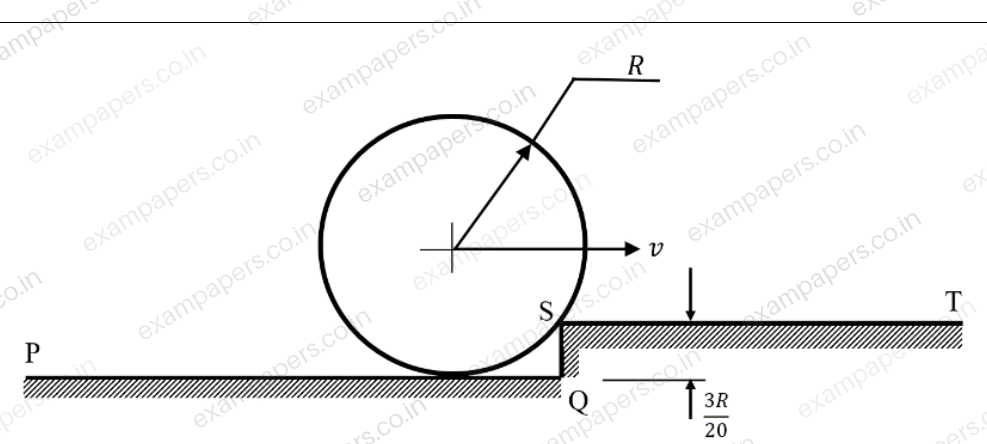
A solid uniform rigid disk of mass
and radius
rolls without slipping along a horizontal surface PQ. The speed of the center of the disk is
. The disk then strikes a hurdle of height
at point S. During the impact, there is no rebound or slip at S and no impulse from the surface PQ. The magnitude of the velocity of the center of the disk immediately after the impact is
Your answerChoose one option.
Log in to check the answer
You can attempt this question now. Sign in to view the answer key, explanations and discussion.Log in to check answerQuestion 81
Open questionXE-DNAT2 marksNeeds review
A steel ball of mass m = 10 kg is suspended from the ceiling of a moving carriage by two inextensible strings making 60° with the horizontal as shown. The carriage has an acceleration a such that the tension in the string on the right is double the tension in the string on the left. Take the acceleration due to gravity (g) as 10 m/s
. The acceleration a (in m/s
) is_____(rounded off to one decimal place). 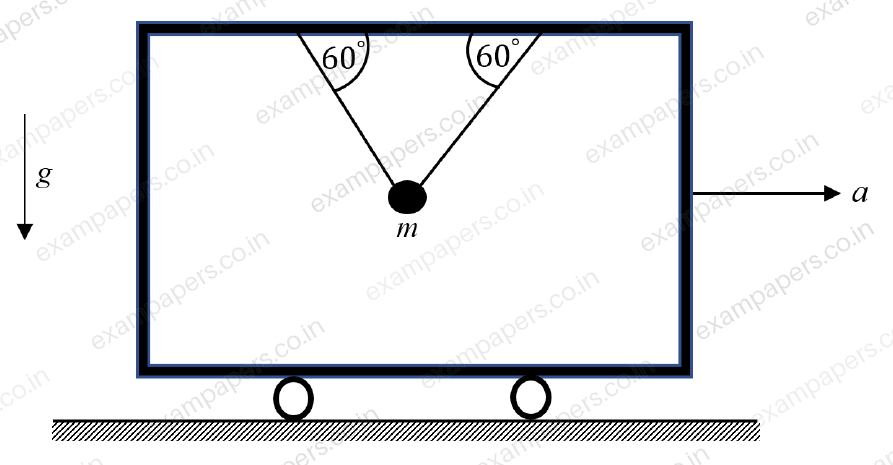
Log in to check the answer
You can attempt this question now. Sign in to view the answer key, explanations and discussion.Log in to check answerQuestion 82
Open questionXE-DNAT2 marksNeeds review
A block of mass m = 10 kg is lying on an inclined plane PQ. The mass is restrained from sliding down the inclined plane by a force F. The coefficient of friction between the block and the inclined plane is 0.3. Take the acceleration due to gravity as 10 m/s
. The smallest force F (in N) required to prevent the block from sliding down is_____(rounded off to one decimal place). 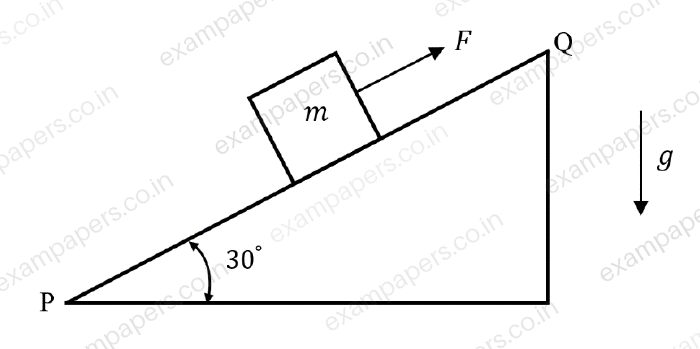
Log in to check the answer
You can attempt this question now. Sign in to view the answer key, explanations and discussion.Log in to check answerQuestion 83
Open questionXE-DNAT2 marksNeeds review
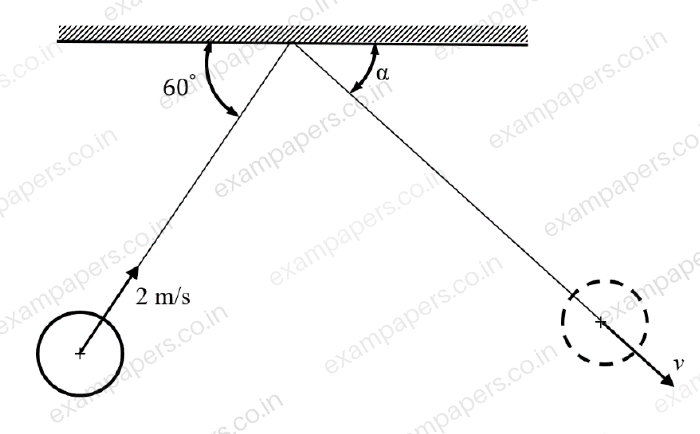
A spherical rigid ball of mass 10 kg is moving with a speed of 2 m/s in the direction shown. The ball collides with a rigid frictionless wall and rebounds at an angle α with a speed of v, as shown. The coefficient of restitution is 0.9. The angle α (in degrees) is_____(rounded off to one decimal place).
Log in to check the answer
You can attempt this question now. Sign in to view the answer key, explanations and discussion.Log in to check answerQuestion 69
Open questionXE-DMCQ1 markNeeds review
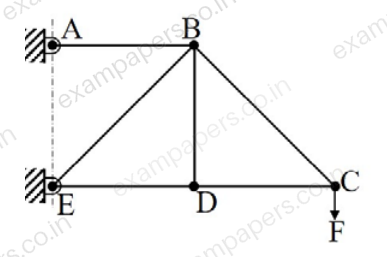
In the truss shown in the figure, all the members are pin joined to each other. The members AB, BD, DE and DC have the same length. For the given loading, which of the following is the correct statement?
Your answerChoose one option.
Log in to check the answer
You can attempt this question now. Sign in to view the answer key, explanations and discussion.Log in to check answer