
Engineering Sciences
GATE XE Mechanics of rigid bodies PYQs
Build your understanding with focused practice from past exam papers.
Questions 41–50 of 72. Imported answers require independent review unless marked reviewed.
Question 1
Open questionXE-DMCQ1 markNeeds review
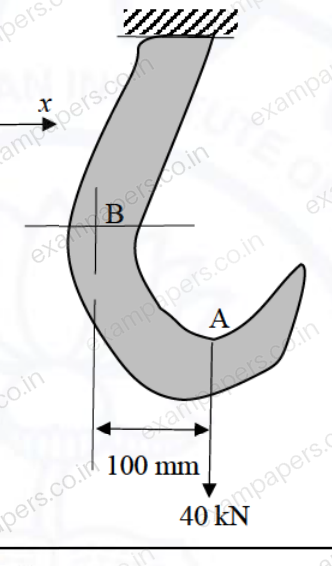
A force F = 40 kN is applied on the hook as shown. The equivalent force-couple system at B is
Your answerChoose one option.
Log in to check the answer
You can attempt this question now. Sign in to view the answer key, explanations and discussion.Log in to check answerQuestion 2
Open questionXE-DMCQ1 markNeeds review
A rigid rod OA rotates clockwise at an angular velocity of 10 rad/s. A bead B (OB = 1 m) translates outward on the rod at a speed of 5 m/s and acceleration 2.5 m/s
(both quantities with respect to the rod). The Coriolis component of acceleration is 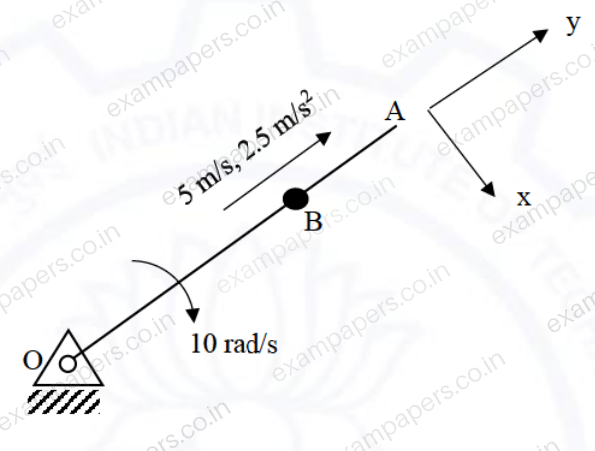
Your answerChoose one option.
Log in to check the answer
You can attempt this question now. Sign in to view the answer key, explanations and discussion.Log in to check answerQuestion 3
Open questionXE-DMCQ1 markNeeds review
A two force member in equilibrium is one in which
Your answerChoose one option.
Log in to check the answer
You can attempt this question now. Sign in to view the answer key, explanations and discussion.Log in to check answerQuestion 13
Open questionXE-DMCQ2 marksNeeds review
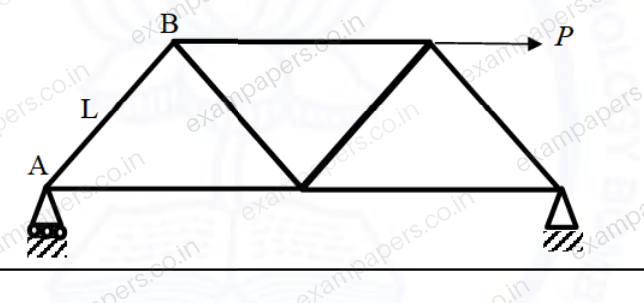
The truss shown is subjected to a force P. All members of the truss have the same length L. The reaction at A and force in member AB are
Your answerChoose one option.
Log in to check the answer
You can attempt this question now. Sign in to view the answer key, explanations and discussion.Log in to check answerQuestion 14
Open questionXE-DMCQ2 marksNeeds review
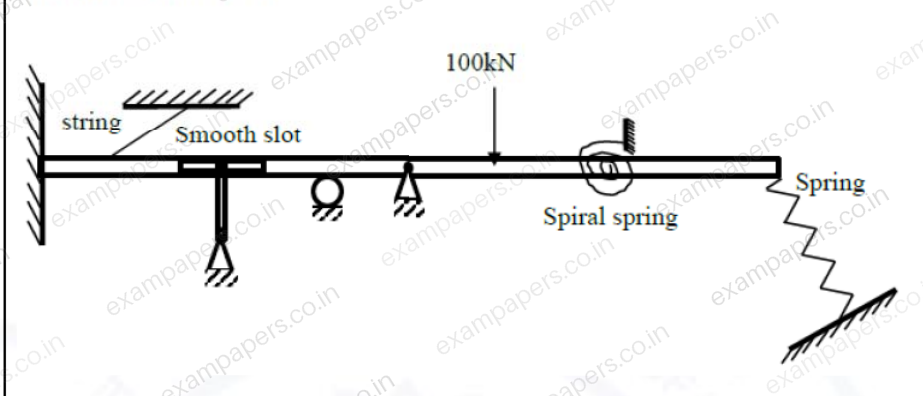
The figure shows a structure with supports. The correct free body diagram when the supports are removed is
Your answerChoose one option.
Log in to check the answer
You can attempt this question now. Sign in to view the answer key, explanations and discussion.Log in to check answerQuestion 1
Open questionXE-DMCQ1 markNeeds review
Which among the following statements is true for a body moving on a dry surface under the action of applied forces?
Your answerChoose one option.
Log in to check the answer
You can attempt this question now. Sign in to view the answer key, explanations and discussion.Log in to check answerQuestion 4
Open questionXE-DMCQ1 markNeeds review
The angular momentum of a particle moving under a central force is
Your answerChoose one option.
Log in to check the answer
You can attempt this question now. Sign in to view the answer key, explanations and discussion.Log in to check answerQuestion 6
Open questionXE-DMCQ1 markNeeds review
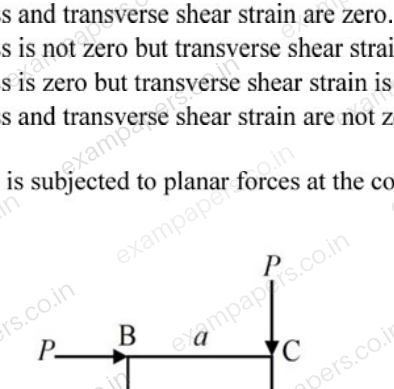
A rigid square ABCD is subjected to planar forces at the corners as shown. For this planar force system, the equivalent force couple system at corner A can be represented as
Your answerChoose one option.
Log in to check the answer
You can attempt this question now. Sign in to view the answer key, explanations and discussion.Log in to check answerQuestion 7
Open questionXE-DNAT1 markNeeds review
A particle of mass 0.1 kg, which is released from rest, falls vertically downward under gravity in a fluid. The fluid offers a resistive force, which is linearly proportional to the particle velocity with 0.1 N.s/m as the constant of proportionality. The uniform gravitational acceleration is 10 m/s
throughout the trajectory of the particle. The magnitude of the particle velocity (in m/s) at time 1 s after release (rounded off to two decimal places) is _____.Log in to check the answer
You can attempt this question now. Sign in to view the answer key, explanations and discussion.Log in to check answerQuestion 9
Open questionXE-DNAT1 markNeeds review
Consider two point masses
kg and
kg connected by a massless inextensible string passing over a massless and frictionless pulley with radius
mm as shown. The masses are released from rest and move vertically under the action of gravity. Let acceleration due to gravity,
m/s
. The tension (in N) in the string is _____. 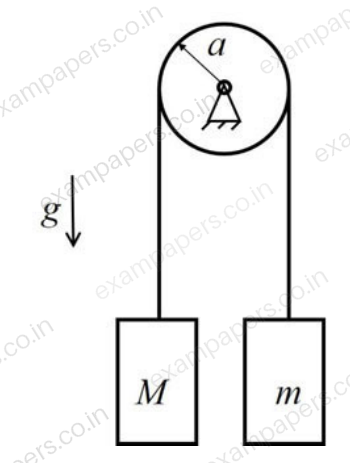
Log in to check the answer
You can attempt this question now. Sign in to view the answer key, explanations and discussion.Log in to check answer