
Engineering Sciences
GATE XE Ocean Sciences PYQs
Build your understanding with focused practice from past exam papers.
How to practice Ocean Sciences
Attempt a question, record the concept and assumptions, then check the available answer. Rework mistakes after revising the relevant concepts. Topic tags can overlap; review the question context.
Questions 1–10 of 100. Imported answers require independent review unless marked reviewed.
Question 156
Open questionXE-HMCQ1 markNeeds review
What is the approximate value of annual-mean pH of seawater at the surface in the northern Indian Ocean?
Your answerChoose one option.
Log in to check the answer
You can attempt this question now. Sign in to view the answer key, explanations and discussion.Log in to check answerQuestion 158
Open questionXE-HMSQ1 markNeeds review
Which of the following statements based on the given figure is / are TRUE with respect to the upwelling process in the ocean?
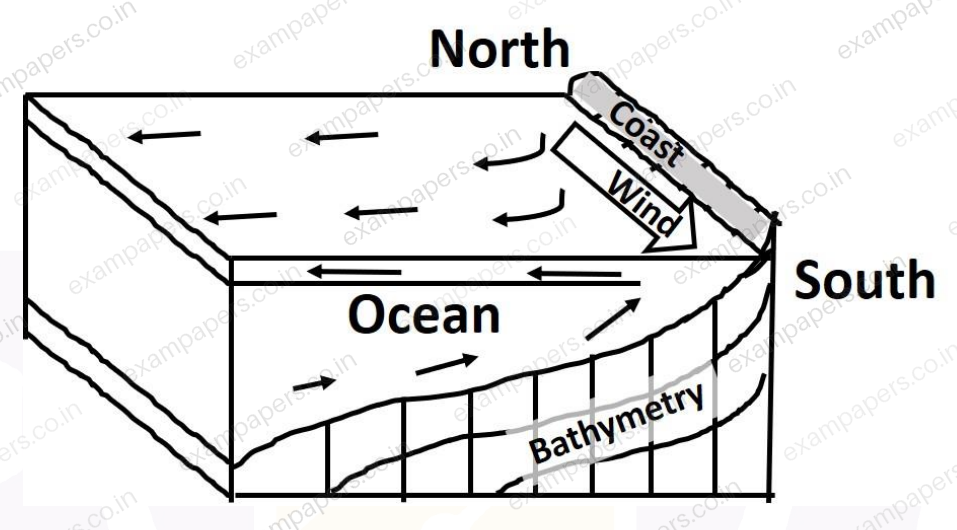
Your answerSelect all correct options. You can choose more than one.
Log in to check the answer
You can attempt this question now. Sign in to view the answer key, explanations and discussion.Log in to check answerQuestion 160
Open questionXE-HNAT1 markNeeds review
If 20 wave crests pass a fixed point in an interval of 5 minutes, then the frequency of the wave (in Hertz) is ______. (rounded off to three decimal places)
Log in to check the answer
You can attempt this question now. Sign in to view the answer key, explanations and discussion.Log in to check answerQuestion 163
Open questionXE-HMCQ2 marksNeeds review
In a two-layered fluid system, temperature and salinity values are given for cases P, Q and R. Which of the following options indicates that the process of ‘salt fingering’ is likely to occur?
Case | Upper layer | Lower layer |
|---|---|---|
P | | |
Q | | |
R | | |
Your answerChoose one option.
Log in to check the answer
You can attempt this question now. Sign in to view the answer key, explanations and discussion.Log in to check answerQuestion 165
Open questionXE-HMCQ2 marksNeeds review
From the given cases (P, Q, R and S), which represents the annual mean profile of dissolved oxygen in the Bay of Bengal?
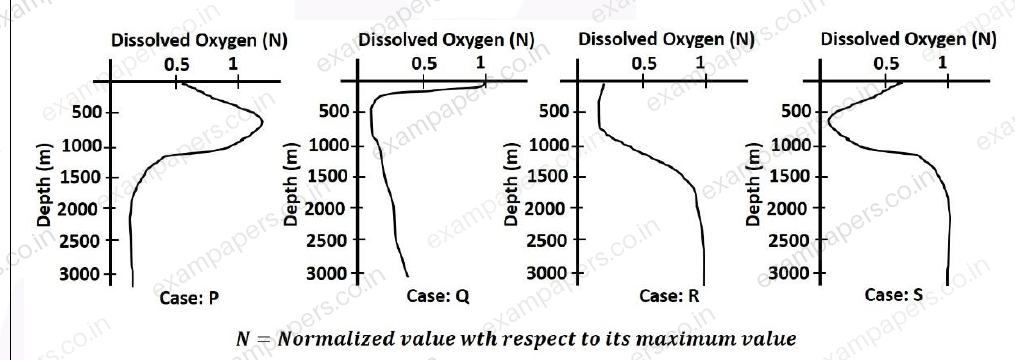
Your answerChoose one option.
Log in to check the answer
You can attempt this question now. Sign in to view the answer key, explanations and discussion.Log in to check answerQuestion 166
Open questionXE-HMCQ2 marksNeeds review
The given figure illustrates a subtropical gyre in the Southern Indian Ocean.
Identify the currents in the correct sequence of P, Q, R and S, respectively from the following options.
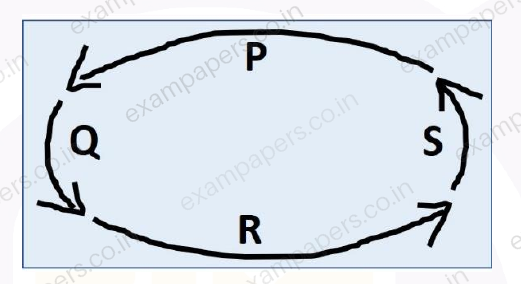
Your answerChoose one option.
Log in to check the answer
You can attempt this question now. Sign in to view the answer key, explanations and discussion.Log in to check answerQuestion 167
Open questionXE-HMSQ2 marksNeeds review
Which of the following is/are generally associated with a cyclonic eddy in the northern Indian Ocean?
Your answerSelect all correct options. You can choose more than one.
Log in to check the answer
You can attempt this question now. Sign in to view the answer key, explanations and discussion.Log in to check answerQuestion 169
Open questionXE-HMSQ2 marksNeeds review
Which of the following statements is/are correct for the Equatorial Indian Ocean during a positive Indian Ocean Dipole event?
Your answerSelect all correct options. You can choose more than one.
Log in to check the answer
You can attempt this question now. Sign in to view the answer key, explanations and discussion.Log in to check answerQuestion 172
Open questionXE-HNAT2 marksNeeds review
A steady westerly wind is blowing over the ocean surface at a latitude of 30°N and exerting a wind stress of 0.8
.The magnitude of net volume transport (in
) per unit width is _____. (rounded off to three decimal places)[Density of seawater is 1025
, angular velocity of the Earth is
.]Log in to check the answer
You can attempt this question now. Sign in to view the answer key, explanations and discussion.Log in to check answerQuestion 174
Open questionXE-HNAT2 marksNeeds review
Using the dispersion relation for deep water small amplitude wave, the wavelength (in m) for a 20 second gravity wave is _____. (Answer in integer)
[Take acceleration due to gravity as 9.81
]Log in to check the answer
You can attempt this question now. Sign in to view the answer key, explanations and discussion.Log in to check answer