
Engineering Sciences
GATE XE Polymer Characterization PYQs
Build your understanding with focused practice from past exam papers.
How to practice Polymer Characterization
Attempt a question, record the concept and assumptions, then check the available answer. Rework mistakes after revising the relevant concepts. Topic tags can overlap; review the question context.
Questions 1–10 of 26. Imported answers require independent review unless marked reviewed.
Question 113
Open questionXE-FMCQ1 markNeeds review
For a polydisperse polymer, the viscosity-average molecular weight (
) becomes equal to the weight-average molecular weight (
), when the Mark–Houwink constant a is _________________.Your answerChoose one option.
Log in to check the answer
You can attempt this question now. Sign in to view the answer key, explanations and discussion.Log in to check answerQuestion 125
Open questionXE-FMCQ2 marksNeeds review
Select the correct option to match the Characterization technique with the Information that is obtained using these techniques.
Your answerChoose one option.
Log in to check the answer
You can attempt this question now. Sign in to view the answer key, explanations and discussion.Log in to check answerQuestion 110
Open questionXE-FMCQ1 markNeeds review
Which one of the following measures of viscosity is dimensionless?
Your answerChoose one option.
Log in to check the answer
You can attempt this question now. Sign in to view the answer key, explanations and discussion.Log in to check answerQuestion 111
Open questionXE-FMCQ1 markNeeds review
Which one of the following permits the direct determination of intrinsic viscosity of a polymer solution for known molecular weight of the polymer?
Your answerChoose one option.
Log in to check the answer
You can attempt this question now. Sign in to view the answer key, explanations and discussion.Log in to check answerQuestion 129
Open questionXE-FNAT2 marksNeeds review
Titration was used to determine the molar mass of two linear monodisperse polymers A and B. Both the polymers possess the same repeat unit and contain acid end-groups. First, 10 g of polymer A was titrated with 5 mL of a 0.1 M alkali solution. In a separate experiment, 5 g of polymer B was titrated with 5 mL of a 0.1 M alkali solution. All of the alkali solution reacted with the acid end-groups present in both polymer A and polymer B.
The ratio of the molar mass of A to the molar mass of B is ________ . (Round off to one decimal place)
Log in to check the answer
You can attempt this question now. Sign in to view the answer key, explanations and discussion.Log in to check answerQuestion 112
Open questionXE-FMCQ1 markNeeds review
A certain polymer synthesised in the laboratory shows that all the chains have same number of repeat units (i.e., same degree of polymerization). The relationship between weight-average (
), number-average (
), and z-average (
) molecular weights for this polymer can be expressed asYour answerChoose one option.
Log in to check the answer
You can attempt this question now. Sign in to view the answer key, explanations and discussion.Log in to check answerQuestion 124
Open questionXE-FNAT2 marksNeeds review
If a given poly(ethylene) sample with specific volume,
shows:
specific volume of the crystalline fraction,
and
specific volume of the amorphous fraction,
,
then the % crystallinity (based on mass fraction) of the poly(ethylene) sample is ______ % (rounded off to the nearest integer).Log in to check the answer
You can attempt this question now. Sign in to view the answer key, explanations and discussion.Log in to check answerQuestion 128
Open questionXE-FNAT2 marksNeeds review
A monodisperse polymer sample of molecular weight 10,000 g mol
is mixed with another monodisperse sample of the same polymer of molecular weight 50,000 g mol
. The total mass of the mixture is 1,000 g and the total number of moles of the polymer in the mixture is 0.04 mol. The weight-average molecular weight (
) of the polymer mixture is ______ g mol
(rounded off to the nearest integer).Log in to check the answer
You can attempt this question now. Sign in to view the answer key, explanations and discussion.Log in to check answerQuestion 130
Open questionXE-FNAT2 marksNeeds review
The dilute solution viscometry data for two samples of a polymer with two different molecular weights are shown in the figure, where
has been plotted against
. Here,
is the specific viscosity and
is the mass concentration of the polymer solution. The slopes and intercepts of the plots for both the samples are shown in the figure. The plotted data for both samples are described by the Huggins equation of dilute solution. The value of the Mark-Houwink constant ‘a’ for both polymer samples is 0.5.
The ratio of the viscosity-average molecular weight (
) of polymer sample 1 to that of polymer sample 2, i.e.,
, is ______ (rounded off to two decimal places). 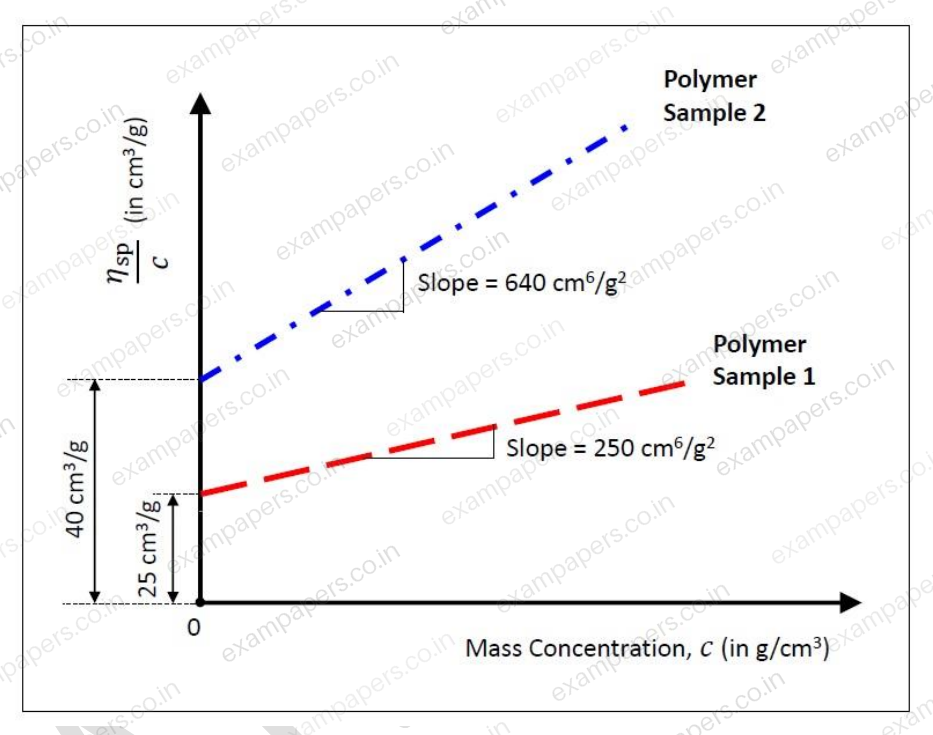
Log in to check the answer
You can attempt this question now. Sign in to view the answer key, explanations and discussion.Log in to check answerQuestion 129
Open questionXE-FNAT2 marksNeeds review
A polymer weighing 0.2 g is dissolved in 100 ml of benzene and has a relative viscosity of 1.5. The polymer obeys Mark-Houwink equation with constants a = 0.5 and K = 0.001. The molecular weight of the polymer is _____ ×10¹⁰ g/mol. (Rounded off to two decimal places)
Log in to check the answer
You can attempt this question now. Sign in to view the answer key, explanations and discussion.Log in to check answer