
Engineering Sciences
GATE XE Polymer rheology PYQs
Build your understanding with focused practice from past exam papers.
How to practice Polymer rheology
Attempt a question, record the concept and assumptions, then check the available answer. Rework mistakes after revising the relevant concepts. Topic tags can overlap; review the question context.
Questions 1–10 of 27. Imported answers require independent review unless marked reviewed.
Question 114
Open questionXE-FMCQ1 markNeeds review
Which one of the following is NOT a rotational rheometer?
Your answerChoose one option.
Log in to check the answer
You can attempt this question now. Sign in to view the answer key, explanations and discussion.Log in to check answerQuestion 123
Open questionXE-FMCQ2 marksNeeds review
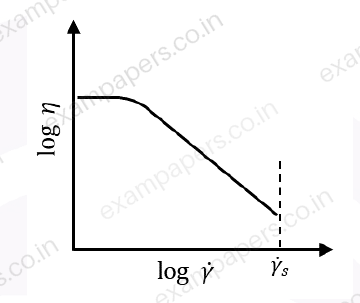
The variation of steady shear viscosity (
) of a polymer melt with shear rate (
) is shown in the figure, where
is the upper limit of the applied shear rate. Which one of the following figures, labeled P, Q, R and S, shows the most appropriate variation of shear stress (
) with shear rate for the same polymer melt?
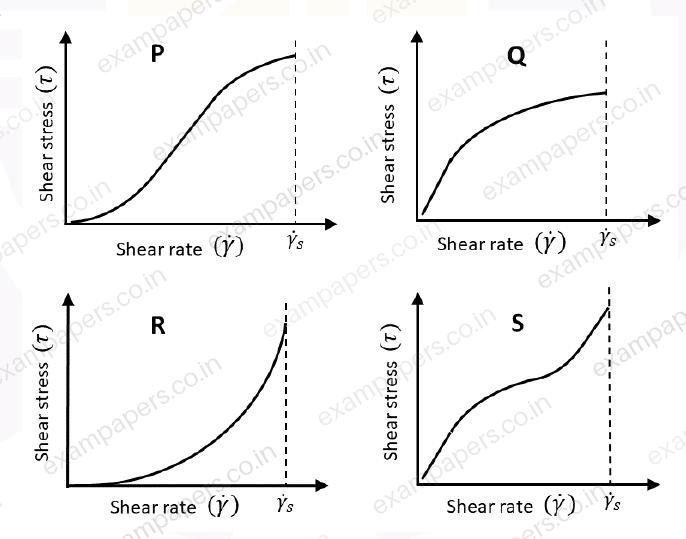
Your answerChoose one option.
Log in to check the answer
You can attempt this question now. Sign in to view the answer key, explanations and discussion.Log in to check answerQuestion 130
Open questionXE-FNAT2 marksNeeds review
A viscoelastic polymer is subjected to a constant strain of 0.3. The behavior of the polymer follows Maxwell model of linear viscoelasticity. Elastic modulus of the polymer is 5 MPa and the relaxation time is 200 days. The stress in the polymer after 100 days from the initial application of the strain is ______________ MPa (rounded off to two decimal places).
Log in to check the answer
You can attempt this question now. Sign in to view the answer key, explanations and discussion.Log in to check answerQuestion 115
Open questionXE-FMCQ1 markNeeds review
The ‘die swell’ phenomenon exhibited by a polymer melt is due to
Your answerChoose one option.
Log in to check the answer
You can attempt this question now. Sign in to view the answer key, explanations and discussion.Log in to check answerQuestion 129
Open questionXE-FNAT2 marksNeeds review
For a polymer solution, the dependence of viscosity (
) on shear rate (
) is described by the three-parameter Carreau model given by
where,
,
, and
are the three parameters of the model. Here, all three parameters are positive quantities. As the shear rate increases from 1 s
to 100 s
, the viscosity of the polymer solution decreases by a factor of 10. For a polymer solution with
and
Pa s, the value of the parameter
is ______ s (rounded off to two decimal places).Log in to check the answer
You can attempt this question now. Sign in to view the answer key, explanations and discussion.Log in to check answerQuestion 131
Open questionXE-FNAT2 marksNeeds review
The linear viscoelastic behavior of a polymer is described by the Kelvin-Voigt model consisting of a spring element of elastic modulus 10 MPa in parallel with a dashpot of viscosity 3.6 × 10
Pa s. A fixed stress of 40 MPa is suddenly applied to the polymer and maintained thereafter. The value of the strain after one hour from the sudden application of the stress is ______ (rounded off to two decimal places).Log in to check the answer
You can attempt this question now. Sign in to view the answer key, explanations and discussion.Log in to check answerQuestion 111
Open questionXE-FMCQ1 markNeeds review
A copper wire upon loading instantaneously increases in length to l, and then continues to elongate gradually. Upon unloading, the wire retracts to length l. According to the Maxwell model, which one of the options given correctly relates the total strain E, the applied stress S, the modulus G, the material’s resistance to flow η, and the elapsed time t between loading and unloading?
Your answerChoose one option.
Log in to check the answer
You can attempt this question now. Sign in to view the answer key, explanations and discussion.Log in to check answerQuestion 137
Open questionXE-GMCQ1 markNeeds review
Which of the following statements is NOT correct?
Your answerChoose one option.
Log in to check the answer
You can attempt this question now. Sign in to view the answer key, explanations and discussion.Log in to check answerQuestion 119
Open questionXE-FMCQ2 marksNeeds review
From the dynamic mechanical analysis of a polymer sample with a phase angle of 30°, the relationship between storage modulus (E') and loss modulus (E'') can be expressed as
Your answerChoose one option.
Log in to check the answer
You can attempt this question now. Sign in to view the answer key, explanations and discussion.Log in to check answerQuestion 127
Open questionXE-FNAT2 marksNeeds review
For a polymer sample with a viscosity of
poise, if the apparent plateau modulus of
dyne cm
drops to zero above a certain temperature, the relaxation time of the polymer is ________ days (rounded off to one decimal place).Log in to check the answer
You can attempt this question now. Sign in to view the answer key, explanations and discussion.Log in to check answer