
Engineering Sciences
GATE XE purpose:exam-prep PYQs
Build your understanding with focused practice from past exam papers.
Questions 31–40 of 1772. Imported answers require independent review unless marked reviewed.
Question 31
Open questionXE-BMCQ2 marksNeeds review
A steady, laminar, and incompressible flow between a pair of infinite parallel plates is driven by a constant pressure gradient
. The plates are separated by a distance
, as shown in the figure. The fully-developed velocity profile of the flow is
where
is the dynamic viscosity.The values of
, for which the local flow velocity is equal to the average flow velocity, are 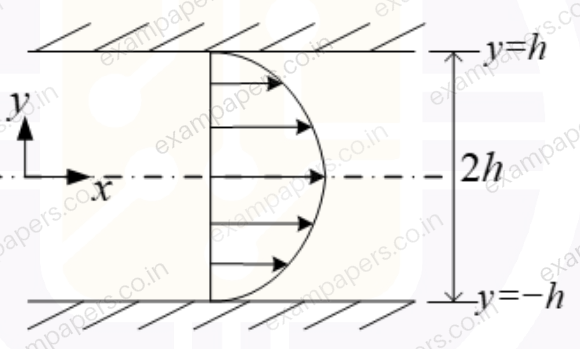
Your answerChoose one option.
Log in to check the answer
You can attempt this question now. Sign in to view the answer key, explanations and discussion.Log in to check answerQuestion 32
Open questionXE-BMCQ2 marksNeeds review
An incompressible fluid flows between a pair of infinite plates separated by a distance
. The top plate is moving with a constant velocity
, whereas the bottom plate is stationary, as shown in the figure. The difference of the stream functions (
) at the two plates for a laminar and fully-developed flow is equal to 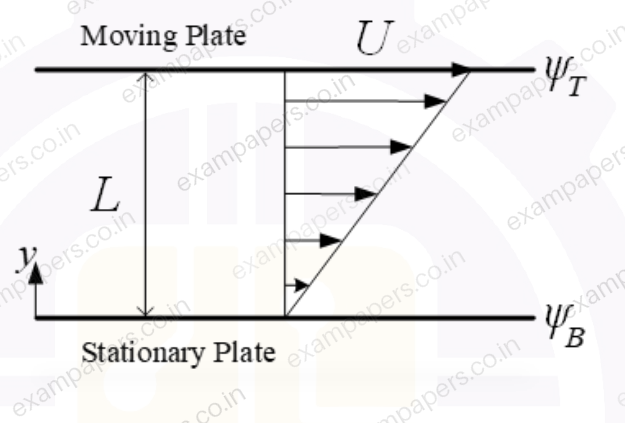
Your answerChoose one option.
Log in to check the answer
You can attempt this question now. Sign in to view the answer key, explanations and discussion.Log in to check answerQuestion 33
Open questionXE-BMCQ2 marksNeeds review
Consider two different cases of water flowing through a smooth pipe of 50 cm diameter. The mass flow rates for the two cases are (i) 0.25 kg.s
, and (ii) 0.8 kg.s
. Assume the density and dynamic viscosity of water as 1000 kg.m
and
Pa.s, respectively. Which one of the following options is correct?Your answerChoose one option.
Log in to check the answer
You can attempt this question now. Sign in to view the answer key, explanations and discussion.Log in to check answerQuestion 34
Open questionXE-BMCQ2 marksNeeds review
A two-dimensional source flow (with stream function,
) is placed at the origin in a uniform flow (with stream function,
). Here, the strength of the source is
and the freestream velocity is
. The velocity components
and
of the combined flow in
- and
-directions, respectively, areYour answerChoose one option.
Log in to check the answer
You can attempt this question now. Sign in to view the answer key, explanations and discussion.Log in to check answerQuestion 35
Open questionXE-BMCQ2 marksNeeds review
Consider a steady, laminar, and incompressible flow over a flat plate, as shown in the figure. With freestream velocity
and kinematic viscosity
, the boundary layer thickness at a distance
from the leading edge is
. If the kinematic viscosity of the fluid is increased by a factor of four (
), the boundary layer thickness (
) at
with same
will be equal to 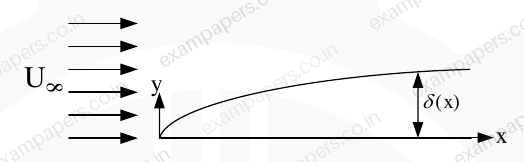
Your answerChoose one option.
Log in to check the answer
You can attempt this question now. Sign in to view the answer key, explanations and discussion.Log in to check answerQuestion 36
Open questionXE-BMSQ2 marksNeeds review
A vertical jet of diameter
strikes a horizontal plate with a velocity
, as shown in the figure. The plate has a hole of diameter
concentric to the flow through which a portion of fluid passes with the same velocity
. The remaining fluid moves radially outward along the plate. If
is the force acting vertically upward to hold the horizontal plate at its initial place, which of the following statements is/are true? 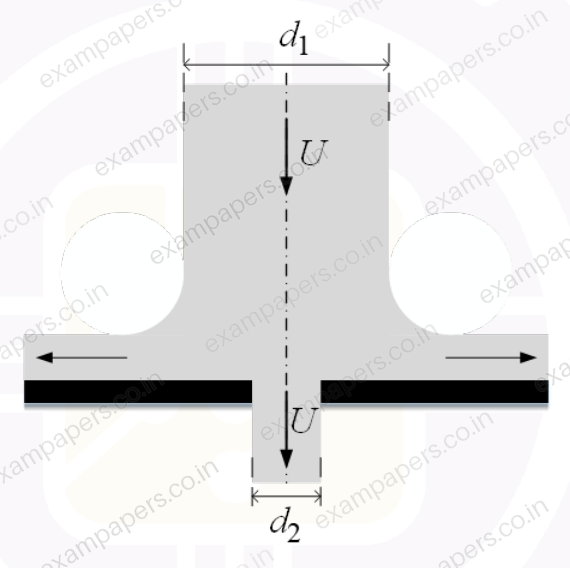
Your answerSelect all correct options. You can choose more than one.
Log in to check the answer
You can attempt this question now. Sign in to view the answer key, explanations and discussion.Log in to check answerQuestion 37
Open questionXE-BMSQ2 marksNeeds review
The velocity of a fluid part in a flow is given as:
where
,
,
are constants, and
,
,
are unit vectors in x-, y-, z-directions, respectively.
Which of the following statements is/are correct?Your answerSelect all correct options. You can choose more than one.
Log in to check the answer
You can attempt this question now. Sign in to view the answer key, explanations and discussion.Log in to check answerQuestion 38
Open questionXE-BNAT2 marksNeeds review
A gas is pressurized in a vertical frictionless piston-cylinder device, as shown in the figure. The piston has a mass of 4 kg and a cross-sectional area of 40 cm
. A metallic block of 13 kg is placed on the piston. The atmospheric pressure (
) is 1 bar. Assume acceleration due to gravity as 10 m.s
. The pressure inside the cylinder,
(in bar) is __________. (rounded off to three decimal places) 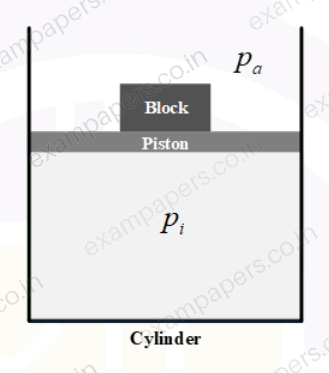
Log in to check the answer
You can attempt this question now. Sign in to view the answer key, explanations and discussion.Log in to check answerQuestion 39
Open questionXE-BNAT2 marksNeeds review
A ship is designed to sail at a speed of 8 m.s
. A designer makes a 1/10 scaled model to test the ship in a water tunnel. The model and the ship satisfy the dynamic similarity. The speed (in m.s
) of the model is __________. (rounded off to two decimal places)Log in to check the answer
You can attempt this question now. Sign in to view the answer key, explanations and discussion.Log in to check answerQuestion 40
Open questionXE-BNAT2 marksNeeds review
A rectangular block (density = 600 kg.m
) with base area of 0.06 m
and height 15 cm is partially submerged in water (density = 1000 kg.m
), as shown in the figure. Assume acceleration due to gravity as 10 m.s
. The submerged depth,
(in m) of the block in the water is __________. (rounded off to two decimal places) 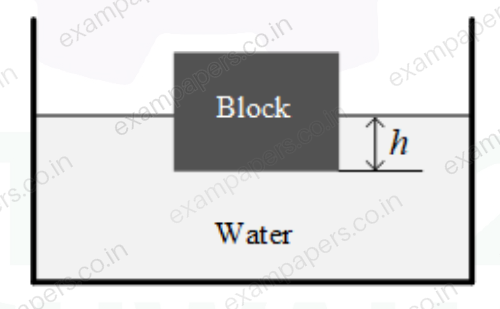
Log in to check the answer
You can attempt this question now. Sign in to view the answer key, explanations and discussion.Log in to check answer