
Engineering Sciences
GATE XE purpose:exam-prep PYQs
Build your understanding with focused practice from past exam papers.
Questions 761–770 of 1772. Imported answers require independent review unless marked reviewed.
Question 39
Open questionXE-BNAT2 marksNeeds review
Consider a lawn sprinkler with horizontal arms of radius,
cm which has water introduced vertically through the centre, as shown in the figure. The exit area of the jet is 25 cm
and the jet velocity is 1 m/s. The water is ejected orthogonal to the sprinkler arm and the jet makes an angle of 60° with the horizontal plane. Find the torque (in N-m) required to hold the sprinkler stationary.
Consider water density 1000 kg/m
. Neglect the effects of friction and gravity.
(Round off to two decimal places) 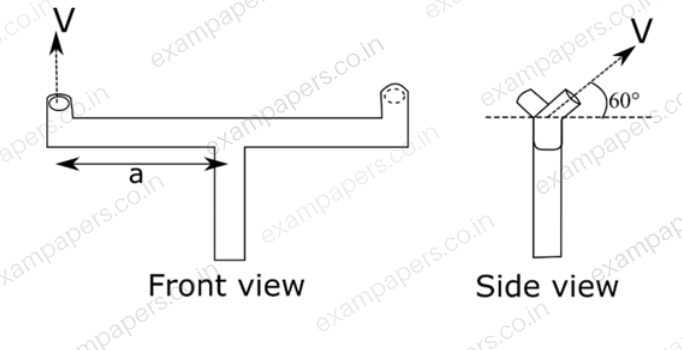
Log in to check the answer
You can attempt this question now. Sign in to view the answer key, explanations and discussion.Log in to check answerQuestion 40
Open questionXE-BNAT2 marksNeeds review
A wooden cylinder (specific gravity = 0.6) of length
and diameter
floats in water (density 1000 kg/m
). Find out the minimum value of
for which the cylinder floats with its axis vertical.
(Round off to three decimal places)Log in to check the answer
You can attempt this question now. Sign in to view the answer key, explanations and discussion.Log in to check answerQuestion 41
Open questionXE-BNAT2 marksNeeds review
Consider a cart of mass 10 kg placed on an inclined plane (angle of inclination 60° with horizontal) as shown in the figure. A turning vane of negligible weight is mounted on the cart. A horizontal steady water jet is issued from a stationary nozzle of area 0.1 m
and strikes the turning vane as shown in the figure. The vane turns the jet downward parallel to the inclined plane. Find out the minimum jet velocity (in m/s) which will not allow the cart to come down. Neglect friction, consider density of water = 1000 kg/m
and acceleration due to gravity = 10 m/s
.
(Round off to two decimal places) 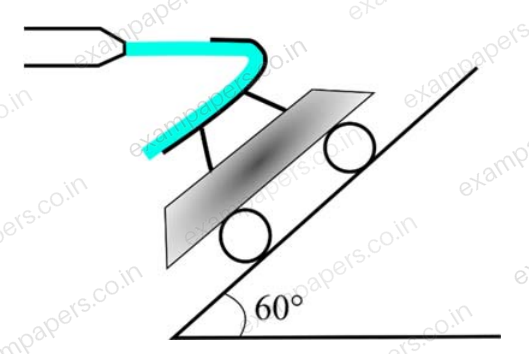
Log in to check the answer
You can attempt this question now. Sign in to view the answer key, explanations and discussion.Log in to check answerQuestion 42
Open questionXE-BNAT2 marksNeeds review
A siphon is used to drain out water (density 1000 kg/m³) from a tank as shown in the figure. What can be the maximum height
(in meter) of the point C? Consider acceleration due to gravity = 10 m/s², pressure at point A = 10 kPa, vapour pressure of water = 29.5 kPa and neglect friction. (Round off to two decimal places) 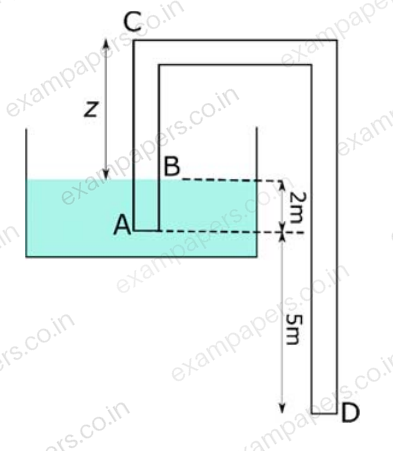
Log in to check the answer
You can attempt this question now. Sign in to view the answer key, explanations and discussion.Log in to check answerQuestion 43
Open questionXE-BNAT2 marksNeeds review
The horizontal belt of negligible weight shown in the figure moves with a steady velocity (
) of 2.5 m/s and skims over the top surface of an oil-film of depth
= 3 cm. The length (
) and width (
) of the belt are, respectively, 2 m and 60 cm. Find the viscosity of the oil (in Pa-s), given that the minimum power required to move the belt is 100 W. Neglect the end effects. (Round off to two decimal places) 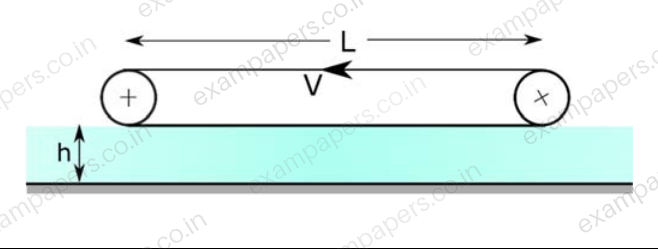
Log in to check the answer
You can attempt this question now. Sign in to view the answer key, explanations and discussion.Log in to check answerQuestion 44
Open questionXE-CMCQ1 markNeeds review
Number of atoms per unit area of the (110) plane of a body centered cubic crystal, with lattice parameter 'a', is
Your answerChoose one option.
Log in to check the answer
You can attempt this question now. Sign in to view the answer key, explanations and discussion.Log in to check answerQuestion 45
Open questionXE-CMCQ1 markNeeds review
Match the following materials with their corresponding bonding types.
Material | Bonding |
|---|---|
P: Cu₀.₅Al₀.₅ | 1: Ionic |
Q: ZnS | 2: Covalent |
R: Na₂O | 3: Metallic |
S: Li₄SiO₄ | 4: Mixed |
Your answerChoose one option.
Log in to check the answer
You can attempt this question now. Sign in to view the answer key, explanations and discussion.Log in to check answerQuestion 46
Open questionXE-CMCQ1 markNeeds review
In an ideal rubber, the primary factor responsible for elasticity up to small strains is
Your answerChoose one option.
Log in to check the answer
You can attempt this question now. Sign in to view the answer key, explanations and discussion.Log in to check answerQuestion 47
Open questionXE-CMCQ1 markNeeds review
Which one of the following statements is true for an intrinsic semiconductor?
Your answerChoose one option.
Log in to check the answer
You can attempt this question now. Sign in to view the answer key, explanations and discussion.Log in to check answerQuestion 48
Open questionXE-CMCQ1 markNeeds review
A differential scanning calorimetry (DSC) experiment tracks the heat flow into or out of a system as a function of temperature. If the experiments given in the options below are performed at 1 atmospheric pressure, then in which case will the DSC thermogram exhibit a spike, either upward or downward?
Your answerChoose one option.
Log in to check the answer
You can attempt this question now. Sign in to view the answer key, explanations and discussion.Log in to check answer