
Engineering Sciences
GATE XE purpose:exam-prep PYQs
Build your understanding with focused practice from past exam papers.
Questions 921–930 of 1772. Imported answers require independent review unless marked reviewed.
Question 3
Open questionXE-BMCQ1 markNeeds review
If
and
are the average pressures at inlet and outlet respectively for a fully-developed flow inside a channel having a height of
, then the absolute value of average shear stress (in Pa) acting on the walls of the channel of length
isYour answerChoose one option.
Log in to check the answer
You can attempt this question now. Sign in to view the answer key, explanations and discussion.Log in to check answerQuestion 4
Open questionXE-BMCQ1 markNeeds review
Consider the fully-developed flow of a Newtonian fluid (density
; viscosity
) through a smooth pipe of diameter
and length
. The average velocity of the flow is
. If the length of the pipe is doubled, keeping
,
,
,
constant, the friction factorYour answerChoose one option.
Log in to check the answer
You can attempt this question now. Sign in to view the answer key, explanations and discussion.Log in to check answerQuestion 5
Open questionXE-BMCQ1 markNeeds review
The absolute value of pressure difference between the inside and outside of a spherical soap bubble of radius,
, and surface tension,
, is:Your answerChoose one option.
Log in to check the answer
You can attempt this question now. Sign in to view the answer key, explanations and discussion.Log in to check answerQuestion 6
Open questionXE-BMCQ1 markNeeds review
Which one of the following statements is TRUE about the continuity equation
(where
are the velocity components along the
and
coordinates respectively):Your answerChoose one option.
Log in to check the answer
You can attempt this question now. Sign in to view the answer key, explanations and discussion.Log in to check answerQuestion 7
Open questionXE-BMCQ1 markNeeds review
The head loss (
) associated with the flow entry of water to an internal passage depends on the shape of the entry. The following figure shows three different types of flow entry into a pipe. Which one of the following relationships correctly represents the head loss associated with the three different flow entries? 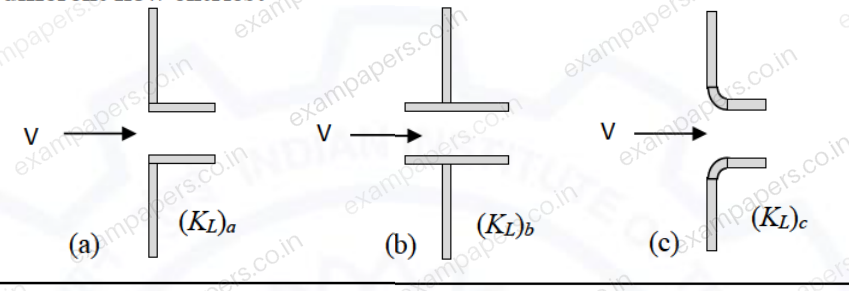
Your answerChoose one option.
Log in to check the answer
You can attempt this question now. Sign in to view the answer key, explanations and discussion.Log in to check answerQuestion 8
Open questionXE-BMCQ1 markNeeds review
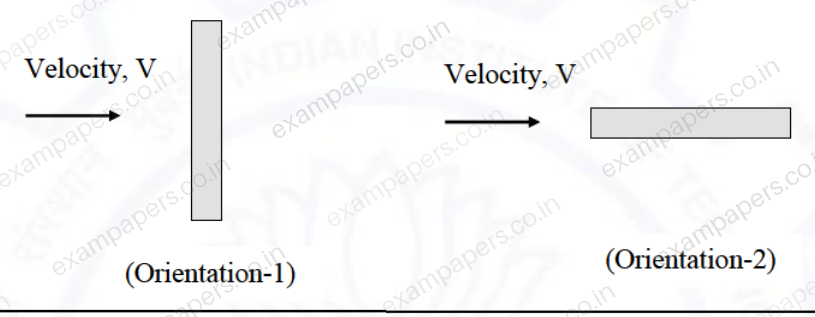
The form and friction drags together contribute to the total drag when flow of air occurs past any object. Two orientations of a finite flat plate are shown in the figure. In Orientation-1, the plate is placed perpendicular to the flow while in Orientation-2 the plate is placed parallel to the flow. If the velocity (V) of air in both orientations is the same, which one of the following options is TRUE?
Your answerChoose one option.
Log in to check the answer
You can attempt this question now. Sign in to view the answer key, explanations and discussion.Log in to check answerQuestion 9
Open questionXE-BNAT1 markNeeds review
A spherical ball is steadily supported against gravity by an upward air jet as shown in the figure. Take acceleration due to gravity to be
. The mass flow rate of air, reaching the ball, is 0.01 kg/s and the air reaches the ball at an upward velocity of 3 m/s. Neglecting the buoyancy force, and using the principle of integral momentum balance, the mass (in grams, up to one decimal place) of the ball is ____. 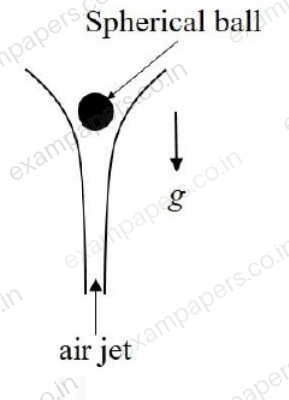
Log in to check the answer
You can attempt this question now. Sign in to view the answer key, explanations and discussion.Log in to check answerQuestion 10
Open questionXE-BMCQ2 marksNeeds review
The incompressible flow of air over a curved surface having possible flow separation is schematically shown in the figure. Two zones P and Q are indicated in the figure. Which one of the following combinations is TRUE for zones P and Q?
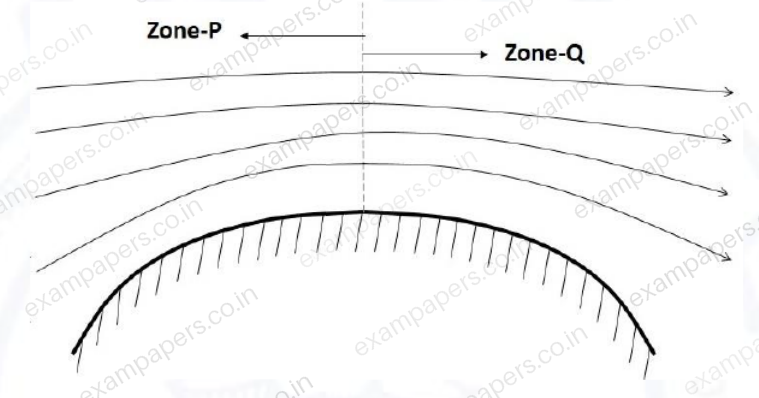
(a) Acceleration of flow, (b) Deceleration of flow, (c) Adverse pressure gradient, (d) Favorable pressure gradient, (e) No flow separation (f) Possible flow separation.
Your answerChoose one option.
Log in to check the answer
You can attempt this question now. Sign in to view the answer key, explanations and discussion.Log in to check answerQuestion 11
Open questionXE-BMCQ2 marksNeeds review
A spherical metal ball (of density
and diameter
), attached to a string, is exposed to a crossflow (of velocity
) of a viscous fluid (of viscosity
and density
). Due to the crossflow, the string makes an angle of inclination,
, with the top surface as shown in the figure. The acceleration due to gravity is denoted by
. For this flow, Reynolds number,
and buoyancy force in the fluid is negligible compared to viscous force. Assuming the string to be weightless and offering negligible drag, the expression for
is 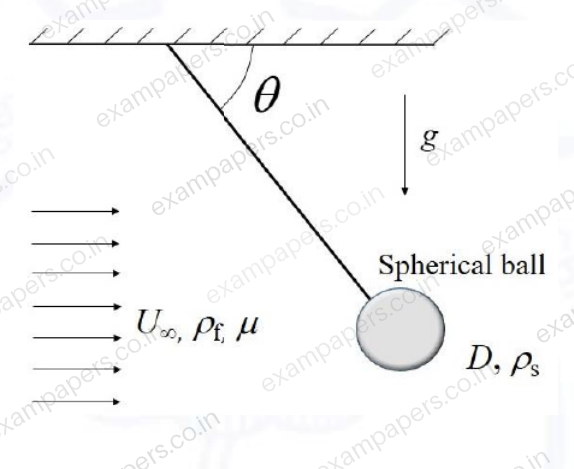
Your answerChoose one option.
Log in to check the answer
You can attempt this question now. Sign in to view the answer key, explanations and discussion.Log in to check answerQuestion 12
Open questionXE-BMCQ2 marksNeeds review
In a Cartesian coordinate system, a steady, incompressible velocity field of a Newtonian fluid is given by
Here, V is the velocity vector in m/s, i is the unit vector in the x-direction,
is a positive, real constant (in m/s), and
is a positive, real constant (in m
). The viscosity of the fluid is
(in Pa-s). The absolute value of the pressure gradient (in Pa/m) isYour answerChoose one option.
Log in to check the answer
You can attempt this question now. Sign in to view the answer key, explanations and discussion.Log in to check answer