
Engineering Sciences
GATE XE Thermodynamic Cycles PYQs
Build your understanding with focused practice from past exam papers.
How to practice Thermodynamic Cycles
Attempt a question, record the concept and assumptions, then check the available answer. Rework mistakes after revising the relevant concepts. Topic tags can overlap; review the question context.
Questions 1–10 of 37. Imported answers require independent review unless marked reviewed.
Question 96
Open questionXE-ENAT1 markNeeds review
Consider an ideal Otto-cycle with cold-air-standard assumptions to be applicable. The temperature of the working fluid at the start and the end of the compression process is 300 K and 750 K, respectively. For the working fluid take the ratio of the specific heat capacities as 1.4. The thermal efficiency (in %) of the cycle is __________________ (rounded off to two decimal places).
Log in to check the answer
You can attempt this question now. Sign in to view the answer key, explanations and discussion.Log in to check answerQuestion 100
Open questionXE-EMSQ2 marksNeeds review
Consider an ideal Rankine cycle with fixed conditions at the turbine inlet. If the condenser pressure is lowered, which of the following statements is/are CORRECT?
Your answerSelect all correct options. You can choose more than one.
Log in to check the answer
You can attempt this question now. Sign in to view the answer key, explanations and discussion.Log in to check answerQuestion 107
Open questionXE-ENAT2 marksNeeds review
Consider an ideal Diesel-cycle with cold-air-standard assumptions to be applicable. The compression ratio is 20 and the cut-off ratio is 1.8. At the end of the compression process, the working fluid is at 1120 K and 6.6 MPa. The ratio of the specific heat capacities is 1.4 for the working fluid. The temperature (in K) at the end of the expansion process is ____________ (rounded off to two decimal places).
Log in to check the answer
You can attempt this question now. Sign in to view the answer key, explanations and discussion.Log in to check answerQuestion 108
Open questionXE-ENAT2 marksNeeds review
A mixture of helium (He) and nitrogen (N₂) expands in a turbine from 800 kPa to 100 kPa. The mixture composition is 40% He and 60% N₂ by mass. The turbine inlet temperature is 1000 K. The temperature (in K) at the turbine exit is ____________ (rounded off to two decimal places).
Assume:
The process is isentropic. Kinetic and potential energy changes in the process are negligible. He and N₂ behaves as ideal gases. Specific heat capacities are constant.
Use the following data:
Ratio of specific heat capacities for He and N₂ are 1.67 and 1.4, respectively.
Specific heat capacities at constant pressure for He and N₂ are 5.19 kJ/kg-K and 1.04 kJ/kg-K, respectively.
Log in to check the answer
You can attempt this question now. Sign in to view the answer key, explanations and discussion.Log in to check answerQuestion 92
Open questionXE-EMCQ1 markNeeds review
If
refers to the ratio of specific heats, the air-standard efficiency of an Otto cycle isYour answerChoose one option.
Log in to check the answer
You can attempt this question now. Sign in to view the answer key, explanations and discussion.Log in to check answerQuestion 97
Open questionXE-EMCQ2 marksNeeds review
For an ideal gas turbine cycle,
and
are the compressor inlet temperature and turbine inlet temperature respectively. The ratio
is denoted by
and the ratio of specific heats is denoted by
. For any given
, the optimum pressure ratio for the maximum specific work output isYour answerChoose one option.
Log in to check the answer
You can attempt this question now. Sign in to view the answer key, explanations and discussion.Log in to check answerQuestion 101
Open questionXE-ENAT2 marksNeeds review
Air in an ideal Diesel cycle is compressed from 3 litre to 0.15 litre. It then expands during a constant pressure heat addition process to 0.3 litre. If the ratio of specific heats,
, the thermal efficiency (in %) of the cycle is ____________ (rounded to one decimal place).Log in to check the answer
You can attempt this question now. Sign in to view the answer key, explanations and discussion.Log in to check answerQuestion 92
Open questionXE-EMCQ1 markNeeds review
A power plant operates on a simple ideal Rankine cycle. If superheating is added to this cycle, then which one of the following options is CORRECT?
Your answerChoose one option.
Log in to check the answer
You can attempt this question now. Sign in to view the answer key, explanations and discussion.Log in to check answerQuestion 95
Open questionXE-ENAT1 markNeeds review
Following data is for an actual vapour compression refrigeration cycle.
Enthalpy at compressor inlet: 246 kJ/kg
Enthalpy at compressor exit: 286 kJ/kg
Heat load on the evaporator: 158 kJ/kg
The enthalpy at the exit of the condenser in kJ/kg is ________ (rounded off to the nearest integer).
Log in to check the answer
You can attempt this question now. Sign in to view the answer key, explanations and discussion.Log in to check answerQuestion 97
Open questionXE-EMCQ2 marksNeeds review
A fixed mass of an ideal gas undergoes two different cycles M and N as shown in the Pressure (
) – Volume (
) diagrams. Based on the information provided, which one of the following statements is always TRUE? 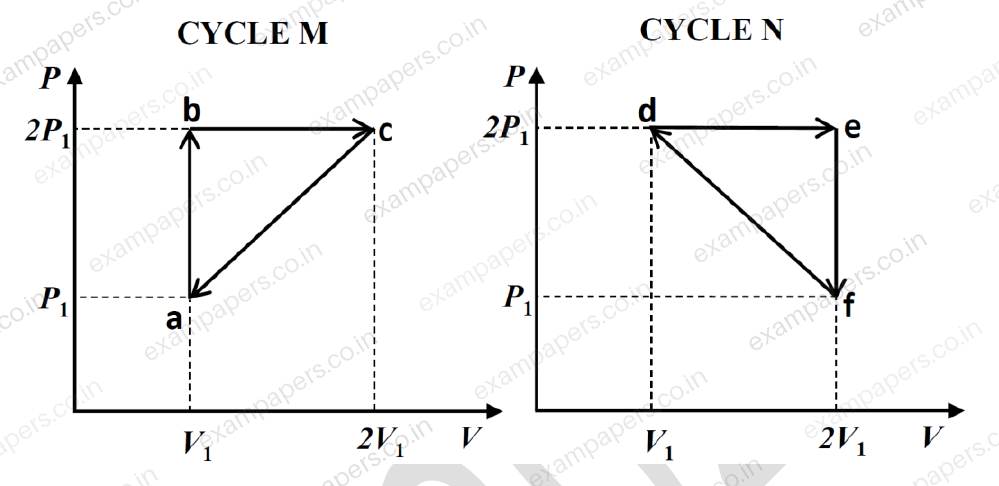
Your answerChoose one option.
Log in to check the answer
You can attempt this question now. Sign in to view the answer key, explanations and discussion.Log in to check answer