
Engineering Sciences
GATE XE Thermodynamics, Kinetics and Phase Transformations PYQs
Build your understanding with focused practice from past exam papers.
Questions 11–20 of 53. Imported answers require independent review unless marked reviewed.
Question 62
Open questionXE-CNAT2 marksNeeds review
The standard free energy change for the reaction,
at equilibrium is given by
, where T is in Kelvin and
is in Joule. The equilibrium constant (
) at 1050 K is (rounded off to two decimal places) ____________Given: Universal gas constant (R) = 8.314 J K
mol
Log in to check the answer
You can attempt this question now. Sign in to view the answer key, explanations and discussion.Log in to check answerQuestion 63
Open questionXE-CNAT2 marksNeeds review
The slopes of reduction potential versus pH plots for the two reactions,
and
, at 298 K and one atmospheric pressure are
and
, respectively. The ratio
is (rounded off to one decimal place) ____________Log in to check the answer
You can attempt this question now. Sign in to view the answer key, explanations and discussion.Log in to check answerQuestion 64
Open questionXE-CNAT2 marksNeeds review
At 873 K, hydrogen diffuses under steady state condition through a 5 mm thick palladium sheet with a cross-sectional area of 0.3 m
. The concentrations of hydrogen at high and low pressure ends of the sheet are 3 kg m
and 0.5 kg m
, respectively. The amount of hydrogen (in kg per day) passing through the sheet is (rounded off to two decimal places) ____________Given: At 873 K, diffusivity of hydrogen =
m
s
Log in to check the answer
You can attempt this question now. Sign in to view the answer key, explanations and discussion.Log in to check answerQuestion 44
Open questionXE-CMCQ1 markNeeds review
The correct combination of phases in the one-component H
O phase diagram, as given below, is 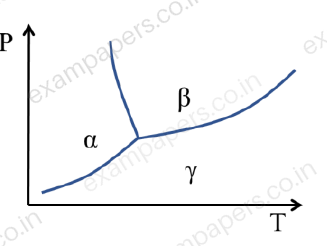
Your answerChoose one option.
Log in to check the answer
You can attempt this question now. Sign in to view the answer key, explanations and discussion.Log in to check answerQuestion 52
Open questionXE-CNAT1 markNeeds review
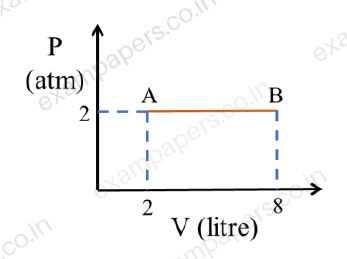
The work done by a body expanding from an initial state A to the final state B, as shown in the P-V diagram below, is (in units of litre-atm) __________ (rounded off to nearest integer).
Log in to check the answer
You can attempt this question now. Sign in to view the answer key, explanations and discussion.Log in to check answerQuestion 53
Open questionXE-CMCQ2 marksNeeds review
A binary phase diagram is given below.
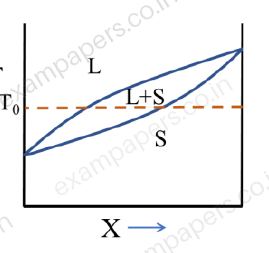
Which one of the following figures qualitatively represents the G-X (Gibbs free energy – composition) plot at temperature
shown in the phase diagram?Your answerChoose one option.
Log in to check the answer
You can attempt this question now. Sign in to view the answer key, explanations and discussion.Log in to check answerQuestion 58
Open questionXE-CMSQ2 marksNeeds review
Which of the following options is/are true for glass transition temperature T_g?
Your answerSelect all correct options. You can choose more than one.
Log in to check the answer
You can attempt this question now. Sign in to view the answer key, explanations and discussion.Log in to check answerQuestion 60
Open questionXE-CMSQ2 marksNeeds review
Given that k is the first order reaction rate constant and T is the temperature in absolute scale, the temperature dependence of rate constant is/are represented by
Your answerSelect all correct options. You can choose more than one.
Log in to check the answer
You can attempt this question now. Sign in to view the answer key, explanations and discussion.Log in to check answerQuestion 63
Open questionXE-CNAT2 marksNeeds review
A 2 mm thick palladium sheet of 1000 mm
cross section is used as a diffusional membrane to purify hydrogen. The hydrogen concentration is maintained at a steady state with
kg m
and
kg m
on the two sides of the membrane as shown in the figure below.
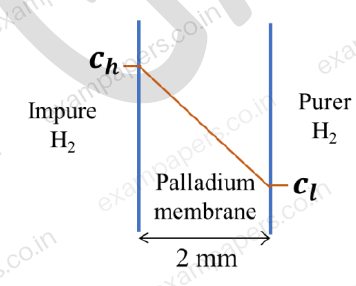
The rate of hydrogen purification is (in units of kg hr
) ______ × 10
(rounded off to one decimal place).Given: The diffusion coefficient of hydrogen in palladium is 1.0 × 10
m
s
Log in to check the answer
You can attempt this question now. Sign in to view the answer key, explanations and discussion.Log in to check answerQuestion 44
Open questionXE-CMCQ1 markNeeds review
In age-hardening of an aluminium alloy, the purpose of solution treatment followed by quenching is to
Your answerChoose one option.
Log in to check the answer
You can attempt this question now. Sign in to view the answer key, explanations and discussion.Log in to check answer