
Engineering Sciences
GATE XE topic:atmospheric-science PYQs
Build your understanding with focused practice from past exam papers.
Questions 11–20 of 123. Imported answers require independent review unless marked reviewed.
Question 173
Open questionXE-HNAT2 marksNeeds review
In a free atmosphere without friction, if the pressure increases by one kilo Pascal eastward across a distance of 200 km, the magnitude of geostrophic flow (in
) is _____. (rounded off to two decimal places)[Density of air is 1.029
and the Coriolis parameter is
.]Log in to check the answer
You can attempt this question now. Sign in to view the answer key, explanations and discussion.Log in to check answerQuestion 154
Open questionXE-HMCQ1 markNeeds review
During which of the following times of the day is the 2 m air temperature usually the lowest at a tropical location?
Your answerChoose one option.
Log in to check the answer
You can attempt this question now. Sign in to view the answer key, explanations and discussion.Log in to check answerQuestion 155
Open questionXE-HMCQ1 markNeeds review
At which of the following locations in the atmosphere is the anvil of a towering cumulonimbus cloud usually located?
Your answerChoose one option.
Log in to check the answer
You can attempt this question now. Sign in to view the answer key, explanations and discussion.Log in to check answerQuestion 156
Open questionXE-HMCQ1 markNeeds review
Which one of the following is the main reason why tropical cyclones rarely form over the Bay of Bengal during the summer monsoon season?
Your answerChoose one option.
Log in to check the answer
You can attempt this question now. Sign in to view the answer key, explanations and discussion.Log in to check answerQuestion 157
Open questionXE-HMCQ1 markNeeds review
Which one of the following is the main cause of the land-sea temperature contrast that drives phenomena like sea breeze and the Indian summer monsoon?
Your answerChoose one option.
Log in to check the answer
You can attempt this question now. Sign in to view the answer key, explanations and discussion.Log in to check answerQuestion 161
Open questionXE-HNAT1 markNeeds review
Accumulated rainfall is often measured in mm. If the density of rain water is 1000 kg m
then, one mm of rain is equal to ______________ kg m
of rain. (in integer).Log in to check the answer
You can attempt this question now. Sign in to view the answer key, explanations and discussion.Log in to check answerQuestion 162
Open questionXE-HNAT1 markNeeds review
Acceleration due to Coriolis force of a water parcel at a location P (67 °E, 20 °N) moving with a speed of 0.35 m s
is ________ × 10
m s
. (Round off to two decimal places)[Assume the angular velocity of the Earth is 7.3 × 10
s
.]Log in to check the answer
You can attempt this question now. Sign in to view the answer key, explanations and discussion.Log in to check answerQuestion 163
Open questionXE-HMCQ2 marksNeeds review
A rotating weather system has a tangential velocity of 100 m s
, diameter of 1 km, and located at a latitude where the Coriolis parameter is 10
s
. Which one of the following statements is true about this weather system?Your answerChoose one option.
Log in to check the answer
You can attempt this question now. Sign in to view the answer key, explanations and discussion.Log in to check answerQuestion 169
Open questionXE-HMSQ2 marksNeeds review
In the figures given below, L and H indicate low and high pressure centers, respectively; PGF, CoF and CeF indicate Pressure Gradient Force, Coriolis Force and Centrifugal Force, respectively; V is Velocity. [The arrows indicate only the directions but not the magnitudes of the forces and velocity.]
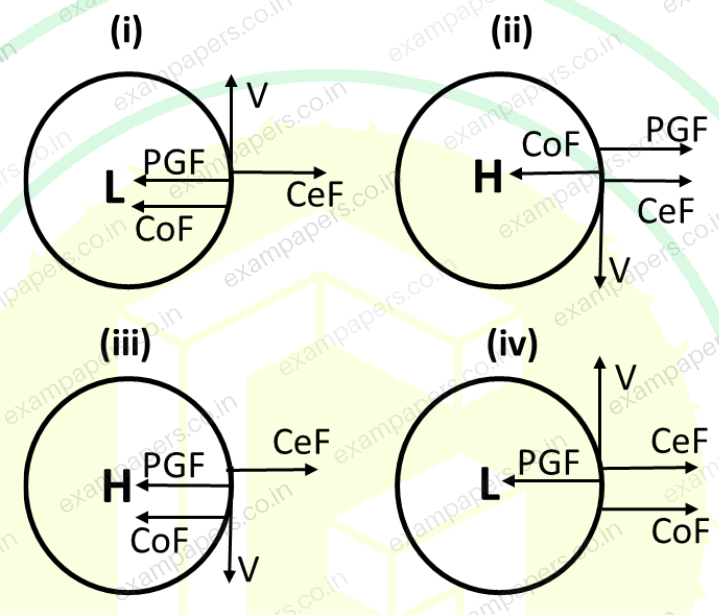
Which of the following is/are the correct representation(s) of the directions of various forces and velocity in the gradient wind balance in the northern hemisphere?
Your answerSelect all correct options. You can choose more than one.
Log in to check the answer
You can attempt this question now. Sign in to view the answer key, explanations and discussion.Log in to check answerQuestion 170
Open questionXE-HNAT2 marksNeeds review
One kg of dry air at 15 °C is isothermally compressed to one-tenth of its initial volume. The work done on the system is ________________ kJ. (Round off to the nearest integer.) [Assume that the gas constant for dry air is 287 × 10⁻⁵ J K⁻¹ kg⁻¹.]
Log in to check the answer
You can attempt this question now. Sign in to view the answer key, explanations and discussion.Log in to check answer