
Engineering Sciences
GATE XE topic:chemistry-high-polymers PYQs
Build your understanding with focused practice from past exam papers.
Questions 21–30 of 66. Imported answers require independent review unless marked reviewed.
Question 116
Open questionXE-FMCQ1 markNeeds review
Among the options given, identify the correct match between the polymers and their glass transition temperatures (T_g).
Polymer: P — High density polyethylene; Q — Poly(vinyl carbazole); R — Polymethyl methacrylate; S — Polycarbonate.
Glass transition temperature (°C): 1 — >200; 2 — 145 to 155; 3 — -100 to -80; 4 — 90 to 100.
Your answerChoose one option.
Log in to check the answer
You can attempt this question now. Sign in to view the answer key, explanations and discussion.Log in to check answerQuestion 117
Open questionXE-FMCQ1 markNeeds review
What is the correct order of decreasing crystallinity of the given polymers?
P — atactic-Polypropylene; Q — syndiotactic-Polystyrene; R — Nylon 6; S — Polyethylene terephthalate
Your answerChoose one option.
Log in to check the answer
You can attempt this question now. Sign in to view the answer key, explanations and discussion.Log in to check answerQuestion 118
Open questionXE-FMCQ1 markNeeds review
Choose the correct option that best correlates the graphs with the polymerization methods.
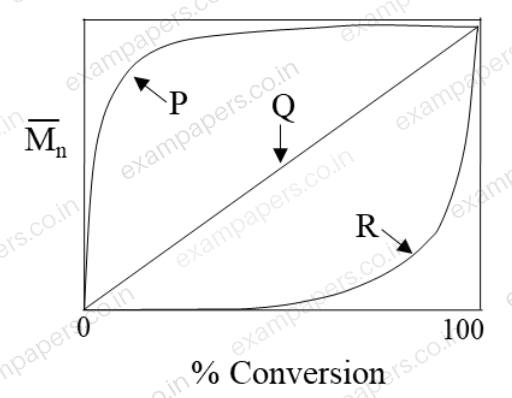
Your answerChoose one option.
Log in to check the answer
You can attempt this question now. Sign in to view the answer key, explanations and discussion.Log in to check answerQuestion 122
Open questionXE-FMSQ2 marksNeeds review
Among the options given, identify the correct pair(s) of catalyst and co-catalyst that form a Ziegler-Natta catalyst.
Your answerSelect all correct options. You can choose more than one.
Log in to check the answer
You can attempt this question now. Sign in to view the answer key, explanations and discussion.Log in to check answerQuestion 125
Open questionXE-FMSQ2 marksNeeds review
Among the options given, which method(s) is/are used for the synthesis of atactic polystyrene?
Your answerSelect all correct options. You can choose more than one.
Log in to check the answer
You can attempt this question now. Sign in to view the answer key, explanations and discussion.Log in to check answerQuestion 127
Open questionXE-FNAT2 marksNeeds review
Polyvinylidene fluoride (PVDF) was quenched from the melt in one case and in the other case, it was slowly cooled from the melt at 10 °C/min. The percentage crystallinity of the slowly cooled PVDF is 60%. The heat of fusion for the quenched PVDF is 0.5ΔH_m (ΔH_m is the heat of fusion for the slowly cooled PVDF), and the heat of fusion for 100% crystalline PVDF is 100 J/g. The percentage crystallinity of the quenched PVDF is ______ %. (Answer in integer)
Log in to check the answer
You can attempt this question now. Sign in to view the answer key, explanations and discussion.Log in to check answerQuestion 110
Open questionXE-FMCQ1 markNeeds review
Interfacial polymerization can be used to prepare
Your answerChoose one option.
Log in to check the answer
You can attempt this question now. Sign in to view the answer key, explanations and discussion.Log in to check answerQuestion 112
Open questionXE-FMCQ1 markNeeds review
The initiator system which can be used for free radical polymerization at 5 °C is
Your answerChoose one option.
Log in to check the answer
You can attempt this question now. Sign in to view the answer key, explanations and discussion.Log in to check answerQuestion 118
Open questionXE-FNAT1 markNeeds review
The functionality of adipic acid for condensation reaction with glycerol is ________ (in integer).
Log in to check the answer
You can attempt this question now. Sign in to view the answer key, explanations and discussion.Log in to check answerQuestion 125
Open questionXE-FMCQ2 marksNeeds review
Match the polymers to the polymerization method used for their synthesis.
Polymer | Polymerization method |
|---|---|
P. Linear low density polyethylene | 1. Ring opening |
Q. Nylon 6 | 2. Ziegler-Natta |
R. Styrene-butadiene rubber | 3. Condensation |
S. Aromatic polyamide | 4. Emulsion |
Your answerChoose one option.
Log in to check the answer
You can attempt this question now. Sign in to view the answer key, explanations and discussion.Log in to check answer