
Engineering Sciences
GATE XE topic:engineering-sciences PYQs
Build your understanding with focused practice from past exam papers.
Questions 221–230 of 1772. Imported answers require independent review unless marked reviewed.
Question 24
Open questionXE-BMCQ1 markNeeds review
Consider the following Statements [1] and [2].
Statement [1]: The Eulerian study focuses attention on individual particle and its motion is observed as a function of time.
Statement [2]: The Lagrangian study focuses attention on the motion of the particles pass through an identified point.
Which one of the following options identifies the correctness of the given statements?
Your answerChoose one option.
Log in to check the answer
You can attempt this question now. Sign in to view the answer key, explanations and discussion.Log in to check answerQuestion 25
Open questionXE-BMCQ1 markNeeds review
Statement of Reynolds Transport Theorem is given below with three blanks.
The rate of change of ______ extensive property can be calculated by summing the rate of change of the amount of same property in the ______ and the rate at which the property is ______ the surface of the control volume.
Which one of the following options correctly fills the blanks by using its comma-separated phrases in sequence?
Your answerChoose one option.
Log in to check the answer
You can attempt this question now. Sign in to view the answer key, explanations and discussion.Log in to check answerQuestion 26
Open questionXE-BMCQ1 markNeeds review
For a steady and incompressible flow, the velocity field (
) in Cartesian
coordinate system is given as:
Here,
,
, and
are unit vectors along
,
, and
directions, respectively and
is a constant. Which one of the following options is the correct value of
that satisfies the conservation of mass for the given velocity field?Your answerChoose one option.
Log in to check the answer
You can attempt this question now. Sign in to view the answer key, explanations and discussion.Log in to check answerQuestion 27
Open questionXE-BMCQ1 markNeeds review
Conservation of mass for a steady axisymmetric flow field in the cylindrical
coordinates is:
Here,
and
are radial and axial components of velocity, respectively.
Which one of the following options is correct if
is the stream function?Your answerChoose one option.
Log in to check the answer
You can attempt this question now. Sign in to view the answer key, explanations and discussion.Log in to check answerQuestion 28
Open questionXE-BMCQ1 markNeeds review
Group-I indicates different properties of fluid and Group-II defines their basic dimensions in terms of Force (
), Length (
), and Time (
).Group-I | Group-II |
|---|---|
P: Dynamic viscosity | 1: |
Q: Surface tension | 2: |
R: Density | 3: |
Which one of the following options identifies the correct match between Group-I and Group-II?
Your answerChoose one option.
Log in to check the answer
You can attempt this question now. Sign in to view the answer key, explanations and discussion.Log in to check answerQuestion 29
Open questionXE-BMCQ1 markNeeds review
Consider the steady, incompressible, and fully developed laminar flow of a fluid through a circular pipe. Here,
is the pressure drop in the direction of the flow and
is the average velocity of the fluid at any cross-section. The relation between
and
is:
Here,
and
are constants.
Which one of the following options is the correct value of
?Your answerChoose one option.
Log in to check the answer
You can attempt this question now. Sign in to view the answer key, explanations and discussion.Log in to check answerQuestion 30
Open questionXE-BMCQ1 markNeeds review
A doublet is the resulting flow pattern when a sink and a source of equal strength are brought together.
Which one of the following options correctly represents the nature of the product of the strength and the distance between them during approach?
Your answerChoose one option.
Log in to check the answer
You can attempt this question now. Sign in to view the answer key, explanations and discussion.Log in to check answerQuestion 31
Open questionXE-BMCQ2 marksNeeds review
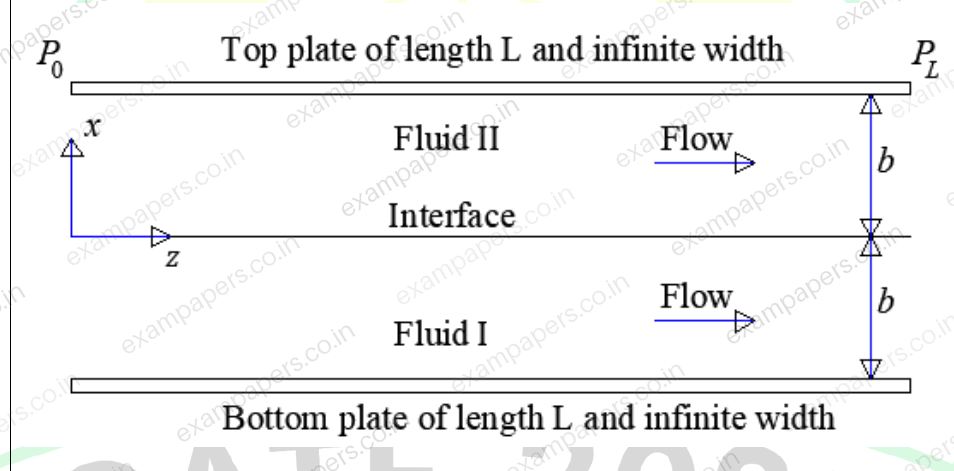
Figure shows two parallel plates (upper plate at
and lower one at
) of length L (aligned in
direction) and infinite width (in
direction, normal to the plane of the figure). Two immiscible, incompressible liquids are flowing steadily in the
direction through the thin passage between the plates under the influence of horizontal pressure gradient
. During the flow, the passage is always half-filled with denser fluid I (viscosity
) at the bottom and rest is occupied by lighter fluid II (viscosity
;
). Considering exactly planar interface between the fluids and no instabilities in the flow, the shear stress,
is expressed as:
Which one of the following options correctly identifies the location of the point having maximum velocity of the flow?
Your answerChoose one option.
Log in to check the answer
You can attempt this question now. Sign in to view the answer key, explanations and discussion.Log in to check answerQuestion 32
Open questionXE-BMCQ2 marksNeeds review
Group-I shows different two-dimensional bodies and Group-II mentions their total drag coefficient (
) based on frontal area while facing parallel flow of fluid having Reynolds number
along the direction of arrow. The bodies are placed symmetrically with respect to the flow direction.Group-I | Group-II |
|---|---|
P: 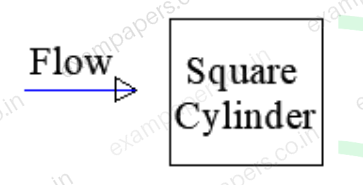 | 1: 1.2 |
Q: 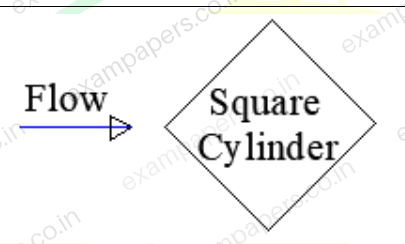 | 2: 1.6 |
R: 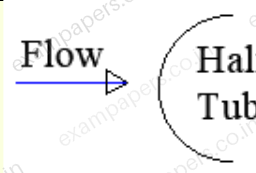 | 3: 2.1 |
S: 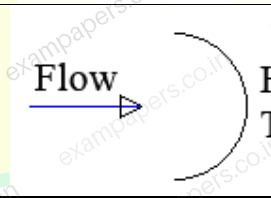 | 4: 2.3 |
Which one of the following options identifies the correct match between Group-I and Group-II, as per the concept of degree of streamlining?
Your answerChoose one option.
Log in to check the answer
You can attempt this question now. Sign in to view the answer key, explanations and discussion.Log in to check answerQuestion 33
Open questionXE-BMCQ2 marksNeeds review
A solid body of uniform specific gravity floats in a deep liquid pool. Take
,
, and
as the centre of buoyancy, centre of gravity, and metacentre of the body, respectively.
Which one of the following options is correct for the stable flotation of the body in the pool when the body is given a small tilt angle?Your answerChoose one option.
Log in to check the answer
You can attempt this question now. Sign in to view the answer key, explanations and discussion.Log in to check answer