
Engineering Sciences
GATE XE topic:engineering PYQs
Build your understanding with focused practice from past exam papers.
Questions 1211–1220 of 1772. Imported answers require independent review unless marked reviewed.
Question 8
Open questionXE-GNAT1 markNeeds review
The velocity of 2.2 μm diameter fat particles inside a centrifuge, running at 600 rpm and 20 °C, is 0.25 mm s⁻¹. The velocity of 1.5 μm diameter fat particles inside the same centrifuge running at 750 rpm and same temperature (round off to 2 decimal places) will be _____ mm s⁻¹.
Log in to check the answer
You can attempt this question now. Sign in to view the answer key, explanations and discussion.Log in to check answerQuestion 9
Open questionXE-GNAT1 markNeeds review
The initial population of a bacterial strain increases from 1×10⁴ cells per mL to 1×10⁶ cells per mL in 120 minutes. The generation time for this strain (round off to 2 decimal places) is _____ minutes.
Log in to check the answer
You can attempt this question now. Sign in to view the answer key, explanations and discussion.Log in to check answerQuestion 10
Open questionXE-GMCQ2 marksNeeds review
Match the protein in Column I with its food source in Column II.
Column I:
P. Zein
Q. Gluten
R. Glycinin
S. Ovalbumin
Column II:
Soybean
Maize
Egg
Wheat
Your answerChoose one option.
Log in to check the answer
You can attempt this question now. Sign in to view the answer key, explanations and discussion.Log in to check answerQuestion 11
Open questionXE-GMCQ2 marksNeeds review
Match the carbohydrate in Column I with corresponding enzyme used for its hydrolysis in Column II.
Column I: P. Pectin; Q. Lactose; R. Hemicellulose; S. Inulin
Column II: 1. Xylanase; 2. β-galactosidase; 3. Polygalacturonase; 4. β-fructofuranosidase
Your answerChoose one option.
Log in to check the answer
You can attempt this question now. Sign in to view the answer key, explanations and discussion.Log in to check answerQuestion 12
Open questionXE-GMCQ2 marksNeeds review
Match the edible oil refining stage in Column I with its purpose in Column II.
Column I: P. Degumming; Q. Neutralization; R. Bleaching; S. Winterization
Column II: 1. Separation of triglycerides; 2. Remove of pigments; 3. Remove of phosphates; 4. Remove of free fatty acids
Your answerChoose one option.
Log in to check the answer
You can attempt this question now. Sign in to view the answer key, explanations and discussion.Log in to check answerQuestion 13
Open questionXE-GMCQ2 marksNeeds review
Match the food material in Column I with its related term in Column II.
Column I: P. Coffee; Q. Cocoa; R. Beer; S. Wine
Column II: 1. Wort; 2. Must; 3. Arabica; 4. Theobroma
Your answerChoose one option.
Log in to check the answer
You can attempt this question now. Sign in to view the answer key, explanations and discussion.Log in to check answerQuestion 14
Open questionXE-GMCQ2 marksNeeds review
Match the component/system in Column I with the peeling method for fruits and vegetables in Column II.
Column I: P. Lye solution; Q. Carborundum rollers; R. Pressure vessel; S. Conveyor belt
Column II: 1. Flash peeling; 2. Flame peeling; 3. Abrasion peeling; 4. Caustic peeling
Your answerChoose one option.
Log in to check the answer
You can attempt this question now. Sign in to view the answer key, explanations and discussion.Log in to check answerQuestion 15
Open questionXE-GMCQ2 marksNeeds review
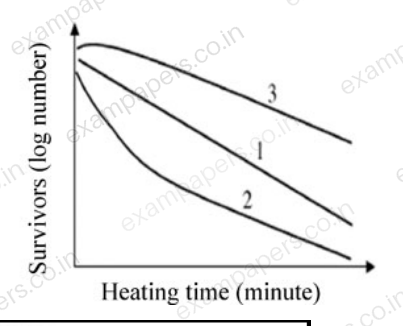
Which among the given options correctly explains the nature of the microbial culture represented by curves 1, 2 and 3 in the following figure?
Your answerChoose one option.
Log in to check the answer
You can attempt this question now. Sign in to view the answer key, explanations and discussion.Log in to check answerQuestion 16
Open questionXE-GMCQ2 marksNeeds review
Match the equation/law in Column I with its application in Column II.
Column I: P. Plank’s equation; Q. Arrhenius equation; R. Guggenheim-Anderson-de Boer equation; S. Stoke’s law
Column II: 1. Terminal velocity; 2. Freezing time; 3. Activation energy; 4. Monolayer moisture content
Your answerChoose one option.
Log in to check the answer
You can attempt this question now. Sign in to view the answer key, explanations and discussion.Log in to check answerQuestion 17
Open questionXE-GMCQ2 marksNeeds review
Match the absorber used in modified atmosphere packaging and storage in Column I with the scavenger in Column II.
Column I: P. Oxygen absorber; Q. Carbon dioxide absorber; R. Ethylene absorber; S. Moisture absorber
Column II: 1. Calcium chloride; 2. Magnesium oxide; 3. Ferric oxide; 4. Potassium permanganate
Your answerChoose one option.
Log in to check the answer
You can attempt this question now. Sign in to view the answer key, explanations and discussion.Log in to check answer