
Engineering Sciences
GATE XE topic:external-flows PYQs
Build your understanding with focused practice from past exam papers.
How to practice topic:external-flows
Attempt a question, record the concept and assumptions, then check the available answer. Rework mistakes after revising the relevant concepts. Topic tags can overlap; review the question context.
Questions 1–10 of 31. Imported answers require independent review unless marked reviewed.
Question 23
Open questionXE-BMCQ1 markNeeds review
Air flows with a freestream velocity
over four different bodies having same frontal area facing the flow direction, as shown in the figure. Which one of the following bodies has the lowest pressure (form) drag force for Reynolds number,
? 
Your answerChoose one option.
Log in to check the answer
You can attempt this question now. Sign in to view the answer key, explanations and discussion.Log in to check answerQuestion 24
Open questionXE-BMCQ1 markNeeds review
Consider a steady, and incompressible flow over a body with characteristic length
. The boundary layer thickness at a distance
from the leading edge is
. Which one of the following assumptions is correct for deriving the Prandtl boundary layer equations?Your answerChoose one option.
Log in to check the answer
You can attempt this question now. Sign in to view the answer key, explanations and discussion.Log in to check answerQuestion 35
Open questionXE-BMCQ2 marksNeeds review
Consider a steady, laminar, and incompressible flow over a flat plate, as shown in the figure. With freestream velocity
and kinematic viscosity
, the boundary layer thickness at a distance
from the leading edge is
. If the kinematic viscosity of the fluid is increased by a factor of four (
), the boundary layer thickness (
) at
with same
will be equal to 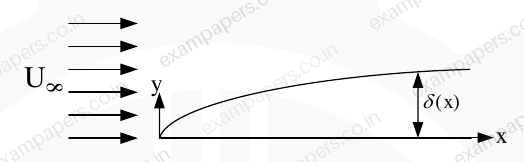
Your answerChoose one option.
Log in to check the answer
You can attempt this question now. Sign in to view the answer key, explanations and discussion.Log in to check answerQuestion 41
Open questionXE-BNAT2 marksNeeds review
For a steady, laminar, and incompressible flow over a flat plate, the local skin friction coefficient is given as
; where
is the local Reynolds number. The density and kinematic viscosity of the fluid are 1.2 kg.m
and
m
.s
, respectively. If the freestream velocity is 3 m.s
, then the local shear stress (in N.m
) at
m is __________. (rounded off to three decimal places)Log in to check the answer
You can attempt this question now. Sign in to view the answer key, explanations and discussion.Log in to check answerQuestion 23
Open questionXE-BMCQ1 markNeeds review
A sharp flat plate of length
and infinite width is immersed parallel to a fluid stream having velocity
. At a point on the plate, far away from the leading edge and not near the trailing edge, the boundary layer thickness, the displacement thickness, and the momentum thickness are denoted as
,
, and
, respectively. Which one of the following options correctly represents the relation between these thicknesses?Your answerChoose one option.
Log in to check the answer
You can attempt this question now. Sign in to view the answer key, explanations and discussion.Log in to check answerQuestion 32
Open questionXE-BMCQ2 marksNeeds review
Group-I shows different two-dimensional bodies and Group-II mentions their total drag coefficient (
) based on frontal area while facing parallel flow of fluid having Reynolds number
along the direction of arrow. The bodies are placed symmetrically with respect to the flow direction.Group-I | Group-II |
|---|---|
P: 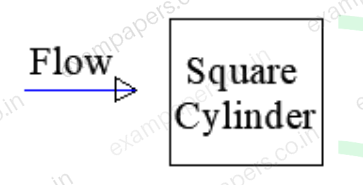 | 1: 1.2 |
Q: 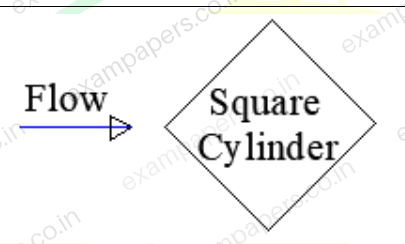 | 2: 1.6 |
R: 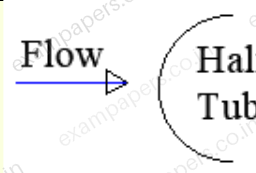 | 3: 2.1 |
S: 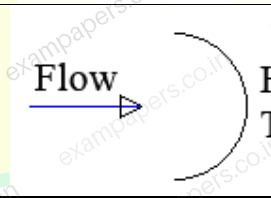 | 4: 2.3 |
Which one of the following options identifies the correct match between Group-I and Group-II, as per the concept of degree of streamlining?
Your answerChoose one option.
Log in to check the answer
You can attempt this question now. Sign in to view the answer key, explanations and discussion.Log in to check answerQuestion 39
Open questionXE-BNAT2 marksNeeds review
Consider, a kite weighing 100 grams as essentially a rigid flat plate making an angle 8° with the horizontal and having a planform area of 0.045 m
when exposed to horizontal parallel wind of 60 km/h. The thread string of the kite makes an angle 45° with the horizontal. A tension of 450 grams in the thread is necessary to float the kite steadily. Take air density as 1.2 kg/m
and gravitational acceleration as 9.81 m/s
. The lift coefficient (
) associated with the air flow around steadily floating kite (rounded off to 2 decimal places) is ________Log in to check the answer
You can attempt this question now. Sign in to view the answer key, explanations and discussion.Log in to check answerQuestion 25
Open questionXE-BMCQ1 markNeeds review
For the laminar, incompressible flow over a flat plate with uniform free stream velocity, the axial pressure gradient within the boundary layer is
Your answerChoose one option.
Log in to check the answer
You can attempt this question now. Sign in to view the answer key, explanations and discussion.Log in to check answerQuestion 34
Open questionXE-BMCQ2 marksNeeds review
Consider a fluid flow around an airfoil as shown in figure.
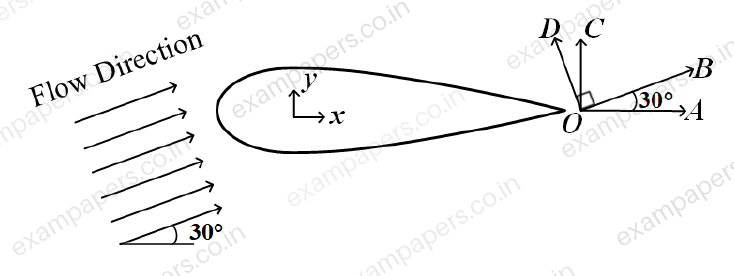
The directions of drag force and lift force, respectively are along
Your answerChoose one option.
Log in to check the answer
You can attempt this question now. Sign in to view the answer key, explanations and discussion.Log in to check answerQuestion 43
Open questionXE-BNAT2 marksNeeds review
Consider the incompressible fluid flow over a flat plate with a free stream velocity,
m/s. The fluid kinematic viscosity is
m²/s and density is 1 kg/m³. The velocity profile within the boundary layer at any location
is given by
, where boundary layer thickness,
. The local wall shear stress at
m from the leading edge is _____ × 10⁻³ N/m² (rounded off to two decimal places).Log in to check the answer
You can attempt this question now. Sign in to view the answer key, explanations and discussion.Log in to check answer