
Engineering Sciences
GATE XE topic:external-flows PYQs
Build your understanding with focused practice from past exam papers.
Questions 21–30 of 31. Imported answers require independent review unless marked reviewed.
Question 11
Open questionXE-BMCQ2 marksNeeds review
A spherical metal ball (of density
and diameter
), attached to a string, is exposed to a crossflow (of velocity
) of a viscous fluid (of viscosity
and density
). Due to the crossflow, the string makes an angle of inclination,
, with the top surface as shown in the figure. The acceleration due to gravity is denoted by
. For this flow, Reynolds number,
and buoyancy force in the fluid is negligible compared to viscous force. Assuming the string to be weightless and offering negligible drag, the expression for
is 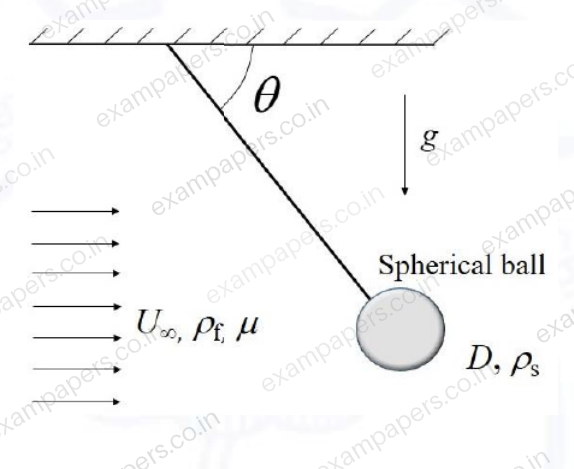
Your answerChoose one option.
Log in to check the answer
You can attempt this question now. Sign in to view the answer key, explanations and discussion.Log in to check answerQuestion 1
Open questionXE-BMCQ1 markNeeds review
Figures given below show the velocity and shear stress profiles for the flow in a duct. In each option, ‘1’ represents velocity profile and ‘2’ represents shear stress profile.
Choose the correct option that closely represents the turbulent flow condition.
Your answerChoose one option.
Log in to check the answer
You can attempt this question now. Sign in to view the answer key, explanations and discussion.Log in to check answerQuestion 4
Open questionXE-BMCQ1 markNeeds review
A laminar hydrodynamic boundary layer over a smooth flat plate is shown in the Figure. The shear stress at the wall is denoted by
. Which one of the following conditions is correct. 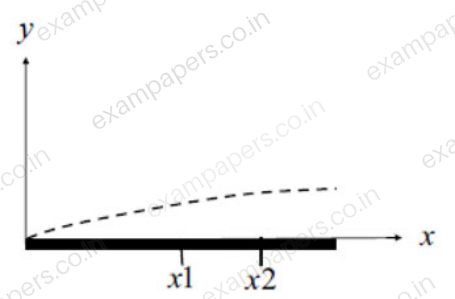
Your answerChoose one option.
Log in to check the answer
You can attempt this question now. Sign in to view the answer key, explanations and discussion.Log in to check answerQuestion 4
Open questionXE-BMCQ1 markNeeds review
A golf ball is dimpled to make the flow turbulent and consequently to reduce the drag. Turbulent flow reduces the drag on the golf ball because
Your answerChoose one option.
Log in to check the answer
You can attempt this question now. Sign in to view the answer key, explanations and discussion.Log in to check answerQuestion 5
Open questionXE-BMCQ1 markNeeds review
For a steady laminar incompressible boundary layer flow over a sharp-edged flat plate at zero incidence,
Your answerChoose one option.
Log in to check the answer
You can attempt this question now. Sign in to view the answer key, explanations and discussion.Log in to check answerQuestion 15
Open questionXE-BMCQ2 marksNeeds review
For steady laminar flow at zero incidence over a flat plate, the component of velocity parallel to the plate in the boundary layer is given by
, where
is the distance measured normal to the flat plate. If
is the coefficient of dynamic viscosity,
is the velocity parallel to the wall at the edge of the boundary layer and
is the boundary layer thickness, the wall shear stress is given byYour answerChoose one option.
Log in to check the answer
You can attempt this question now. Sign in to view the answer key, explanations and discussion.Log in to check answerQuestion 17
Open questionXE-BNAT2 marksNeeds review
A 2.6 gram smooth table-tennis (ping-pong) ball has a diameter of 38 mm. Density (ρ) of air is 1.2 kg/m³. Neglect the effect of gravity. Take coefficient of drag as 0.5. If the ball is struck with an initial velocity of 30 m/s, the initial deceleration, in m/s², is ________.
Log in to check the answer
You can attempt this question now. Sign in to view the answer key, explanations and discussion.Log in to check answerQuestion 18
Open questionXE-BNAT2 marksNeeds review
On a flat plate, transition from laminar to turbulent boundary layer occurred at a critical Reynolds number (Re_cr). The empirical relations for the laminar and turbulent boundary layer thickness are given by
and
, respectively. The ratio of laminar to turbulent boundary layer thickness, at the location of transition, is 0.3. The value of Re_cr is ________.Log in to check the answer
You can attempt this question now. Sign in to view the answer key, explanations and discussion.Log in to check answerQuestion 21
Open questionXE-BNAT2 marksNeeds review
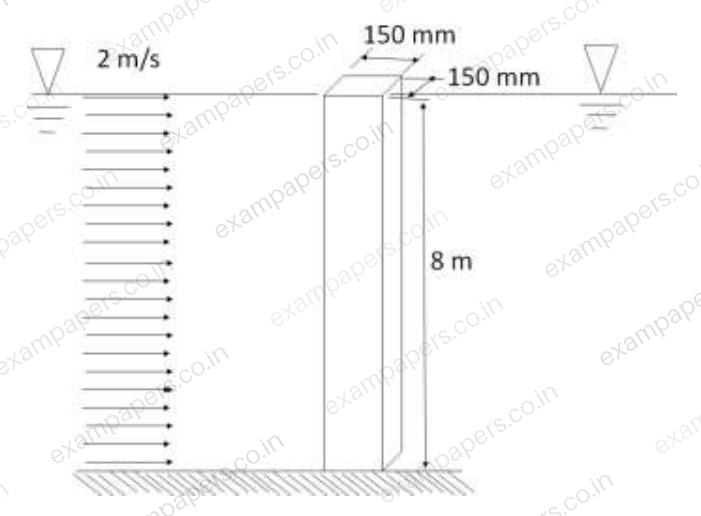
A (150 mm × 150 mm) square pillar is located in a river with water flowing at a velocity of 2 m/s, as shown in figure. The height of the pillar in water is 8 m. Take density of water as 1000 kg/m³ and kinematic viscosity as 1×10⁻⁶ m²/s. The coefficient of drag of the pillar is 2.0. The drag force exerted by water on the pillar in N is ________.
Log in to check the answer
You can attempt this question now. Sign in to view the answer key, explanations and discussion.Log in to check answerQuestion 31
Open questionXE-BNAT2 marksNeeds review
Air flows over a smooth flat plate at a velocity of 4.39 m/s. The density of air is 1.031 kg/m³ and the kinematic viscosity is 1.34×10⁻⁵ m²/s. The plate length is 12.2 m in the direction of the flow. The boundary layer thickness (
) is given as
, where
is the distance from the leading edge and
is the Reynolds number. The boundary layer thickness (in meters, rounded off to the second decimal place) at 12.2 m from the leading edge will be ________Log in to check the answer
You can attempt this question now. Sign in to view the answer key, explanations and discussion.Log in to check answer