
Engineering Sciences
GATE XE topic:first-law-thermodynamics PYQs
Build your understanding with focused practice from past exam papers.
Questions 11–20 of 38. Imported answers require independent review unless marked reviewed.
Question 96
Open questionXE-ENAT1 markNeeds review
A rigid tank, initially at 1 bar and 300 K, contains 5 moles of
, 4 moles of
, and 3 moles of
. From this tank, 2 moles of
are removed keeping the temperature constant. Assuming ideal gas behavior, the final partial pressure of
(in bar) inside the tank is ________ (rounded off to three decimal places).Use
J/mol.KMolecular weights of
,
and
are 2 g/mol, 28 g/mol, and 32 g/mol respectively.Log in to check the answer
You can attempt this question now. Sign in to view the answer key, explanations and discussion.Log in to check answerQuestion 97
Open questionXE-EMCQ2 marksNeeds review
A fixed mass of an ideal gas undergoes two different cycles M and N as shown in the Pressure (
) – Volume (
) diagrams. Based on the information provided, which one of the following statements is always TRUE? 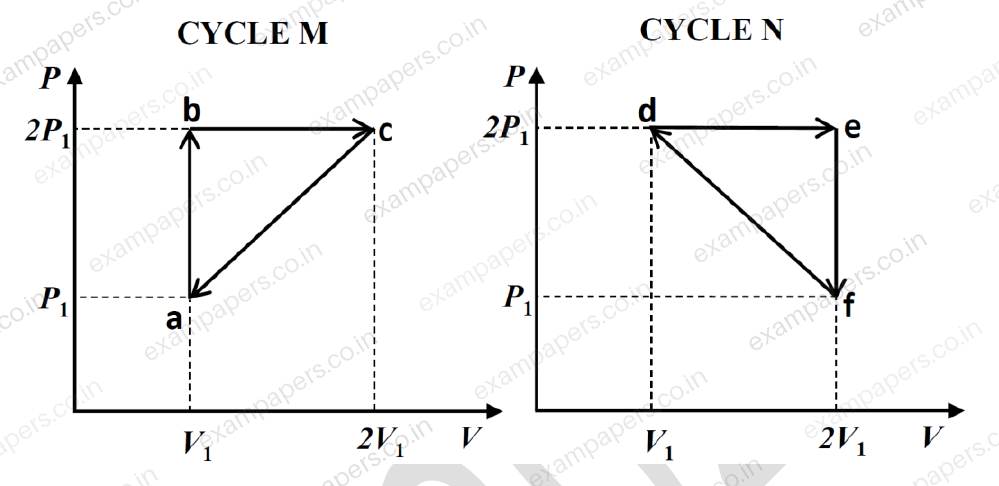
Your answerChoose one option.
Log in to check the answer
You can attempt this question now. Sign in to view the answer key, explanations and discussion.Log in to check answerQuestion 104
Open questionXE-ENAT2 marksNeeds review
An ideal gas undergoes a series of reversible steady state, steady flow processes between states 1, 2 and 3. Process 1→2 satisfies the relation
, where pressure, P is in kPa and specific volume, v is in m³/kg. Process 2→3 is isobaric. Given that
m³/kg,
m³/kg,
, the total work done per unit mass (in kJ/kg) in the series of processes 1→2→3 is ________ (rounded off to the nearest integer).Log in to check the answer
You can attempt this question now. Sign in to view the answer key, explanations and discussion.Log in to check answerQuestion 105
Open questionXE-ENAT2 marksNeeds review
Air (assumed as an ideal gas) with a mass flow rate of 2.5 kg/s enters a horizontal nozzle at 350 K, 350 kPa with a velocity of 3 m/s. The air exits the nozzle at a pressure of 101.5 kPa and temperature 305 K with a Mach number of
. Assuming steady state operation and constant properties given in the data, the ratio of inlet area to exit area required to satisfy the exit condition is ________ (rounded off to one decimal place).Use the following data:
,
kJ/kg.K,
kJ/kg.KLog in to check the answer
You can attempt this question now. Sign in to view the answer key, explanations and discussion.Log in to check answerQuestion 108
Open questionXE-ENAT2 marksNeeds review
A rigid insulated tank containing an ideal gas at 300 K and 1 bar is being filled from an external pressurized line supplying the same gas at 300 K and 10 bar. When the mass of gas inside the tank has doubled, its temperature (in K) is ________ (rounded off to the nearest integer).
Assume ratio of specific heats to be constant for this process and equal to 1.4.
Log in to check the answer
You can attempt this question now. Sign in to view the answer key, explanations and discussion.Log in to check answerQuestion 109
Open questionXE-ENAT2 marksNeeds review
A piston-cylinder system contains 2 kg of wet steam at 90 °C with quality of 0.1. The piston is loaded with a linear spring. The steam is heated to 800 kPa and 250 °C on heating. The work done (in kJ) in this process is ______ (rounded off to two decimal places).
Use the following data:
At 90 °C:
kPa,
m³/kg,
m³/kgAt 250 °C and 800 kPa:
m³/kgLog in to check the answer
You can attempt this question now. Sign in to view the answer key, explanations and discussion.Log in to check answerQuestion 101
Open questionXE-ENAT2 marksNeeds review
A piston-cylinder device initially contains 1 m
of air at 200 kPa and 25 °C. Air expands at constant pressure while a heater of 250 W is switched on for 10 minutes. There is a heat loss of 4 kJ during this process. Assuming air as an ideal gas, the final temperature of air is ______ °C (rounded off to one decimal place).Use the following data for air:
kJ/kg-K,
kJ/kg-KLog in to check the answer
You can attempt this question now. Sign in to view the answer key, explanations and discussion.Log in to check answerQuestion 102
Open questionXE-ENAT2 marksNeeds review
Steam at 2 MPa and 300 °C steadily enters a nozzle of inlet diameter of 20 cm. Steam leaves the nozzle with a velocity of 300 m/s. The mass flow rate of steam through the nozzle is 10 kg/s. Assume no work interaction and no change in potential energy. If the heat loss from the nozzle per kg of steam is 3 kJ, the exit enthalpy per kg of steam is ______ kJ (rounded off to nearest integer).
Use the following data for steam:
At 2 MPa and 300 °C:
m
/kg,
kJ/kgLog in to check the answer
You can attempt this question now. Sign in to view the answer key, explanations and discussion.Log in to check answerQuestion 93
Open questionXE-ENAT1 markNeeds review
Air in a closed system undergoes a thermodynamic process from an initial temperature of 300 K to the final temperature of 400 K. The specific heat of air at constant volume,
varies linearly with the temperature,
(in K) as
Change in the specific internal energy of the air in the system is ______ kJ/kg (round off to 2 decimal places).
Log in to check the answer
You can attempt this question now. Sign in to view the answer key, explanations and discussion.Log in to check answerQuestion 103
Open questionXE-ENAT2 marksNeeds review
An insulated rigid tank of volume 10 m³ contains air initially at 1 MPa and 600 K. A valve connected to the tank is opened, and air is allowed to escape until the temperature inside the tank drops to 400 K. The temperature of the discharged air can be approximated as the average of the initial and final temperatures of the air in the tank. Neglect kinetic and potential energies of the discharged air. Assume that air behaves as an ideal gas with constant specific heat so that internal energy
and enthalpy
. Then, the final pressure of the air in the tank is ______ MPa (round off to 2 decimal places).Assume
kJ/(kg K),
Log in to check the answer
You can attempt this question now. Sign in to view the answer key, explanations and discussion.Log in to check answer