
Engineering Sciences
GATE XE topic:first-law-thermodynamics PYQs
Build your understanding with focused practice from past exam papers.
Questions 31–38 of 38. Imported answers require independent review unless marked reviewed.
Question 8
Open questionXE-ENAT1 markNeeds review
A spring, having a spring constant of 350 kN/m, is initially compressed by 0.4 cm. The work required (in J) to compress it by another 0.6 cm (up to 1 decimal place) is ________.
Log in to check the answer
You can attempt this question now. Sign in to view the answer key, explanations and discussion.Log in to check answerQuestion 16
Open questionXE-ENAT2 marksNeeds review
A rigid insulated vessel is divided into two compartments by a partition. One compartment contains 12 kg of oxygen at 200 kPa and 280 K. The other compartment contains 26 kg of carbon dioxide at 400 kPa and 360 K. The specific heats at constant volume in kJ/kg.K for oxygen and carbon dioxide are 0.662 and 0.653, respectively. The partition is removed and the gases are allowed to mix. Considering both gases are ideal, the final temperature (in K) of the mixture (up to 1 decimal place) is ________.
Log in to check the answer
You can attempt this question now. Sign in to view the answer key, explanations and discussion.Log in to check answerQuestion 18
Open questionXE-ENAT2 marksNeeds review
Air at 150 kPa and 323 K is filled in a rigid vessel of 0.05 m
capacity. For air, assumed as an ideal gas, specific heat at constant volume is 0.7163 kJ/kg.K and the specific gas constant is 0.287 kJ/kg.K. Neglect kinetic and potential energy changes. If 30 kJ of heat is added, the final temperature (in K) of air (up to 1 decimal place) is __________.Log in to check the answer
You can attempt this question now. Sign in to view the answer key, explanations and discussion.Log in to check answerQuestion 19
Open questionXE-ENAT2 marksNeeds review
Superheated steam at 2 bar and 300 °C, with an enthalpy of 3072.1 kJ/kg, enters a horizontal adiabatic nozzle with negligible velocity and leaves at 0.2 bar as saturated vapour with an enthalpy of 2609.9 kJ/kg. Assuming steady flow and neglecting the potential energy changes, the exit velocity (in m/s) of the steam (up to 1 decimal place) is __________.
Log in to check the answer
You can attempt this question now. Sign in to view the answer key, explanations and discussion.Log in to check answerQuestion 79
Open questionXE-EMCQ1 markNeeds review
A paddle wheel is installed in a rigid insulated tank containing 10 kg air (
kJ/kg.K). A torque of 100 N.m is applied on the paddle wheel to rotate it at 60 revolutions per minute for 2 minutes. At the end of the process, the increase in temperature of air in °C isYour answerChoose one option.
Log in to check the answer
You can attempt this question now. Sign in to view the answer key, explanations and discussion.Log in to check answerQuestion 80
Open questionXE-EMCQ1 markNeeds review
Consider two systems each containing 20 kg of air at the same temperature and pressure. It is desired to increase the temperature of the air in both systems by 10°C. One system undergoes a constant pressure heat addition process and the other undergoes a constant volume heat addition. The difference in the values of heat transferred to the two systems in kJ is
Your answerChoose one option.
Log in to check the answer
You can attempt this question now. Sign in to view the answer key, explanations and discussion.Log in to check answerQuestion 89
Open questionXE-ENAT2 marksNeeds review
Two streams of air (
J/kg.K) flow through insulated pipes 1 and 2 with the conditions as shown in figure. They mix in an insulated pipe-3 and the mixture steadily exits with a velocity of 100 m/s at 150 kPa. Neglecting the change in potential energy in all the pipes, the exit area of the pipe-3 in m² (up to 3 decimal places) is ________. 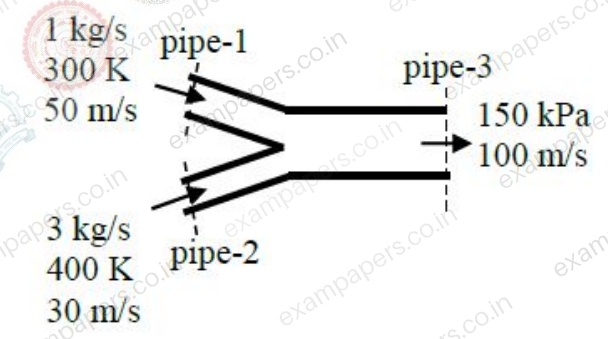
Log in to check the answer
You can attempt this question now. Sign in to view the answer key, explanations and discussion.Log in to check answerQuestion 90
Open questionXE-ENAT2 marksNeeds review
A 1 m³ rigid vessel contains air at 200 kPa. A vacuum pump is connected to the vessel in order to control the pressure inside. The volume flow rate of air through the pump is maintained at a constant value of 0.1 m³/s. If the pump operates for 10 seconds and the temperature of the air is maintained constant during operation, the pressure in the tank in kPa after 10 seconds (up to 2 decimal places) is ________.
Log in to check the answer
You can attempt this question now. Sign in to view the answer key, explanations and discussion.Log in to check answer