
Engineering Sciences
GATE XE topic:mechanics-rigid-bodies PYQs
Build your understanding with focused practice from past exam papers.
Questions 11–20 of 72. Imported answers require independent review unless marked reviewed.
Question 77
Open questionXE-DMCQ2 marksNeeds review
The figure shows a rod PQ, hinged at P, rotating counter-clockwise with a uniform angular speed of 15 rad/s. A block R translates along a slot cut in rod PQ. At the instant shown the distance PR = 0.5 m and
. The relative velocity of R with respect to the rod PQ is 5 m/s at the instant shown. The relative acceleration of R with respect to the rod PQ is zero at the instant shown.Which one of the following is the CORRECT magnitude of the absolute acceleration (in m/s
) of block R? 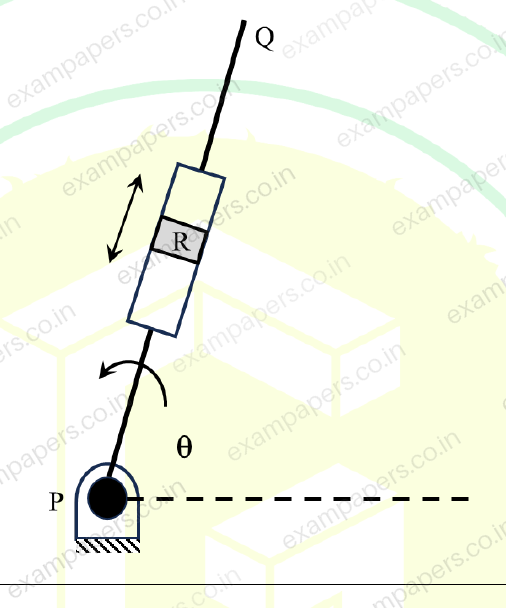
Your answerChoose one option.
Log in to check the answer
You can attempt this question now. Sign in to view the answer key, explanations and discussion.Log in to check answerQuestion 78
Open questionXE-DMCQ2 marksNeeds review
The frame shown in the figure is loaded at S with a force of 2000 N. The reactions at T are denoted by T
and T
, while the reaction at W is W
. Neglect the weight of the members.Which one of the following options for the magnitudes of the forces (in N), T
, T
and W
, is CORRECT? 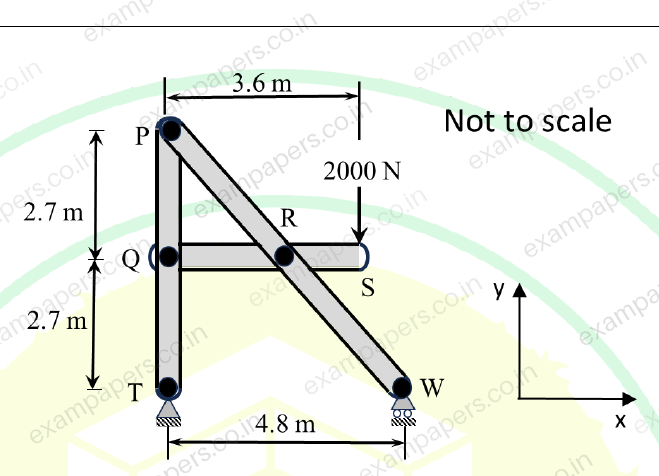
Your answerChoose one option.
Log in to check the answer
You can attempt this question now. Sign in to view the answer key, explanations and discussion.Log in to check answerQuestion 86
Open questionXE-DNAT2 marksNeeds review
An electric motor’s rotor is spinning at 1500 rpm when its load and power are cut-off. The rotor which has a mass of 50 kg and a radius of gyration of 200 mm, then coasts down to rest. Due to kinetic friction, a constant torque of 10 Nm acts on the rotor as it coasts down. The number of revolutions executed by the rotor before it comes to rest is ____ (in integer).
Log in to check the answer
You can attempt this question now. Sign in to view the answer key, explanations and discussion.Log in to check answerQuestion 67
Open questionXE-DMCQ1 markNeeds review
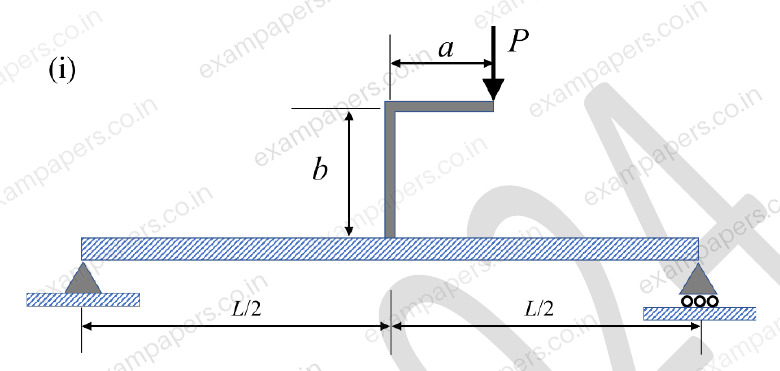
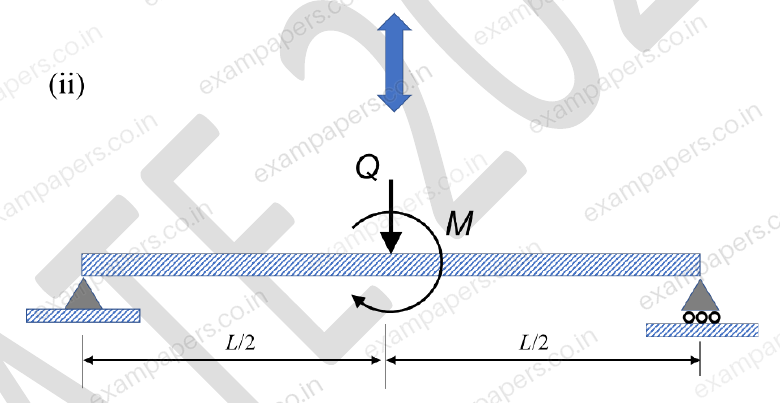
An L-shaped rigid member is fixed at the midpoint of a simply-supported beam, as shown in figure (i). The member is subjected to a vertically downward force P at its free end. In an equivalent system, the member along with the applied load is replaced with a force Q = P and a moment M (see figure (ii)). Which of the following statements is correct?
(Negelect the mass of the beam and of the rigid member)
Your answerChoose one option.
Log in to check the answer
You can attempt this question now. Sign in to view the answer key, explanations and discussion.Log in to check answerQuestion 68
Open questionXE-DMCQ1 markNeeds review
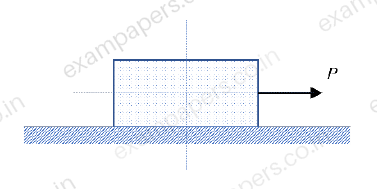
A block of weight W, placed on a surface, is subjected to a horizontal force P as shown in the figure. The line of action of force P passes through the center-of-gravity of the block. The magnitude of P is such that the block remains at rest. If N is the resultant normal reaction exerted by the surface, and F is the frictional force acting on the bottom surface of the block, then which of the following represents the correct free body diagram of the block?
Your answerChoose one option.
Log in to check the answer
You can attempt this question now. Sign in to view the answer key, explanations and discussion.Log in to check answerQuestion 71
Open questionXE-DMCQ1 markNeeds review
An ice-skater starts spinning during her performance. As she retracts her arms and legs closer to her body, her angular velocity ____________________.
Your answerChoose one option.
Log in to check the answer
You can attempt this question now. Sign in to view the answer key, explanations and discussion.Log in to check answerQuestion 74
Open questionXE-DNAT1 markNeeds review
A particle of mass 1 kg is attached to one end of a spring having stiffness of 125 N/m. The free length of the spring is 100 mm. The system is rotated about the other end of the spring at a uniform angular velocity of 5 rad/s. Ignore gravity and consider that the elongation of the spring may be comparable to the free length of the spring. The elongation of the spring (in mm, rounded off to the nearest integer) is _____ .
Log in to check the answer
You can attempt this question now. Sign in to view the answer key, explanations and discussion.Log in to check answerQuestion 77
Open questionXE-DMCQ2 marksNeeds review
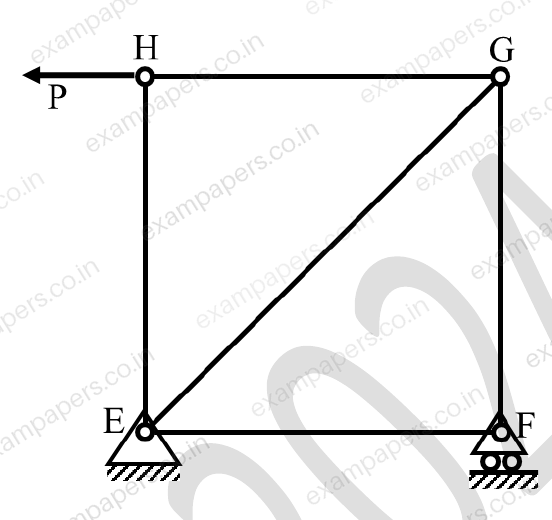
A pin-jointed truss has a pin support at the point E and a roller support at the point F. A horizontal force P is applied at pin H as shown in the figure. Which one of the members is in compression?
Your answerChoose one option.
Log in to check the answer
You can attempt this question now. Sign in to view the answer key, explanations and discussion.Log in to check answerQuestion 78
Open questionXE-DMCQ2 marksNeeds review
Two identical rigid slender bars of length
and mass
are acted upon by a transverse force F at one of the ends as shown in the figure. In the first case, the bar is pinned at the other end. In the second case, the bar is pinned at its mid-point. What should be the magnitude of the force F such that the resulting angular accelerations of the two bars are equal? 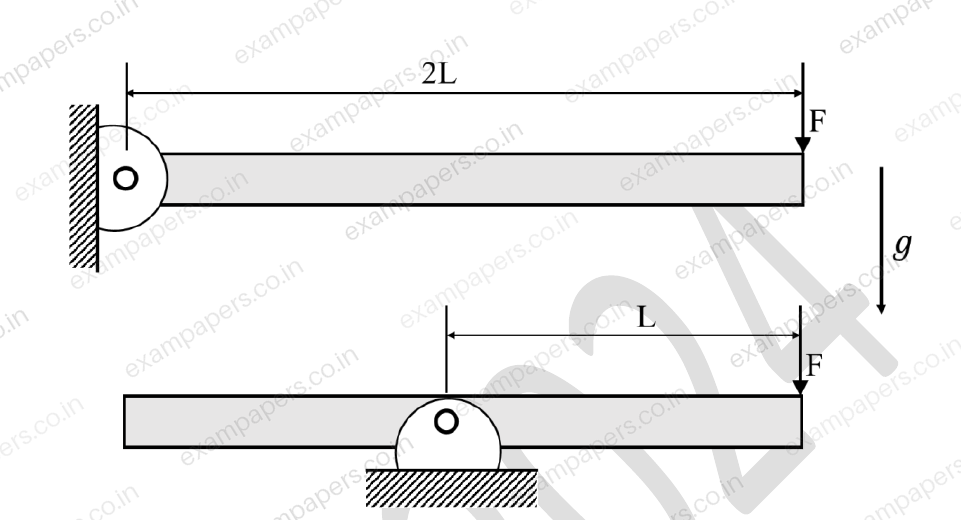
Your answerChoose one option.
Log in to check the answer
You can attempt this question now. Sign in to view the answer key, explanations and discussion.Log in to check answerQuestion 85
Open questionXE-DNAT2 marksNeeds review
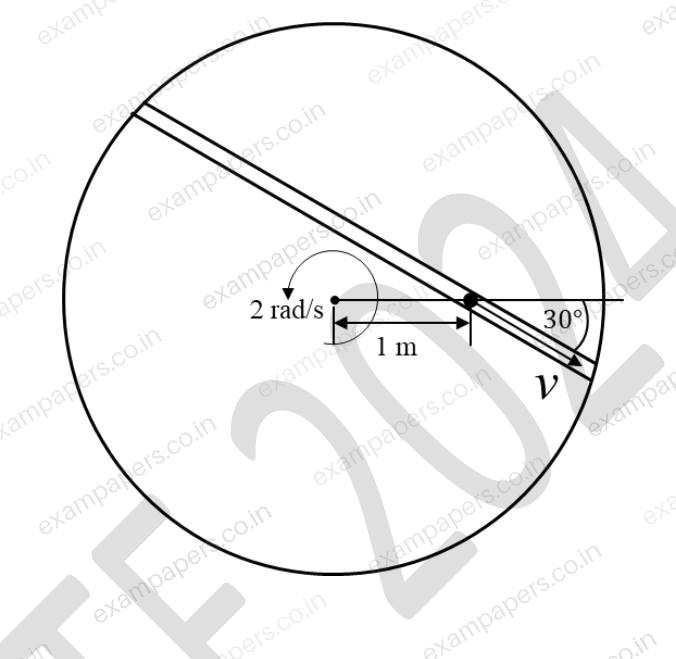
A turn-table is rotating about its center with an angular velocity of 2 rad/s in the counter-clockwise direction. There is a groove in the turn-table within which a marble moves with a constant speed
m/s relative to the turn-table. At a given instant, the marble is at a radial distance of 1 m from the center and the line joining the center of the turn-table with the marble makes an angle of 30° with the groove. The value of
(in m/s, rounded off to one decimal place) for which there is no radial acceleration for the marble at this instant is _____.
Log in to check the answer
You can attempt this question now. Sign in to view the answer key, explanations and discussion.Log in to check answer