
Engineering Sciences
GATE XE topic:polymer-rheology PYQs
Build your understanding with focused practice from past exam papers.
Questions 11–20 of 27. Imported answers require independent review unless marked reviewed.
Question 11
Open questionXE-FMCQ2 marksNeeds review
Match the polymer processing operation with respect to its typical range of shear rate.
Processing Operation | Shear rate (s⁻¹) |
|---|---|
P. Compression Moulding | 1. 1000 - 10000 |
Q. Extrusion | 2. 100 - 1000 |
R. Calendering | 3. 1 - 10 |
S. Injection Moulding | 4. 10 - 100 |
Your answerChoose one option.
Log in to check the answer
You can attempt this question now. Sign in to view the answer key, explanations and discussion.Log in to check answerQuestion 12
Open questionXE-FMCQ2 marksNeeds review
Shear stress (
) and shear viscosity (
) are plotted as functions of the shear rate,
, for idealized “solid-like with yielding (1)” and “liquid-like (2)” materials.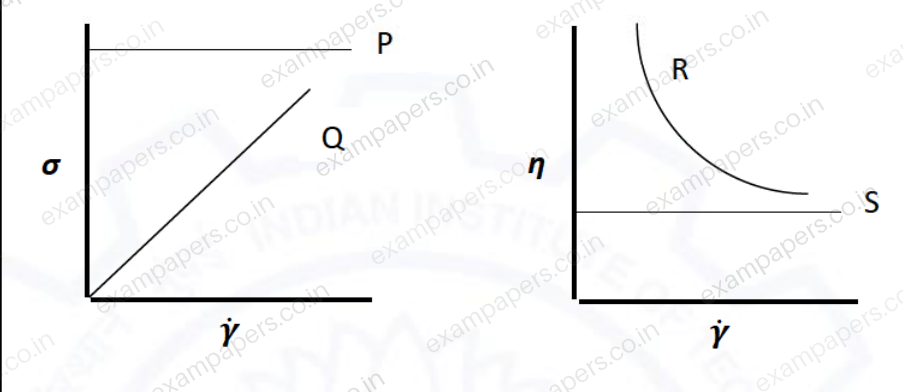
Associate the shear stress and viscosity plots with the appropriate material responses.
Your answerChoose one option.
Log in to check the answer
You can attempt this question now. Sign in to view the answer key, explanations and discussion.Log in to check answerQuestion 13
Open questionXE-FNAT2 marksNeeds review
The plateau modulus of polystyrene has a value of 0.2 × 10⁶ Pa at 150 °C. Given, the density of polystyrene is 1.05 g/cm³, the universal gas constant,
= 8.3 J K⁻¹ mol⁻¹, and the monomer molecular weight is 104 g/mol. The molecular weight between entanglements (rounded off to the nearest integer) of polystyrene chains is ______ g/mol.Log in to check the answer
You can attempt this question now. Sign in to view the answer key, explanations and discussion.Log in to check answerQuestion 16
Open questionXE-FNAT2 marksNeeds review
At 215 °C, the viscosity of a polystyrene of molecular weight 250 × 10³ g/mol is 8.0 × 10³ Pa s. The critical molecular weight of polystyrene,
= 35 × 10³ g/mol. For a similar polystyrene of molecular weight 500 × 10³ g/mol, the viscosity (rounded off to nearest integer) will be ______ × 10³ Pa s.Log in to check the answer
You can attempt this question now. Sign in to view the answer key, explanations and discussion.Log in to check answerQuestion 18
Open questionXE-FNAT2 marksNeeds review
The behavior of a polymer is described by a Maxwell model consisting of a spring element of modulus 10¹⁰ Pa in series with a dashpot of viscosity 10¹² Pa s. In the solid, 50 s after the sudden application of a fixed strain of 1%, the stress (rounded off to 2 decimal places) will be ______ × 10⁷ Pa.
Log in to check the answer
You can attempt this question now. Sign in to view the answer key, explanations and discussion.Log in to check answerQuestion 9
Open questionXE-FMCQ1 markNeeds review
The change in stress of a polymer as a function of time at a fixed strain is known as
Your answerChoose one option.
Log in to check the answer
You can attempt this question now. Sign in to view the answer key, explanations and discussion.Log in to check answerQuestion 14
Open questionXE-FMCQ2 marksNeeds review
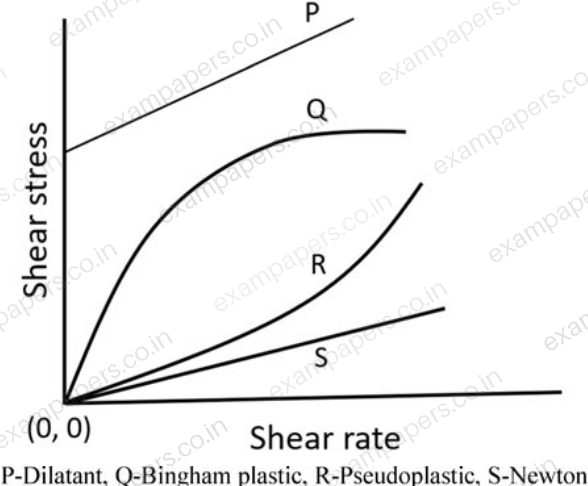
Plot of shear stress against shear rate for various types of fluids is given below. The appropriate assignment for P, Q, R and S is
Your answerChoose one option.
Log in to check the answer
You can attempt this question now. Sign in to view the answer key, explanations and discussion.Log in to check answerQuestion 19
Open questionXE-FNAT2 marksNeeds review
A polymer solution flows through a cylindrical tube with a diameter of 4 mm at a volumetric flow rate of 10⁻⁹ m³ s⁻¹. Under laminar flow condition and assuming the polymer solution to be a Newtonian fluid with viscosity 10² N s m⁻², the value of pressure drop per unit length of the tube in N m⁻³ is ______ (round off to nearest integer). [Consider the value of π as 3.14]
Log in to check the answer
You can attempt this question now. Sign in to view the answer key, explanations and discussion.Log in to check answerQuestion 16
Open questionXE-FNAT2 marksNeeds review
A linear amorphous polymer has a T_g of +10 °C. At 28 °C, it has a melt viscosity of 4 × 10⁸ poise. The viscosity of the polymer at its T_g is ______ × 10¹³ poise (round off to one decimal place).
Log in to check the answer
You can attempt this question now. Sign in to view the answer key, explanations and discussion.Log in to check answerQuestion 19
Open questionXE-FNAT2 marksNeeds review
A 3 mm thick layer of softened poly(methyl methacrylate) at 190 °C is sandwiched between two flat parallel plates. A shear stress of 100 kPa is applied to the softened polymer. Assuming the softened polymer as a Newtonian fluid with an apparent viscosity of 3.9 × 10⁴ Pa s, the relative sliding velocity between the two plates is ____ mm s⁻¹ (round off to one decimal place).
Log in to check the answer
You can attempt this question now. Sign in to view the answer key, explanations and discussion.Log in to check answer