
Engineering Sciences
GATE XE topic:second-law-thermodynamics PYQs
Build your understanding with focused practice from past exam papers.
How to practice topic:second-law-thermodynamics
Attempt a question, record the concept and assumptions, then check the available answer. Rework mistakes after revising the relevant concepts. Topic tags can overlap; review the question context.
Questions 1–10 of 43. Imported answers require independent review unless marked reviewed.
Question 95
Open questionXE-ENAT1 markNeeds review
A house looses heat at a rate of 150 MJ per hour. The temperature outside the house is −3 °C. The minimum power (in kW) required to maintain the temperature inside the house at 25 °C using a heat pump is ____________ (rounded off to two decimal places).
Log in to check the answer
You can attempt this question now. Sign in to view the answer key, explanations and discussion.Log in to check answerQuestion 98
Open questionXE-EMCQ2 marksNeeds review
M kg of a liquid at a temperature
is mixed with M kg of the same liquid at another temperature
in an isolated tank at constant pressure. The mass specific heat capacity at constant pressure of the liquid is
, which is a constant. The total entropy change in the process isYour answerChoose one option.
Log in to check the answer
You can attempt this question now. Sign in to view the answer key, explanations and discussion.Log in to check answerQuestion 106
Open questionXE-ENAT2 marksNeeds review
A rigid spherical solid ball at 100 °C is cooled slowly to 200 °C in a surrounding air at 25 °C. The density, specific heat capacity, and diameter of the ball are 800 kg/m³, 500 J/kg-K, and 10 mm; respectively. Assuming that the cooling process is quasi-equilibrium, the entropy generated (in J/K) in the process is ____________ (rounded off to two decimal places).
Log in to check the answer
You can attempt this question now. Sign in to view the answer key, explanations and discussion.Log in to check answerQuestion 91
Open questionXE-EMCQ1 markNeeds review
The inlet and outlet temperatures of the flowing fluid during a steady state flow process are the same as that of the surroundings. If the changes in kinetic and potential energies are neglected, the maximum power that can be obtained is equal to
Your answerChoose one option.
Log in to check the answer
You can attempt this question now. Sign in to view the answer key, explanations and discussion.Log in to check answerQuestion 93
Open questionXE-EMCQ1 markNeeds review
Let
and
denote the absolute temperatures of high and low temperature reservoirs, respectively. The coefficient of performance of a reversible refrigerator operating between these two reservoirs isYour answerChoose one option.
Log in to check the answer
You can attempt this question now. Sign in to view the answer key, explanations and discussion.Log in to check answerQuestion 95
Open questionXE-ENAT1 markNeeds review
A heat engine having thermal efficiency of 40% receives heat from a source at 600 K and rejects heat to a sink at 300 K. The second-law efficiency (in %) of this engine is __________ (answer in integer).
Log in to check the answer
You can attempt this question now. Sign in to view the answer key, explanations and discussion.Log in to check answerQuestion 105
Open questionXE-ENAT2 marksNeeds review
Air enters a air dryer at 22 °C and 100 kPa with a velocity of 3.7 m/s, and leaves the dryer at 83 °C and 100 kPa with a velocity of 9.1 m/s. The exit area of the dryer is 18.7 cm
, and the ambient temperature is 22 °C. The air is an ideal gas with gas constant
= 0.287 kJ/kg-K and isobaric specific heat
= 1.005 kJ/kg-K. If the change in potential energy is neglected, the second law efficiency (in %) of the dryer is __________ (rounded off to one decimal place).Log in to check the answer
You can attempt this question now. Sign in to view the answer key, explanations and discussion.Log in to check answerQuestion 107
Open questionXE-ENAT2 marksNeeds review
Two Carnot heat engines (E1 and E2) are operating in series as shown in figure. Engine E1 receives heat from a reservoir at
K and does work
. Engine E2 receives heat from an intermediate reservoir at
, does work
and rejects the rest to a reservoir at
K. Both the engines have identical thermal efficiencies.
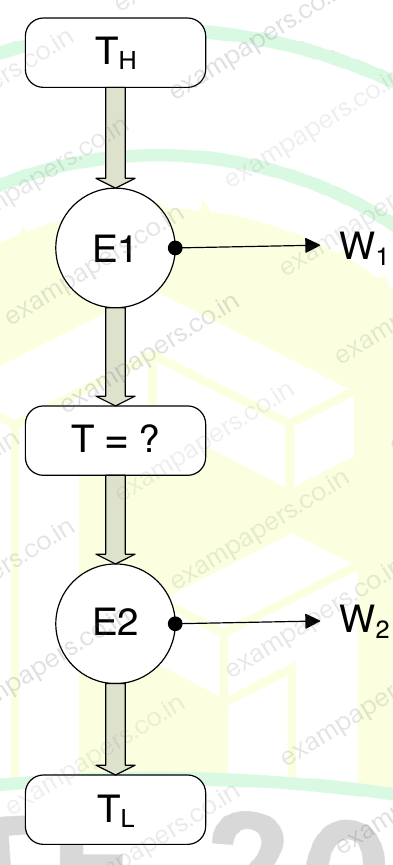
The temperature T (in K) of the intermediate reservoir is __________ (answer in integer).
Log in to check the answer
You can attempt this question now. Sign in to view the answer key, explanations and discussion.Log in to check answerQuestion 109
Open questionXE-ENAT2 marksNeeds review
In a piston cylinder assembly, one kmol of an ideal gas is compressed from an initial state of 200 kPa and 400 K to a final state of 1 MPa and 400 K. If the surroundings are at 400 K, the minimum amount of work (in kJ/kmol) required for the compression process is __________ (rounded off to two decimal places).
Use: Universal gas constant (
) = 8.314 kJ/kmol-KLog in to check the answer
You can attempt this question now. Sign in to view the answer key, explanations and discussion.Log in to check answerQuestion 88
Open questionXE-EMCQ1 markNeeds review
A heat source at temperature
transfers the same amount of heat to a sink under the following situations:Case A: Sink is at temperature
Case B: Sink is at temperature
If
, which one of the following statements is TRUE?Your answerChoose one option.
Log in to check the answer
You can attempt this question now. Sign in to view the answer key, explanations and discussion.Log in to check answer