
Engineering Sciences
GATE XE topic:second-law-thermodynamics PYQs
Build your understanding with focused practice from past exam papers.
Questions 21–30 of 43. Imported answers require independent review unless marked reviewed.
Question 104
Open questionXE-ENAT2 marksNeeds review
Steam enters a steam turbine at 5 MPa and 600 °C and exits as saturated vapor at 50 kPa. Under steady state condition, the turbine loses heat to the surroundings at the rate of 50 kJ per kilogram of steam flow through the turbine. The ambient temperature is 300 K, and the heat transfer to the surroundings takes place at the outer surface of the turbine at a temperature of 450 K. The irreversibility per unit mass of steam flowing through the turbine is ______ kJ/kg (round off to 2 decimal places).
Neglect the change in kinetic and potential energies of the steam, and use the following property values:
Superheated steam at 5 MPa, 600 °C
m³/kg,
kJ/kg,
kJ/kg,
kJ/(kg K)Saturated vapour at 50 kPa
m³/kg,
kJ/kg,
kJ/kg,
kJ/(kg K)Log in to check the answer
You can attempt this question now. Sign in to view the answer key, explanations and discussion.Log in to check answerQuestion 105
Open questionXE-ENAT2 marksNeeds review
A heat engine receives heat at 1000 K and rejects heat to the environment at 300 K. The efficiency of the heat engine is half of the efficiency of a Carnot engine operating between the above mentioned temperature limits. The work output from the heat engine is completely used to drive a refrigerator that steadily removes heat from a cold space at 260 K at a rate of 5.2 kW, and rejects the heat to the same environment at 300 K. The COP (coefficient of performance) of the refrigerator is half of the COP of the Carnot refrigerator operating between the same temperature limits as that of the refrigerator. Then, rate of heat supplied to the heat engine is ______ kW (round off to 2 decimal places).
Log in to check the answer
You can attempt this question now. Sign in to view the answer key, explanations and discussion.Log in to check answerQuestion 109
Open questionXE-ENAT2 marksNeeds review
Steam enters a steam turbine at 10 MPa and 600 °C with a mass flow rate of 16 kg/s. The steam exits the turbine as saturated vapor at 10 kPa. Under steady state condition, the turbine generates 16.2 MW power. If the ambient temperature is 25 °C, the rate of entropy generation in the turbine is ______ kW/K (round off to 2 decimal places).
Neglect the change in kinetic and potential energies of the steam, and use the following property values:
Superheated steam at 10 MPa, 600 °C
m³/kg,
kJ/kg,
kJ/kg,
kJ/(kg K)Saturated vapour at 10 kPa
m³/kg,
kJ/kg,
kJ/kg,
kJ/(kg K)Log in to check the answer
You can attempt this question now. Sign in to view the answer key, explanations and discussion.Log in to check answerQuestion 12
Open questionXE-EMCQ2 marksNeeds review
Two identical pressure cookers, Cooker A and Cooker B, each having a total internal capacity of 6 litres are available. Cooker A is filled with 2 litres of liquid water at 110°C and Cooker B is filled with 4 litres of liquid water at 110°C. The remaining space in both the cookers is filled with saturated water vapour in equilibrium with the liquid water. If
represents the specific Gibbs free energy, and subscripts
and
represent the saturated vapour and the saturated liquid phases, respectively, which of the following expressions is correct? 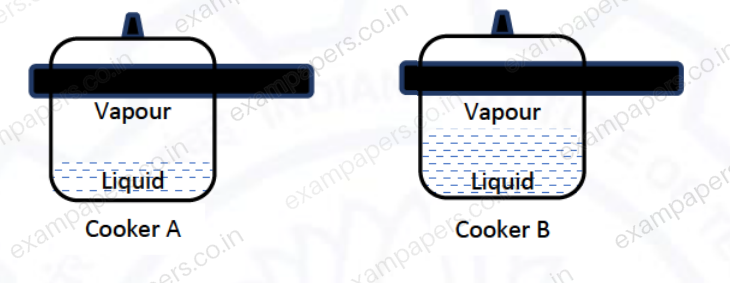
Your answerChoose one option.
Log in to check the answer
You can attempt this question now. Sign in to view the answer key, explanations and discussion.Log in to check answerQuestion 20
Open questionXE-ENAT2 marksNeeds review
A 0.8 m³ insulated rigid tank contains 1.5 kg of an ideal gas at 100 kPa. Electric work is done on the system until the pressure in the tank rises to 135 kPa. The loss in availability (exergy) associated with the process is __________ kJ (2 decimal places).
For the ideal gas, the characteristic gas constant is 188.9 J/(kg K) and the specific heat capacity at constant volume is 680 J/(kg K). The temperature of the dead state is 298 K.
Log in to check the answer
You can attempt this question now. Sign in to view the answer key, explanations and discussion.Log in to check answerQuestion 8
Open questionXE-ENAT1 markNeeds review
The rate of heat received by a heat engine from a source at 900 K is 600 kJ/s. The engine rejects heat to the sink of 300 K. The heat engine produces a power of 200 kW. The irreversibility rate (in kW) of the process is ________.
Log in to check the answer
You can attempt this question now. Sign in to view the answer key, explanations and discussion.Log in to check answerQuestion 10
Open questionXE-EMCQ2 marksNeeds review
A system with rigid wall is initially at a temperature of
. It is used as the heat source for a heat engine, which rejects heat to a reservoir maintained at
(
). The specific heats of the system are constant. If the temperature of the system finally reduces to
, then the maximum work recoverable from the heat engine per unit mass of the system isYour answerChoose one option.
Log in to check the answer
You can attempt this question now. Sign in to view the answer key, explanations and discussion.Log in to check answerQuestion 11
Open questionXE-EMCQ2 marksNeeds review
A reversible heat engine is operating between two reservoirs maintained at
and
, where
. Which one of the following is the most effective option for increasing its thermal efficiency?Your answerChoose one option.
Log in to check the answer
You can attempt this question now. Sign in to view the answer key, explanations and discussion.Log in to check answerQuestion 13
Open questionXE-EMCQ2 marksNeeds review
Air at a pressure of 86 kPa and specific volume of 1 m
/kg is heated at constant pressure till it reaches 627 °C. Air is assumed to be an ideal gas with constant specific heats. It has the gas constant of 0.287 kJ/kg.K and ratio of specific heats of 1.4. The change in specific entropy of air (in kJ/kg.K) during this process will beYour answerChoose one option.
Log in to check the answer
You can attempt this question now. Sign in to view the answer key, explanations and discussion.Log in to check answerQuestion 8
Open questionXE-ENAT1 markNeeds review
A Carnot engine receives 200 kJ heat from a source at 1200 K and rejects 500 kJ heat to sink. The sink temperature (K) is ________.
Log in to check the answer
You can attempt this question now. Sign in to view the answer key, explanations and discussion.Log in to check answer