
Engineering Sciences
GATE XE year:2021 PYQs
Build your understanding with focused practice from past exam papers.
Questions 51–60 of 175. Imported answers require independent review unless marked reviewed.
Question 8
Open questionXE-CMSQ1 markNeeds review
A metal has a melting point of 600 °C. By rapid cooling, liquid metal can be made to solidify either at 500 °C or 400 °C or 300 °C. Critical size of the solid nuclei is
Your answerSelect all correct options. You can choose more than one.
Log in to check the answer
You can attempt this question now. Sign in to view the answer key, explanations and discussion.Log in to check answerQuestion 9
Open questionXE-CNAT1 markNeeds review
A magnet of mass 50 g has a magnetic moment of 4.2 × 10⁻⁷ A m². The density of the magnet is 7.2 g cm⁻³. The intensity of magnetization in A m⁻¹ is ________ (round off to 3 decimal places)
Log in to check the answer
You can attempt this question now. Sign in to view the answer key, explanations and discussion.Log in to check answerQuestion 10
Open questionXE-CMCQ2 marksNeeds review
In the context of scanning electron microscopy, match the information in Column I with most appropriate information in Column II.
Column I
(P) Secondary electrons
(Q) Backscattered electrons
(R) Characteristic X-rays
(S) Diffracted backscattered electrons
Column II
(1) Crystallographic orientation of grains
(2) Failure analysis of fractured surfaces
(3) Chemical composition analysis
(4) Distinguishing chemically distinct phases
Your answerChoose one option.
Log in to check the answer
You can attempt this question now. Sign in to view the answer key, explanations and discussion.Log in to check answerQuestion 11
Open questionXE-CMCQ2 marksNeeds review
Match the heat treatment process given in Column I with the most suitable outcomes in Column II.
Column I
(P) Quenching
(Q) Annealing
(R) Tempering
(S) Carburizing
Column II
(1) hardens the steel
(2) softens the cold worked steel
(3) toughens the steel
(4) hardens the surface of steel
Your answerChoose one option.
Log in to check the answer
You can attempt this question now. Sign in to view the answer key, explanations and discussion.Log in to check answerQuestion 12
Open questionXE-CMCQ2 marksNeeds review
A co-joined cross-ply laminate composite, as shown in figure, is distorted upon heating. What are the resultant shapes of edges XY and YZ?
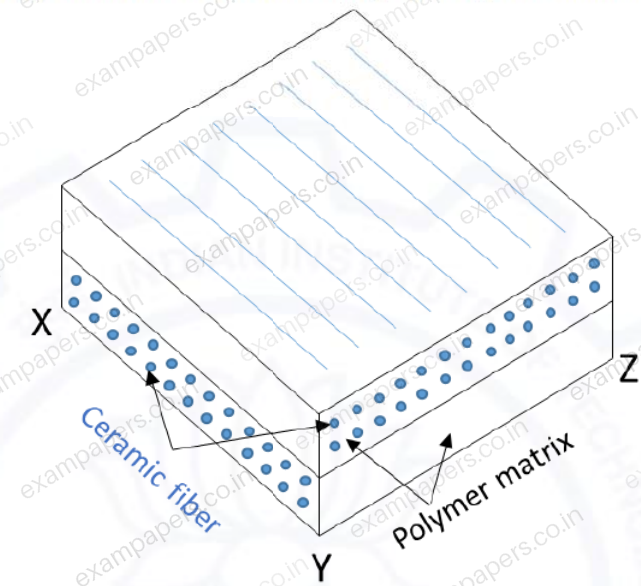
Your answerChoose one option.
Log in to check the answer
You can attempt this question now. Sign in to view the answer key, explanations and discussion.Log in to check answerQuestion 13
Open questionXE-CMSQ2 marksNeeds review
X-ray diffraction peak broadening enables the estimation of
Your answerSelect all correct options. You can choose more than one.
Log in to check the answer
You can attempt this question now. Sign in to view the answer key, explanations and discussion.Log in to check answerQuestion 14
Open questionXE-CNAT2 marksNeeds review
Fe - 10 atom % C austenite (fcc), having no Fe vacancies, has a lattice parameter of 4 Å. The density of austenite in g cm
is ________ (round off to 2 decimal places)(Given: atomic weight of Fe = 55.8; atomic weight of C = 12.0; Avogadro’s number = 6.023 × 10²³)
Log in to check the answer
You can attempt this question now. Sign in to view the answer key, explanations and discussion.Log in to check answerQuestion 15
Open questionXE-CNAT2 marksNeeds review
An element transforms from α to β at 773 K and 1 atm pressure with 912 J mol
as enthalpy of transformation. The molar volumes of α and β phases are 7.377 cm
and 7.317 cm
, respectively. Assume that the difference in molar volumes of α and β is independent of pressure. The pressure (in atm) required for α to β transformation to occur at 723 K is ________ (round off to nearest integer)(Given: 1 atm = 1.01325 × 10⁵ Pa)
Log in to check the answer
You can attempt this question now. Sign in to view the answer key, explanations and discussion.Log in to check answerQuestion 16
Open questionXE-CNAT2 marksNeeds review
A binary A-B alloy has α and β phases at equilibrium. The ratio of weight percentages (wt. %) of α to β is 4. The wt. % of A in α and β phases are 70 and 20, respectively. The wt. % of B in the alloy is ________ (round off to nearest integer)
Log in to check the answer
You can attempt this question now. Sign in to view the answer key, explanations and discussion.Log in to check answerQuestion 17
Open questionXE-CNAT2 marksNeeds review
During heating, Ti undergoes allotropic transformation from hcp to bcc at 882 °C. The percent volume change accompanying this transformation is ________ (round off to 1 decimal place)
(Given: atomic weight of Ti = 47.9; lattice parameter of bcc Ti = 0.332 nm; density of hcp Ti = 4.51 g cm
; Avogadro’s number = 6.023 × 10²³)Log in to check the answer
You can attempt this question now. Sign in to view the answer key, explanations and discussion.Log in to check answer