
Engineering Sciences
GATE XE year:2023 PYQs
Build your understanding with focused practice from past exam papers.
Questions 41–50 of 175. Imported answers require independent review unless marked reviewed.
Question 41
Open questionXE-BNAT2 marksNeeds review
Water flows around a thin flat plate (0.25 m long, 2 m wide) with a free stream velocity (
) of 1 m/s, as shown in the figure. Consider linear velocity profile
for which the laminar boundary layer thickness is expressed as
. For water, density = 1000 kg/m
and dynamic viscosity = 0.001 kg/m.s. Net drag force (in N, rounded off to two decimal places) acting on the plate, neglecting the end effects, is ______. 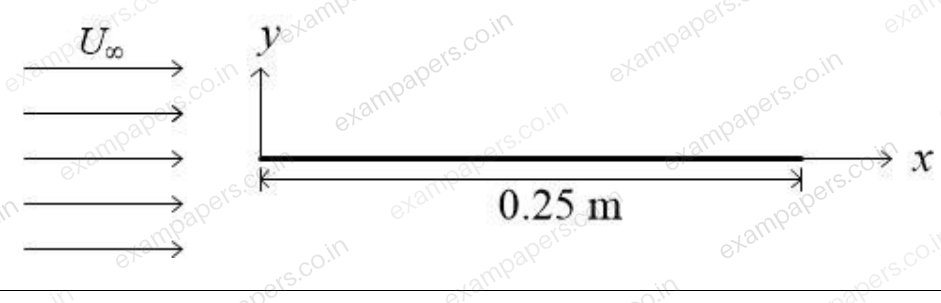
Log in to check the answer
You can attempt this question now. Sign in to view the answer key, explanations and discussion.Log in to check answerQuestion 42
Open questionXE-BNAT2 marksNeeds review
Axial velocity profile
for an axisymmetric flow through a circular tube of radius
is given as,
where
is the center velocity. If
refers to the area-averaged velocity (volume flow rate per unit area), then the ratio
for
(rounded off to two decimal places) is ______________.Log in to check the answer
You can attempt this question now. Sign in to view the answer key, explanations and discussion.Log in to check answerQuestion 43
Open questionXE-BNAT2 marksNeeds review
A stationary circular pipe of radius
m is half filled with water (density = 1000 kg/m
), whereas the upper half is filled with air at atmospheric pressure, as shown in the figure. Acceleration due to gravity is
m/s
. The magnitude of the force per unit length (in kN/m, rounded off to one decimal place) applied by water on the pipe section AB is ______. 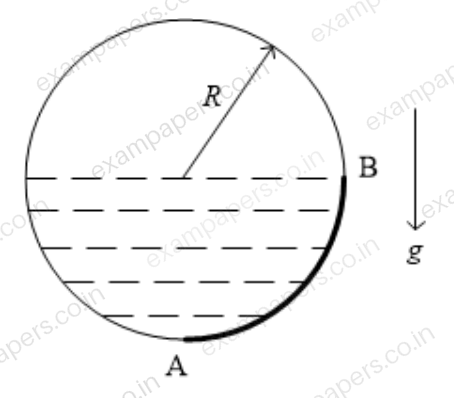
Log in to check the answer
You can attempt this question now. Sign in to view the answer key, explanations and discussion.Log in to check answerQuestion 44
Open questionXE-CMCQ1 markNeeds review
In age-hardening of an aluminium alloy, the purpose of solution treatment followed by quenching is to
Your answerChoose one option.
Log in to check the answer
You can attempt this question now. Sign in to view the answer key, explanations and discussion.Log in to check answerQuestion 45
Open questionXE-CMCQ1 markNeeds review
The magnetization (M) – magnetic field (H) curves for four different materials are given below. Which one of these materials is most suitable for use as a permanent magnet?
Your answerChoose one option.
Log in to check the answer
You can attempt this question now. Sign in to view the answer key, explanations and discussion.Log in to check answerQuestion 46
Open questionXE-CMCQ1 markNeeds review
The band gap of a semiconducting material is ∼ 2 eV. Which one of the following absorption (A) vs. energy (in eV) curves is correct?
Your answerChoose one option.
Log in to check the answer
You can attempt this question now. Sign in to view the answer key, explanations and discussion.Log in to check answerQuestion 47
Open questionXE-CMCQ1 markNeeds review
Figures (i) and (ii) show a binary phase diagram and the corresponding Gibbs free energy (
) vs. composition (
) diagram, respectively. Figure (ii) corresponds to which one of the temperatures shown in Figure (i)? 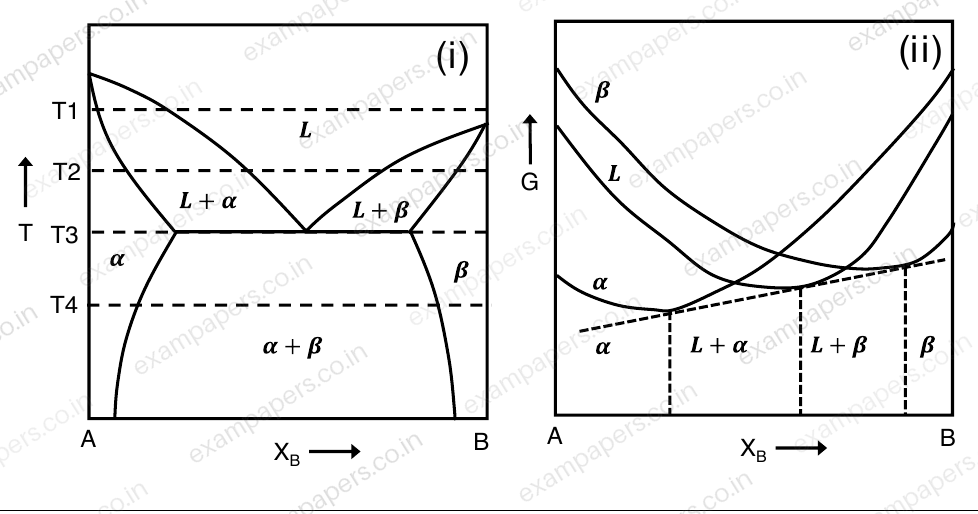
Your answerChoose one option.
Log in to check the answer
You can attempt this question now. Sign in to view the answer key, explanations and discussion.Log in to check answerQuestion 48
Open questionXE-CMCQ1 markNeeds review
Aliovalent doping of
in
leads to the formation of defects. Which one of the following is the correct defect reaction?Your answerChoose one option.
Log in to check the answer
You can attempt this question now. Sign in to view the answer key, explanations and discussion.Log in to check answerQuestion 49
Open questionXE-CMSQ1 markNeeds review
A screw dislocation in a FCC crystal has Burgers vector of
, where
is the lattice constant. The possible slip plane(s) is/are:Your answerSelect all correct options. You can choose more than one.
Log in to check the answer
You can attempt this question now. Sign in to view the answer key, explanations and discussion.Log in to check answerQuestion 50
Open questionXE-CNAT1 markNeeds review
The tensile true stress (
) – true strain (
) curve follows the Hollomon equation:
At the maximum load, the work-hardening rate
is (in MPa): ____________ (round off to nearest integer)Log in to check the answer
You can attempt this question now. Sign in to view the answer key, explanations and discussion.Log in to check answer