
Life Sciences
GATE XL discipline:life-sciences PYQs
Build your understanding with focused practice from past exam papers.
Questions 1061–1070 of 1235. Imported answers require independent review unless marked reviewed.
Question 11
Open questionXL-SMCQ2 marksNeeds review
Accumulating evidence suggest that Domain Archaea is more closely related to Domain Eukarya than to Domain Bacteria. Which of the following properties are shared between eukaryotes and archaea?
(i) Protein biogenesis
(ii) Presence of sterol containing membranes
(iii) Ribosomal subunit structures
(iv) Adaptation to extreme environmental conditions
(v) Fatty acids with ester linkages in the cell membrane
Your answerChoose one option.
Log in to check the answer
You can attempt this question now. Sign in to view the answer key, explanations and discussion.Log in to check answerQuestion 12
Open questionXL-SMCQ2 marksNeeds review
Match the antimicrobial agents in group I with their category/mode of action in group II.
Group I: (i) Fluoroquinolones; (ii) Amphotericin B; (iii) Tetracycline; (iv) Amoxicillin.
Group II: (p) beta lactam antimicrobial; (q) inhibition of protein synthesis; (r) inhibition of nucleic acid synthesis; (s) antifungal agent
Your answerChoose one option.
Log in to check the answer
You can attempt this question now. Sign in to view the answer key, explanations and discussion.Log in to check answerQuestion 13
Open questionXL-SMCQ2 marksNeeds review
Match the microorganisms to their predominant modes of transmission.
Microorganism: (i) Bordetella pertusis; (ii) Denge virus; (iii) Entamoeba histolytica; (iv) Hepatitis B virus.
Mode of Transmission: (p) Vector-borne; (q) Blood-borne; (r) Droplet infection; (s) Contaminated food
Your answerChoose one option.
Log in to check the answer
You can attempt this question now. Sign in to view the answer key, explanations and discussion.Log in to check answerQuestion 14
Open questionXL-SMCQ2 marksNeeds review
Match the precursors/intermediates with the corresponding metabolic pathways.
Precursor/Intermediates: (i) Inosine monophosphate; (ii) Ornithine; (iii) Chorismate; (iv) Homocysteine.
Metabolic pathway: (p) L-methionine biosynthesis; (q) L-tryptophan biosynthesis; (r) Purine biosynthesis; (s) L-arginine biosynthesis
Your answerChoose one option.
Log in to check the answer
You can attempt this question now. Sign in to view the answer key, explanations and discussion.Log in to check answerQuestion 15
Open questionXL-SMCQ2 marksNeeds review
Match the scientists to their area of major contribution.
Scientists: (i) Antonie van Leeuwenhoek; (ii) Carl Linnaeus; (iii) Sir Alexander Fleming; (iv) Louis Pasteur.
Area of major contribution: (p) Taxonomy; (q) Antimicrobial agents; (r) Vaccination; (s) Microscopy
Your answerChoose one option.
Log in to check the answer
You can attempt this question now. Sign in to view the answer key, explanations and discussion.Log in to check answerQuestion 16
Open questionXL-SMCQ2 marksNeeds review
Which of the following combinations would improve the resolution of a microscope?
(i) Increasing the half aperture angle of the objective lens
(ii) Decreasing the wavelength of the illumination source
(iii) Decreasing the numerical aperture of the objective lens
(iv) Decreasing the refractive index of immersion medium
Your answerChoose one option.
Log in to check the answer
You can attempt this question now. Sign in to view the answer key, explanations and discussion.Log in to check answerQuestion 17
Open questionXL-SNAT2 marksNeeds review
Active transport involves the movement of a biomolecule against a concentration gradient across the cell membrane using metabolic energy. If the extracellular concentration of a biomolecule is 0.005M and its intracellular concentration is 0.5M, the least amount of energy that the cell would need to spend to transport this biomolecule from the outside to the inside of the cell is ________ kcal/mol (up to 2 decimal points).
(Temperature T = 298K and universal gas constant R= 1.98 cal/mol·K)
Log in to check the answer
You can attempt this question now. Sign in to view the answer key, explanations and discussion.Log in to check answerQuestion 18
Open questionXL-SNAT2 marksNeeds review
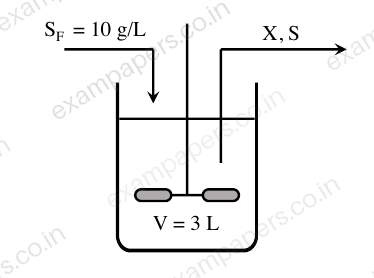
A continuous cell culture being carried out in a stirred tank reactor is described in terms of its cell mass concentration X and substrate concentration S. The concentration of the substrate in the sterile feed stream is S_F = 10 g/L and yield coefficient Y_{x/s} = 0.5. The flow rates of the feed stream and the exit stream are equal (F=5 mL/min) and constant. If the specific growth rate (h⁻¹) μ = \frac{0.3\ S}{(1+S)}, the steady state concentration of S is ____ g/L (up to 1 decimal point).
Log in to check the answer
You can attempt this question now. Sign in to view the answer key, explanations and discussion.Log in to check answerQuestion 19
Open questionXL-SNAT2 marksNeeds review
The initial concentration of cells (N₀) growing unrestricted in a culture is 1.0×10⁶ cells/mL. If the specific growth rate (μ) of the cells is 0.1 h⁻¹, the time required for the cell concentration to become 1.0×10⁸ cells/mL is ________ hours (up to 2 decimal points).
Log in to check the answer
You can attempt this question now. Sign in to view the answer key, explanations and discussion.Log in to check answerQuestion 20
Open questionXL-SNAT2 marksNeeds review
The following stoichiometric equation represents the conversion of glucose to lactic acid in a cell:
Glucose + 2Pi + 2ADP → 2Lactate + 2ATP + 2H₂O
If the free energy of conversion of glucose to lactic acid alone is ΔG⁰ = −4700 cal/mol, the efficiency of energy transfer is ______ % (up to 1 decimal point).
(ΔG⁰ for ATP hydrolysis is −7.3 kcal/mol)
Log in to check the answer
You can attempt this question now. Sign in to view the answer key, explanations and discussion.Log in to check answer