
Life Sciences
GATE XL Evolution PYQs
Build your understanding with focused practice from past exam papers.
How to practice Evolution
Attempt a question, record the concept and assumptions, then check the available answer. Rework mistakes after revising the relevant concepts. Topic tags can overlap; review the question context.
Questions 1–10 of 10. Imported answers require independent review unless marked reviewed.
Question 100
Open questionXL-TMSQ2 marksNeeds review
Two species of snakes, Species P and Species Q, have overlapping geographic distributions. Species P mainly eats rodents, whereas Species Q mainly eats invertebrates. Which one or more of the following terms describe(s) the process of speciation for these two species?
Your answerSelect all correct options. You can choose more than one.
Log in to check the answer
You can attempt this question now. Sign in to view the answer key, explanations and discussion.Log in to check answerQuestion 102
Open questionXL-TMSQ2 marksNeeds review
Which of the following statements is/are correct for the phylogenetic tree depicted below?
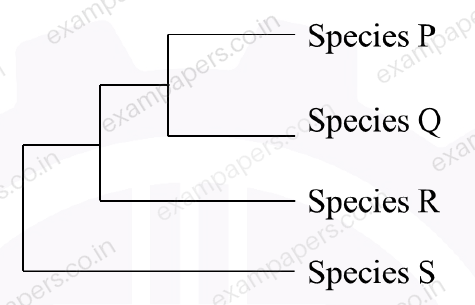
Your answerSelect all correct options. You can choose more than one.
Log in to check the answer
You can attempt this question now. Sign in to view the answer key, explanations and discussion.Log in to check answerQuestion 88
Open questionXL-TMCQ1 markNeeds review
Which one of the following is a “post-zygotic” isolating mechanism of speciation?
Your answerChoose one option.
Log in to check the answer
You can attempt this question now. Sign in to view the answer key, explanations and discussion.Log in to check answerQuestion 95
Open questionXL-TMCQ2 marksNeeds review
Consider a large population of a finch species, where both small and big beak sizes are advantageous, and an intermediate beak size is maladaptive. Over a period of 10 years, which one of the following evolutionary processes is most likely to operate on the beak size of this finch population?
Your answerChoose one option.
Log in to check the answer
You can attempt this question now. Sign in to view the answer key, explanations and discussion.Log in to check answerQuestion 7
Open questionXL-TMCQ1 markNeeds review
The genomes of both human and Drosophila code for an amylase that acts on the same substrate. However, the sequence of nucleotides in the genes encoding the two is dissimilar. This is an example of which ONE of the following types of evolution?
Your answerChoose one option.
Log in to check the answer
You can attempt this question now. Sign in to view the answer key, explanations and discussion.Log in to check answerQuestion 6
Open questionXL-TMCQ1 markNeeds review
The finches on the Galapagos Islands have widely differing beaks adapted according to their diets. This is an example of
Your answerChoose one option.
Log in to check the answer
You can attempt this question now. Sign in to view the answer key, explanations and discussion.Log in to check answerQuestion 15
Open questionXL-TMCQ2 marksNeeds review
Which one of the following factors does NOT contribute to “allopatric speciation”?
Your answerChoose one option.
Log in to check the answer
You can attempt this question now. Sign in to view the answer key, explanations and discussion.Log in to check answerQuestion 5
Open questionXL-TMCQ1 markNeeds review
Increase in the existent population of grey peppered moth, Biston betularia, during industrial revolution in Britain is an example of which ONE of the following evolutionary processes?
Your answerChoose one option.
Log in to check the answer
You can attempt this question now. Sign in to view the answer key, explanations and discussion.Log in to check answerQuestion 18
Open questionXL-TMCQ2 marksNeeds review
Which ONE of the following statements is NOT part of the classical Darwinian theory of evolution by natural selection?
Your answerChoose one option.
Log in to check the answer
You can attempt this question now. Sign in to view the answer key, explanations and discussion.Log in to check answerQuestion 77
Open questionXL-TMCQ1 markNeeds review
One of the most remarkable features of evolution is the formation of amnion and allantois. This appeared for the “first time” in evolutionary time scale in
Your answerChoose one option.
Log in to check the answer
You can attempt this question now. Sign in to view the answer key, explanations and discussion.Log in to check answer