
Life Sciences
GATE XL format:mcq PYQs
Build your understanding with focused practice from past exam papers.
Questions 161–170 of 812. Imported answers require independent review unless marked reviewed.
Question 15
Open questionXL-PMCQ1 markNeeds review
The molecules A and B are a pair of ____________.
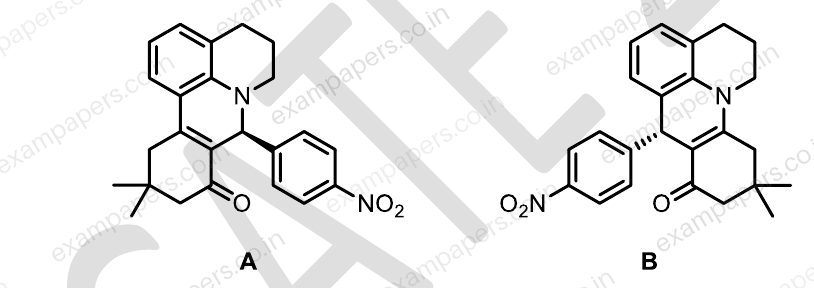
Your answerChoose one option.
Log in to check the answer
You can attempt this question now. Sign in to view the answer key, explanations and discussion.Log in to check answerQuestion 20
Open questionXL-PMCQ2 marksNeeds review
Each of the following alkenes undergoes addition reaction with bromine. Under the same reaction conditions, the CORRECT trend in the reaction rates is
Structures I, II and III are shown.
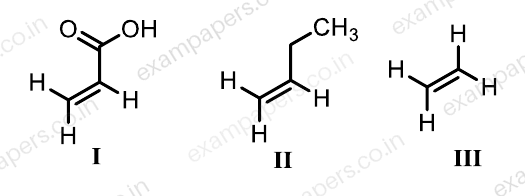
Your answerChoose one option.
Log in to check the answer
You can attempt this question now. Sign in to view the answer key, explanations and discussion.Log in to check answerQuestion 21
Open questionXL-PMCQ2 marksNeeds review
An enzyme-catalyzed conversion of a substrate at 298 K proceeds by a Michaelis-Menten mechanism. The Lineweaver-Burk plot for the analysis of the experimental data has an intercept along the y-axis of 0.357 mol⁻¹ dm³ s and a slope of 2.10 s. The CORRECT Michaelis constant for the reaction is ______ (rounded off to 2 decimal places).
Your answerChoose one option.
Log in to check the answer
You can attempt this question now. Sign in to view the answer key, explanations and discussion.Log in to check answerQuestion 22
Open questionXL-PMCQ2 marksNeeds review
Which one among the following structures is the most stable conformer of (Z)-pent-2-ene?
Your answerChoose one option.
Log in to check the answer
You can attempt this question now. Sign in to view the answer key, explanations and discussion.Log in to check answerQuestion 28
Open questionXL-QMCQ1 markNeeds review
Which one of the following pairs of amino acids is NOT incorporated in a polypeptide chain?
Your answerChoose one option.
Log in to check the answer
You can attempt this question now. Sign in to view the answer key, explanations and discussion.Log in to check answerQuestion 29
Open questionXL-QMCQ1 markNeeds review
Mammalian cells cultured at low temperature (25 to 30 °C) leads to an increased sterol content in the membrane. Elevated sterols in the membrane results in
Your answerChoose one option.
Log in to check the answer
You can attempt this question now. Sign in to view the answer key, explanations and discussion.Log in to check answerQuestion 30
Open questionXL-QMCQ1 markNeeds review
Which one of the following metabolic intermediates is common to glycolysis, nucleotide synthesis and glycogen synthesis?
Your answerChoose one option.
Log in to check the answer
You can attempt this question now. Sign in to view the answer key, explanations and discussion.Log in to check answerQuestion 31
Open questionXL-QMCQ1 markNeeds review
In mammals, hematopoietic stem cells that give rise to different types of blood cells are known as
Your answerChoose one option.
Log in to check the answer
You can attempt this question now. Sign in to view the answer key, explanations and discussion.Log in to check answerQuestion 36
Open questionXL-QMCQ2 marksNeeds review
Metabolic intermediates provide the backbone for the synthesis of amino acids. Match the metabolic intermediates listed in Column I with their corresponding amino acids given in Column II.
Column I | Column II |
|---|---|
P. α-Ketoglutarate | i. Histidine |
Q. Ribose 5-phosphate | ii. Glutamate |
R. 3-Phosphoglycerate | iii. Aspartate |
S. Phosphoenolpyruvate | iv. Phenylalanine |
| v. Serine |
Your answerChoose one option.
Log in to check the answer
You can attempt this question now. Sign in to view the answer key, explanations and discussion.Log in to check answerQuestion 37
Open questionXL-QMCQ2 marksNeeds review
Which one of the following is the correct match between the molecular properties listed in Column I and the corresponding biochemical separation methods in Column II?
Column I | Column II
P. Solubility | i. Reverse phase chromatography
Q. Ionic charge | ii. Ultracentrifugation
R. Polarity | iii. Salting out
S. Molecular size | iv. Isoelectric focusing
| v. Gel electrophoresis
Your answerChoose one option.
Log in to check the answer
You can attempt this question now. Sign in to view the answer key, explanations and discussion.Log in to check answer