
Life Sciences
GATE XL format:mcq PYQs
Build your understanding with focused practice from past exam papers.
Questions 231–240 of 812. Imported answers require independent review unless marked reviewed.
Question 36
Open questionXL-QMCQ2 marksNeeds review
Intracellular concentrations of ATP, ADP, and inorganic phosphate in four cell types are given below. Which one of these cell types has the most negative
for ATP hydrolysis?Cell type | ATP (mM) | ADP (mM) | Inorganic phosphate (mM) |
|---|---|---|---|
L | 3.0 | 1.8 | 5.0 |
K | 3.9 | 1.3 | 3.0 |
B | 2.7 | 0.7 | 2.7 |
M | 7.2 | 0.9 | 8.0 |
Your answerChoose one option.
Log in to check the answer
You can attempt this question now. Sign in to view the answer key, explanations and discussion.Log in to check answerQuestion 37
Open questionXL-QMCQ2 marksNeeds review
Which one of the following amino acids has more than two acid-base groups?
Your answerChoose one option.
Log in to check the answer
You can attempt this question now. Sign in to view the answer key, explanations and discussion.Log in to check answerQuestion 38
Open questionXL-QMCQ2 marksNeeds review
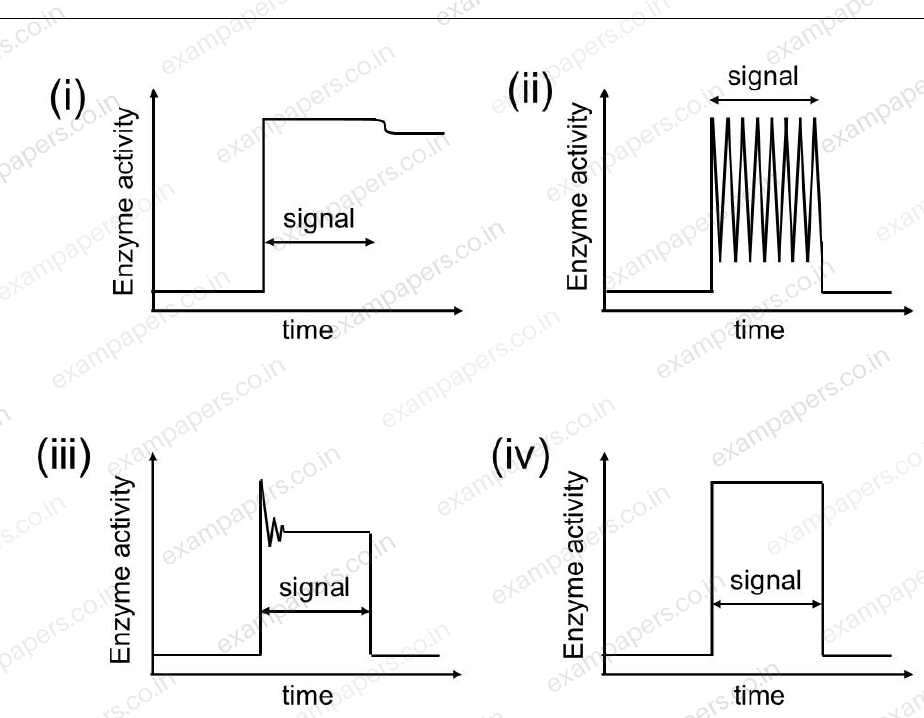
Enzyme activity profiles as a function of time in the absence or presence of different types of feedback mechanisms are shown in the figure below. Match the following feedback mechanisms with the corresponding profiles in the figure.
(p) No feedback mechanism
(q) Negative feedback mechanism with short delay
(r) Negative feedback mechanism with long delay
(s) Positive feedback mechanism
Your answerChoose one option.
Log in to check the answer
You can attempt this question now. Sign in to view the answer key, explanations and discussion.Log in to check answerQuestion 39
Open questionXL-QMCQ2 marksNeeds review
A linear DNA fragment of 5 kilobase (kb) when completely digested with EcoRI produces 2.5 kb, 1.5 kb, and 1 kb fragments. Complete digestion of the same 5 kb fragment with XbaI produces 3.5 kb and 1.5 kb fragments. Which one of the following sets of fragments will be obtained if the 5 kb fragment is fully digested with EcoRI and XbaI simultaneously?
Your answerChoose one option.
Log in to check the answer
You can attempt this question now. Sign in to view the answer key, explanations and discussion.Log in to check answerQuestion 40
Open questionXL-QMCQ2 marksNeeds review
Match the cell types listed in Group I with associated processes listed in Group II.
Group I
(p) NK cells
(q) B cells
(r) Mast cells
(s) Neutrophils
Group II
(i) Antibody production
(ii) First cells to be recruited at the site of infection
(iii) Antibody-dependent cell-mediated cytotoxicity
(iv) Histamine production
Your answerChoose one option.
Log in to check the answer
You can attempt this question now. Sign in to view the answer key, explanations and discussion.Log in to check answerQuestion 47
Open questionXL-RMCQ1 markNeeds review
Which one of the following statements on Casparian strips is correct?
Your answerChoose one option.
Log in to check the answer
You can attempt this question now. Sign in to view the answer key, explanations and discussion.Log in to check answerQuestion 48
Open questionXL-RMCQ1 markNeeds review
Rotenone is a chemical often used to kill insect pests on crop plants and fishes in lakes. Rotenone acts by inhibiting electron transport from the NADH dehydrogenase enzyme in Complex I to ubiquinone in the mitochondrial electron transport chain. Which one of the following explains why plants can tolerate rotenone application?
Your answerChoose one option.
Log in to check the answer
You can attempt this question now. Sign in to view the answer key, explanations and discussion.Log in to check answerQuestion 49
Open questionXL-RMCQ1 markNeeds review
Although Pseudomonas syringae infection in plants is actively inhibited by the endogenous salicylic acid (SA) of host origin, a successful infection is still established because the bacterium secretes coronatine, an effector molecule. Which one of the following best describes the mode of action of coronatine?
Your answerChoose one option.
Log in to check the answer
You can attempt this question now. Sign in to view the answer key, explanations and discussion.Log in to check answerQuestion 50
Open questionXL-RMCQ1 markNeeds review
The schematic depicts an unexpanded plant cell within a hypocotyl with the arrangement of cellulose microfibrils marked on its cell wall.
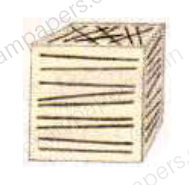
Which one of the following shapes would most likely result from the expansion of this cell if the pattern of the cellulose fibers does not change?
Your answerChoose one option.
Log in to check the answer
You can attempt this question now. Sign in to view the answer key, explanations and discussion.Log in to check answerQuestion 55
Open questionXL-RMCQ2 marksNeeds review
Match the tasks given in Group I with the associated techniques conventionally used as listed in Group II.
Group I
P. Ploidy analysis
Q. Profiling DNA methetion
R. Identifying non-coding RNAs
S. Identifying SNPs
T. Satellite DNA isolation
Group II
RNA sequencing
Exome sequencing
Fluorescence in situ hybridization
Bisulfite sequencing
Density-gradient centrifugation
Your answerChoose one option.
Log in to check the answer
You can attempt this question now. Sign in to view the answer key, explanations and discussion.Log in to check answer