
Life Sciences
GATE XL format:nat PYQs
Build your understanding with focused practice from past exam papers.
Questions 151–160 of 244. Imported answers require independent review unless marked reviewed.
Question 19
Open questionXL-SNAT2 marksNeeds review
A 100 μl aliquot (
dilution) of the bacterial culture plated on the nutrient agar gave 4 colonies. The bacterial stock concentration (in million cells/ml, rounded off to one decimal place) is _____.Log in to check the answer
You can attempt this question now. Sign in to view the answer key, explanations and discussion.Log in to check answerQuestion 20
Open questionXL-SNAT2 marksNeeds review
A continuous bacterial culture carried out in a chemostat is set to a flow rate of 40 ml/hr. The culture volume is equivalent to that of a cubical container having 10 cm sides. The dilution rate (in hr⁻¹, rounded off to two decimal places) of this system is _____.
Log in to check the answer
You can attempt this question now. Sign in to view the answer key, explanations and discussion.Log in to check answerQuestion 20
Open questionXL-TNAT2 marksNeeds review
In Drosophila, the red eye phenotype (W) is dominant over the recessive white eye mutant (w). In a mixed population of red and white eye flies of 10,000 individuals, 3,600 flies were white eyed. The percentage of the heterozygous red eye flies in this population is _____________.
Log in to check the answer
You can attempt this question now. Sign in to view the answer key, explanations and discussion.Log in to check answerQuestion 9
Open questionXL-UNAT1 markNeeds review
The velocity of 2.2 μm diameter fat particles inside a centrifuge, running at 600 rpm and 20 °C, is 0.25 mm s⁻¹. The velocity of 1.5 μm diameter fat particles inside the same centrifuge running at 750 rpm and same temperature (round off to 2 decimal places) will be ______ mm s⁻¹.
Log in to check the answer
You can attempt this question now. Sign in to view the answer key, explanations and discussion.Log in to check answerQuestion 10
Open questionXL-UNAT1 markNeeds review
The initial population of a bacterial strain increases from 1×10⁴ cells per mL to 1×10⁶ cells per mL in 120 minutes. The generation time for this strain (round off to 2 decimal places) is ______ minutes.
Log in to check the answer
You can attempt this question now. Sign in to view the answer key, explanations and discussion.Log in to check answerQuestion 20
Open questionXL-UNAT2 marksNeeds review
An orange juice flowing at 0.80 kg s
enters a counter current double pipe heat exchanger at 20 °C and leaves at 72 °C. Inlet and outlet temperatures of the hot water used as heating medium in the exchanger are 81 °C and 74 °C, respectively. The specific heat of the orange juice is 3.74 kJ kg
K
and overall heat transfer coefficient is 492 W m
K
. The heat transfer surface area (round off to 2 decimal places) will be ______ m
.Log in to check the answer
You can attempt this question now. Sign in to view the answer key, explanations and discussion.Log in to check answerQuestion 4
Open questionXL-PNAT1 markNeeds review
The total number of tautomers for the following molecule (including the structure provided below) is ____.
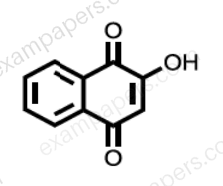
Log in to check the answer
You can attempt this question now. Sign in to view the answer key, explanations and discussion.Log in to check answerQuestion 5
Open questionXL-PNAT1 markNeeds review
The total number of stereoisomers possible for the following structure is ____
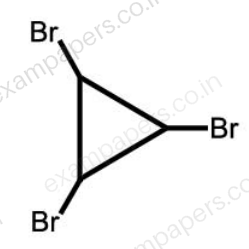
Log in to check the answer
You can attempt this question now. Sign in to view the answer key, explanations and discussion.Log in to check answerQuestion 12
Open questionXL-PNAT2 marksNeeds review
A protein in denatured state (D) is in equilibrium with native state (N).
D ⇌ N
At 360 K, both N and D states are equally populated. If the standard entropy change for the reaction at this temperature ΔS° = −139 J K⁻¹ mol⁻¹, then the corresponding standard enthalpy change ΔH° for the reaction in kJ mol⁻¹ (rounded off to one decimal place) is _____.
Log in to check the answer
You can attempt this question now. Sign in to view the answer key, explanations and discussion.Log in to check answerQuestion 13
Open questionXL-PNAT2 marksNeeds review
The pH of a 1.0 L buffer solution containing 0.2 mol of acetic acid (CH₃COOH) and 0.3 mol of sodium acetate (CH₃COONa) is 5.0. The Kₐ of acetic acid is P × 10⁻⁵, where the numerical value of P (rounded off to one decimal place) is ____.
Log in to check the answer
You can attempt this question now. Sign in to view the answer key, explanations and discussion.Log in to check answer