
Life Sciences
GATE XL kind:question PYQs
Build your understanding with focused practice from past exam papers.
Questions 381–390 of 1235. Imported answers require independent review unless marked reviewed.
Question 15
Open questionXL-PMSQ1 markNeeds review
Suitable reagent(s) to bring about the conversion of P to Q in good yield is/are
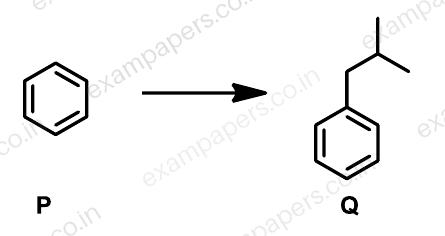
Your answerSelect all correct options. You can choose more than one.
Log in to check the answer
You can attempt this question now. Sign in to view the answer key, explanations and discussion.Log in to check answerQuestion 16
Open questionXL-PMSQ1 markNeeds review
Choose the CORRECT trend(s) of the first ionization energies among the following.
(Given: Atomic numbers C: 6; N: 7; O: 8; F: 9; Si: 14; P: 15; S: 16; Cl: 17)
Your answerSelect all correct options. You can choose more than one.
Log in to check the answer
You can attempt this question now. Sign in to view the answer key, explanations and discussion.Log in to check answerQuestion 17
Open questionXL-PNAT1 markNeeds review
The depression of freezing point of water (in K) for 0.1 molal solutions of NaCl and Na₂SO₄ are ΔT₁ and ΔT₂, respectively. Assuming the solutions to be ideal, the ratio ΔT₁/ΔT₂ is ____________ (rounded off to two decimal places).
Log in to check the answer
You can attempt this question now. Sign in to view the answer key, explanations and discussion.Log in to check answerQuestion 18
Open questionXL-PNAT1 markNeeds review
Considering cyclobutane to be planar, the number of planes of symmetry in the following compound is ____________ (in integer).
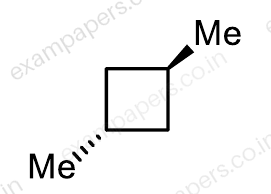
Log in to check the answer
You can attempt this question now. Sign in to view the answer key, explanations and discussion.Log in to check answerQuestion 19
Open questionXL-PNAT1 markNeeds review
The dipole moment (μ) of BrF is 1.42 D and the bond length is 176 pm. The atomic charge distribution (q) in the molecule is _____ (rounded off to two decimal places). (Given: 1 D = 3.3 × 10⁻³⁰ C m; the factor e (electronic charge) = 1.60 × 10⁻¹⁹ C)
Log in to check the answer
You can attempt this question now. Sign in to view the answer key, explanations and discussion.Log in to check answerQuestion 20
Open questionXL-PMCQ2 marksNeeds review
Consider two different paths in which the volume of an ideal gas doubles isothermally:
i) Reversible expansion (work done =
)
ii) Irreversible expansion, with the external pressure equal to the final pressure of the gas (work done =
)Here,
= ______________.Your answerChoose one option.
Log in to check the answer
You can attempt this question now. Sign in to view the answer key, explanations and discussion.Log in to check answerQuestion 21
Open questionXL-PMCQ2 marksNeeds review
A mixture of four peptides, PKRK, RGERV, YRGV and LVVP, is loaded onto an ion-exchange column at pH = 7.2. If carboxymethyl (CM) cellulose is used as the stationary phase of this column, then which peptide elutes first?
Given:

P = Proline, Y = Tyrosine, V = Valine, G = Glycine, K = Lysine, R = Arginine, E = Glutamic acid
Your answerChoose one option.
Log in to check the answer
You can attempt this question now. Sign in to view the answer key, explanations and discussion.Log in to check answerQuestion 22
Open questionXL-PMCQ2 marksNeeds review
Match the coordination complexes given in Column I with the most appropriate properties in Column II. (Given: Atomic numbers of Mn: 25; Co: 27; Ni: 28)
Column I — Coordination complexes:
E. [Mn(H₂O)₆]²⁺
F. [CoF₆]³⁻
G. [NiCl₄]²⁻
H. [Ni(CN)₄]²⁻
Column II — Properties:
5.92 Bohr Magneton (BM)
CFSE = 0.4 Δₒ
Metal ion hybridisation is sp³
Diamagnetic
Your answerChoose one option.
Log in to check the answer
You can attempt this question now. Sign in to view the answer key, explanations and discussion.Log in to check answerQuestion 23
Open questionXL-PMSQ2 marksNeeds review
Compounds P and Q undergo E2 elimination with reaction rate constants of k₁ and k₂, respectively, as shown below. Which is/are the CORRECT option(s)?

Your answerSelect all correct options. You can choose more than one.
Log in to check the answer
You can attempt this question now. Sign in to view the answer key, explanations and discussion.Log in to check answerQuestion 24
Open questionXL-PMSQ2 marksNeeds review
According to Hard-Soft Acid-Base (HSAB) principle, the CORRECT option(s) for the solubility trend in water is/are
Your answerSelect all correct options. You can choose more than one.
Log in to check the answer
You can attempt this question now. Sign in to view the answer key, explanations and discussion.Log in to check answer