
Life Sciences
GATE XL Plant development; cell and tissue morphogenesis PYQs
Build your understanding with focused practice from past exam papers.
How to practice Plant development; cell and tissue morphogenesis
Attempt a question, record the concept and assumptions, then check the available answer. Rework mistakes after revising the relevant concepts. Topic tags can overlap; review the question context.
Questions 1–10 of 29. Imported answers require independent review unless marked reviewed.
Question 54
Open questionXL-RNAT1 markNeeds review
If an endosperm cell of a typical diploid angiosperm species has 15 chromosomes, then the number of chromosomes in a microspore mother cell of this species under normal circumstances would be__________ (in integer).
Log in to check the answer
You can attempt this question now. Sign in to view the answer key, explanations and discussion.Log in to check answerQuestion 55
Open questionXL-RMCQ2 marksNeeds review
Which one of the following class(es) of genes, when deleted, would result in sepal formation in all the floral whorls of Arabidopsis, as per the rules of the typical ABC model of floral organ patterning?
Your answerChoose one option.
Log in to check the answer
You can attempt this question now. Sign in to view the answer key, explanations and discussion.Log in to check answerQuestion 60
Open questionXL-RMCQ2 marksNeeds review
Two genes X and Y are involved in root development in such a way that all the following three homozygous mutants show rootless phenotype.
(i) Gain-of-function mutant of X
(ii) Loss-of-function mutant of Y
(iii) Double mutant of gain-of-function of X and loss-of-function of Y
Which one of the following genetic pathways best describes these observations?
Your answerChoose one option.
Log in to check the answer
You can attempt this question now. Sign in to view the answer key, explanations and discussion.Log in to check answerQuestion 49
Open questionXL-RMCQ1 markNeeds review
Correctly match the carnivorous plants (Group I) with the organs (Group II) they modify to trap the prey.
Group I: (P) Pitcher plant (Nepenthes); (Q) Bladderwort (Utricularia); (R) Sundew (Drosera); (S) Venus flytrap (Dionaea).
Group II: (1) Leaf; (2) Fruit; (3) Stem; (4) Tendril.
Your answerChoose one option.
Log in to check the answer
You can attempt this question now. Sign in to view the answer key, explanations and discussion.Log in to check answerQuestion 56
Open questionXL-RMCQ2 marksNeeds review
Consider a diploid plant species where the cells in the epidermis (the outermost single cell layer) always divide in the anticlinal orientation. If one such cell within the central zone of the shoot apical meristem (SAM) spontaneously becomes tetraploid at the seedling stage, which one of the following cellular arrangements would be most likely observed if the meristem is examined at the adult stage?
Your answerChoose one option.
Log in to check the answer
You can attempt this question now. Sign in to view the answer key, explanations and discussion.Log in to check answerQuestion 60
Open questionXL-RMCQ2 marksNeeds review
Correctly match the following Arabidopsis genes (Group I) and the biological processes they primarily regulate (Group II).
Group I: (P) CLAVATA3; (Q) CONSTANS; (R) SCARECROW; (S) AGAMOUS.
Group II: (1) Organ identity in flower; (2) Cell-type specification in root meristem; (3) Meristem size in shoot; (4) Photoperiodic floral transition
Your answerChoose one option.
Log in to check the answer
You can attempt this question now. Sign in to view the answer key, explanations and discussion.Log in to check answerQuestion 49
Open questionXL-RMSQ1 markNeeds review
Which of the following tissue types is/are established during embryogenesis in wild-type Arabidopsis thaliana?
Your answerSelect all correct options. You can choose more than one.
Log in to check the answer
You can attempt this question now. Sign in to view the answer key, explanations and discussion.Log in to check answerQuestion 55
Open questionXL-RMCQ2 marksNeeds review
In wild-type Arabidopsis thaliana, the four types of floral organs (sepal, petal, stamen, carpel) are arranged in concentric whorls from outside to inside. With reference to the ABC model of floral organ patterning, match the homeotic mutants in Group 1 with their respective arrangements of organs in the four whorls given in Group 2.
Group 1 | Group 2
(P) A class mutants | (i) sepal, sepal, carpel, carpel
(Q) B class mutants | (ii) sepal, petal, petal, sepal
(R) C class mutants | (iii) carpel, stamen, stamen, carpel
| (iv) sepal, sepal, petal, petal
Your answerChoose one option.
Log in to check the answer
You can attempt this question now. Sign in to view the answer key, explanations and discussion.Log in to check answerQuestion 50
Open questionXL-RMCQ1 markNeeds review
The schematic depicts an unexpanded plant cell within a hypocotyl with the arrangement of cellulose microfibrils marked on its cell wall.
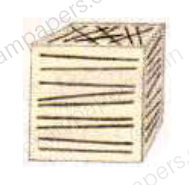
Which one of the following shapes would most likely result from the expansion of this cell if the pattern of the cellulose fibers does not change?
Your answerChoose one option.
Log in to check the answer
You can attempt this question now. Sign in to view the answer key, explanations and discussion.Log in to check answerQuestion 51
Open questionXL-RMSQ1 markNeeds review
Which one or more of the following statements is/are NOT CORRECT with respect to pollen development in angiosperm?
Your answerSelect all correct options. You can choose more than one.
Log in to check the answer
You can attempt this question now. Sign in to view the answer key, explanations and discussion.Log in to check answer