
Life Sciences
GATE XL purpose:exam-prep PYQs
Build your understanding with focused practice from past exam papers.
Questions 1001–1010 of 1235. Imported answers require independent review unless marked reviewed.
Question 6
Open questionXL-PMCQ2 marksNeeds review
Among B–H, C–H, N–H and Si–H bonds in BH
, CH
, NH
and SiH
, respectively, the polarity of the bond which is shown INCORRECTLY isYour answerChoose one option.
Log in to check the answer
You can attempt this question now. Sign in to view the answer key, explanations and discussion.Log in to check answerQuestion 7
Open questionXL-PMCQ2 marksNeeds review
Among the following statements,
(i) [NiCl
]
(atomic number of Ni = 28) is diamagnetic
(ii) Ethylene is a weaker Lewis base compared to pyridine
(iii) [NiCl
{P(C
H
)
}
] has two geometrical isomers
(iv) Bond angle in H
O is greater than that in H
S,
the CORRECT one isYour answerChoose one option.
Log in to check the answer
You can attempt this question now. Sign in to view the answer key, explanations and discussion.Log in to check answerQuestion 8
Open questionXL-PMCQ2 marksNeeds review
In [Mn(H
O)
]
(atomic number of Mn = 25), the d-d transitions according to crystal field theory (CF) areYour answerChoose one option.
Log in to check the answer
You can attempt this question now. Sign in to view the answer key, explanations and discussion.Log in to check answerQuestion 9
Open questionXL-PMCQ2 marksNeeds review
The major product M in the reaction
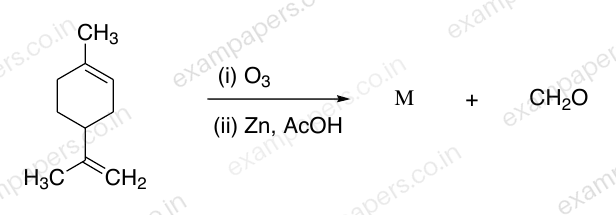
is
Your answerChoose one option.
Log in to check the answer
You can attempt this question now. Sign in to view the answer key, explanations and discussion.Log in to check answerQuestion 10
Open questionXL-PMCQ2 marksNeeds review
The two major products of the reaction
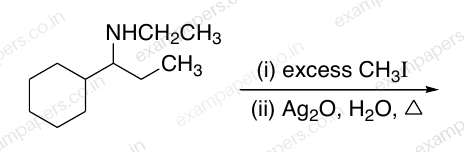
are
Your answerChoose one option.
Log in to check the answer
You can attempt this question now. Sign in to view the answer key, explanations and discussion.Log in to check answerQuestion 11
Open questionXL-PMCQ2 marksNeeds review
The compound, which upon mono-nitration using a mixture of HNO₃ and H₂SO₄, does NOT give the meta-isomer as the major product, is
Your answerChoose one option.
Log in to check the answer
You can attempt this question now. Sign in to view the answer key, explanations and discussion.Log in to check answerQuestion 12
Open questionXL-PMCQ2 marksNeeds review
The standard reduction potential (E°) for the conversion of Cr₂O₇²⁻ to Cr³⁺ at 25 °C in an aqueous solution of pH 3.0 is 1.33 V. The concentrations of Cr₂O₇²⁻ and Cr³⁺ are 1.0 × 10⁻⁴ M and 1.0 × 10⁻³ M, respectively. Then the potential of this half-cell reaction is
(Given: Faraday constant = 96500 C mol⁻¹, Gas constant R = 8.314 J K⁻¹ mol⁻¹)
Your answerChoose one option.
Log in to check the answer
You can attempt this question now. Sign in to view the answer key, explanations and discussion.Log in to check answerQuestion 13
Open questionXL-PNAT2 marksNeeds review
The solubility product (Kₛₚ) of Mg(OH)₂ at 25 °C is 5.6 × 10⁻¹¹. Its solubility in water is S × 10⁻² g/L, where the value of S is ______ (up to two decimal places).
(Given: Molecular weight of Mg(OH)₂ = 58.3 g mol⁻¹)
Log in to check the answer
You can attempt this question now. Sign in to view the answer key, explanations and discussion.Log in to check answerQuestion 14
Open questionXL-PNAT2 marksNeeds review
The activation energy (Eₐ) values for two reactions carried out at 25 °C differ by 5.0 kJ mol⁻¹. If the pre-exponential factors (A₁ and A₂) for these two reactions are of the same magnitude, the ratio of rate constants (k₁/k₂) is ______ (up to two decimal places).
(Given: Gas constant R = 8.314 J K⁻¹ mol⁻¹)
Log in to check the answer
You can attempt this question now. Sign in to view the answer key, explanations and discussion.Log in to check answerQuestion 15
Open questionXL-PNAT2 marksNeeds review
One mole of helium gas in an isolated system undergoes a reversible isothermal expansion at 25 °C from an initial volume of 2.0 liters to a final volume of 10.0 liters. The change in entropy (ΔS) of the surroundings is ______ J K⁻¹ (up to two decimal places).
(Given: Gas constant R = 8.314 J K⁻¹ mol⁻¹)
Log in to check the answer
You can attempt this question now. Sign in to view the answer key, explanations and discussion.Log in to check answer