
Life Sciences
GATE XL purpose:exam-prep PYQs
Build your understanding with focused practice from past exam papers.
Questions 661–670 of 1235. Imported answers require independent review unless marked reviewed.
Question 6
Open questionXL-RMCQ1 markNeeds review
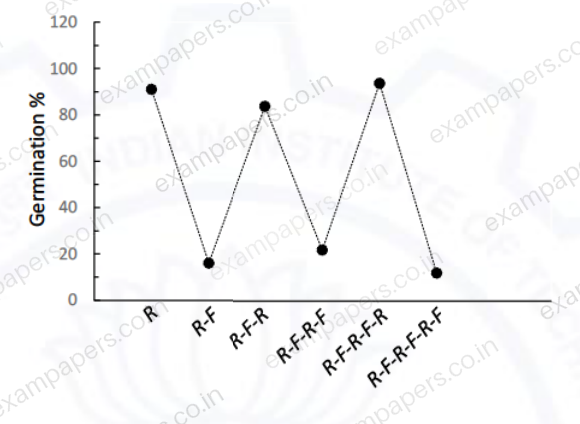
The figure shows the germination percentage of imbibed seeds treated with the given sequence of red (R) and far-red (F) light (each exposure lasting 5 min). The percentage of germination was scored after 72 hours in darkness at 25 °C. Based on this, which ONE of the following options is CORRECT?
Your answerChoose one option.
Log in to check the answer
You can attempt this question now. Sign in to view the answer key, explanations and discussion.Log in to check answerQuestion 7
Open questionXL-RMCQ1 markNeeds review
The structures of four plant hormones are shown. Identify the CORRECT hormone that is responsible for bending of coleoptile of canary grass in response to unidirectional white light.
Your answerChoose one option.
Log in to check the answer
You can attempt this question now. Sign in to view the answer key, explanations and discussion.Log in to check answerQuestion 8
Open questionXL-RMSQ1 markNeeds review
Which of the following cellular component(s) is/are NOT part(s) of cytoskeleton in Angiosperms?
Your answerSelect all correct options. You can choose more than one.
Log in to check the answer
You can attempt this question now. Sign in to view the answer key, explanations and discussion.Log in to check answerQuestion 9
Open questionXL-RMSQ1 markNeeds review
Which of the following enzyme(s), when overexpressed, would result in rice grains with increased β-carotene content?
Your answerSelect all correct options. You can choose more than one.
Log in to check the answer
You can attempt this question now. Sign in to view the answer key, explanations and discussion.Log in to check answerQuestion 10
Open questionXL-RNAT1 markNeeds review
In spiral phyllotaxis, leaves are initiated sequentially on the meristem with two successive primordia being separated by golden angle. If a plant follows right-handed spiral phyllotaxis when looked down the meristem, then the angle between two successive leaves would be ________ degrees (with correct sign, round off to one decimal place).
Log in to check the answer
You can attempt this question now. Sign in to view the answer key, explanations and discussion.Log in to check answerQuestion 11
Open questionXL-RMCQ2 marksNeeds review
Match the cell/tissue types in GROUP I with their corresponding total DNA content in GROUP II of a typical diploid Angiosperm species and choose the CORRECT option (C denotes DNA content in haploid genome).
GROUP I
(P) Pollen tube
(Q) Megaspore mother cell
(R) Synergid
(S) Embryo sac prior to fertilization
GROUP II
(1) 1C
(2) 2C
(3) 3C
(4) 4C
(5) 8C
Your answerChoose one option.
Log in to check the answer
You can attempt this question now. Sign in to view the answer key, explanations and discussion.Log in to check answerQuestion 12
Open questionXL-RMCQ2 marksNeeds review
Match the modified organs in GROUP I with their corresponding prototype forms in GROUP II and choose the CORRECT option.
GROUP I
P. Tendrils in grape vine
Q. Tendrils in garden pea
R. Spines
S. Thorns
GROUP II
Modified stem
Modified leaf
Your answerChoose one option.
Log in to check the answer
You can attempt this question now. Sign in to view the answer key, explanations and discussion.Log in to check answerQuestion 13
Open questionXL-RMCQ2 marksNeeds review
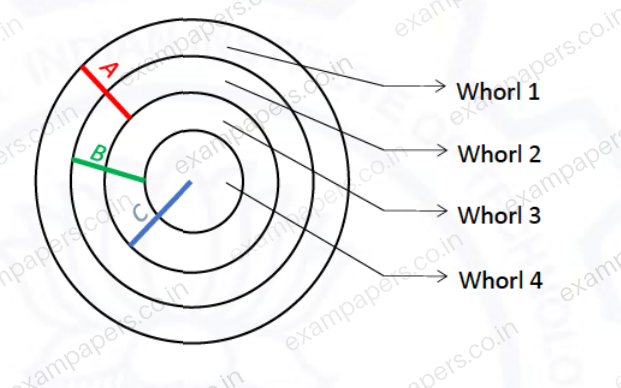
The diagram describes the ABC model of flower patterning in Arabidopsis where the A, B and C functions are operational in the whorls (1+2), (2+3) and (3+4), respectively, in the wild-type flower. Removal of A or C function results in the floral organ arrangements as (carpel; stamen; stamen; carpel) or (sepal; petal; petal; sepal), respectively. Based on these observations, which ONE of the following molecular pathways is CORRECT for floral organ pattern generation? Arrow indicates activation and bar indicates inhibition.
Your answerChoose one option.
Log in to check the answer
You can attempt this question now. Sign in to view the answer key, explanations and discussion.Log in to check answerQuestion 14
Open questionXL-RMCQ2 marksNeeds review
Find the CORRECT match among the plant species in GROUP I, the predominant phytochemical in GROUP II and the economic/medicinal use in GROUP III.
GROUP I
P. Syzygium aromaticum
Q. Gracilaria sp.
R. Catharanthus roseus
S. Theobroma cacao
T. Papaver somniferum
GROUP II
i. Vinciline
ii. Eugenol
iii. Agar
iv. Morphine
v. Flavonols
GROUP III
Toothache relief
Desert jelly
Leukaemia treatment
Analgesic
Beverage
Your answerChoose one option.
Log in to check the answer
You can attempt this question now. Sign in to view the answer key, explanations and discussion.Log in to check answerQuestion 15
Open questionXL-RMCQ2 marksNeeds review
Match the genetically modified crop in GROUP I with the corresponding genetic element in GROUP II.
GROUP I
P. Tomato with delayed fruit ripening
Q. Herbicide-resistant soybean
R. Insect-resistant cotton
S. Soybean with modified oil content
GROUP II
EPS synthase
Δ12-Desaturase
Polygalacturonase
Bt-Cry protein
Your answerChoose one option.
Log in to check the answer
You can attempt this question now. Sign in to view the answer key, explanations and discussion.Log in to check answer