
Life Sciences
GATE XL topic:biological-sciences PYQs
Build your understanding with focused practice from past exam papers.
Questions 851–860 of 1235. Imported answers require independent review unless marked reviewed.
Question 11
Open questionXL-UMCQ2 marksNeeds review
Match the protein in Column I with its food source in Column II.
Column I: P. Zein; Q. Gluten; R. Glycinin; S. Ovalbumin
Column II: 1. Soybean; 2. Maize; 3. Egg; 4. Wheat
Your answerChoose one option.
Log in to check the answer
You can attempt this question now. Sign in to view the answer key, explanations and discussion.Log in to check answerQuestion 12
Open questionXL-UMCQ2 marksNeeds review
Match the carbohydrate in Column I with corresponding enzyme used for its hydrolysis in Column II.
Column I
P. Pectin
Q. Lactose
R. Hemicellulose
S. Inulin
Column II
Xylanase
β-galactosidase
Polygalacturonase
β-fructofuranosidase
Your answerChoose one option.
Log in to check the answer
You can attempt this question now. Sign in to view the answer key, explanations and discussion.Log in to check answerQuestion 13
Open questionXL-UMCQ2 marksNeeds review
Match the edible oil refining stage in Column I with its purpose in Column II.
Column I: P. Degumming; Q. Neutralization; R. Bleaching; S. Winterization
Column II: 1. Separation of triglycerides; 2. Removal of pigments; 3. Removal of phosphates; 4. Removal of free fatty acids
Your answerChoose one option.
Log in to check the answer
You can attempt this question now. Sign in to view the answer key, explanations and discussion.Log in to check answerQuestion 14
Open questionXL-UMCQ2 marksNeeds review
Match the food material in Column I with its related term in Column II.
Column I | Column II
P. Coffee | 1. Wort
Q. Cocoa | 2. Must
R. Beer | 3. Arabica
S. Wine | 4. Theobroma
Your answerChoose one option.
Log in to check the answer
You can attempt this question now. Sign in to view the answer key, explanations and discussion.Log in to check answerQuestion 15
Open questionXL-UMCQ2 marksNeeds review
Match the component/system in Column I with the peeling method for fruits and vegetables in Column II.
Column I | Column II
P. Lye solution | 1. Flash peeling
Q. Carborundum rollers | 2. Flame peeling
R. Pressure vessel | 3. Abrasion peeling
S. Conveyor belt | 4. Caustic peeling
Your answerChoose one option.
Log in to check the answer
You can attempt this question now. Sign in to view the answer key, explanations and discussion.Log in to check answerQuestion 16
Open questionXL-UMCQ2 marksNeeds review
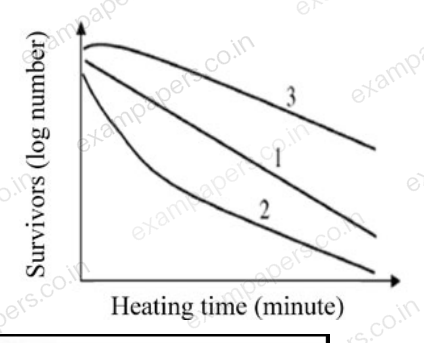
Which among the given options correctly explains the nature of the microbial culture represented by lines 1, 2 and 3 in the following figure?
Your answerChoose one option.
Log in to check the answer
You can attempt this question now. Sign in to view the answer key, explanations and discussion.Log in to check answerQuestion 17
Open questionXL-UMCQ2 marksNeeds review
Match the equation/law in Column I with its application in Column II.
Column I | Column II
P. Planck’s equation | 1. Terminal velocity
Q. Arrhenius equation | 2. Freezing time
R. Guggenheim-Anderson-de Boer equation | 3. Activation energy
S. Stokes’ law | 4. Monolayer moisture content
Your answerChoose one option.
Log in to check the answer
You can attempt this question now. Sign in to view the answer key, explanations and discussion.Log in to check answerQuestion 18
Open questionXL-UMCQ2 marksNeeds review
Match the absorber used in modified atmosphere packaging and storage in Column I with the scavenger in Column II.
Column I | Column II
P. Oxygen absorber | 1. Calcium chloride
Q. Carbon dioxide absorber | 2. Magnesium oxide
R. Ethylene absorber | 3. Ferric oxide
S. Moisture absorber | 4. Potassium permanganate
Your answerChoose one option.
Log in to check the answer
You can attempt this question now. Sign in to view the answer key, explanations and discussion.Log in to check answerQuestion 19
Open questionXL-UMCQ2 marksNeeds review
During extrusion cooking, food materials are generally subjected to a combination of
Your answerChoose one option.
Log in to check the answer
You can attempt this question now. Sign in to view the answer key, explanations and discussion.Log in to check answerQuestion 20
Open questionXL-UNAT2 marksNeeds review
An orange juice flowing at 0.80 kg s
enters a counter current double pipe heat exchanger at 20 °C and leaves at 72 °C. Inlet and outlet temperatures of the hot water used as heating medium in the exchanger are 81 °C and 74 °C, respectively. The specific heat of the orange juice is 3.74 kJ kg
K
and overall heat transfer coefficient is 492 W m
K
. The heat transfer surface area (round off to 2 decimal places) will be ______ m
.Log in to check the answer
You can attempt this question now. Sign in to view the answer key, explanations and discussion.Log in to check answer