
Life Sciences
GATE XL topic:food-microbiology PYQs
Build your understanding with focused practice from past exam papers.
Questions 21–30 of 33. Imported answers require independent review unless marked reviewed.
Question 10
Open questionXL-UNAT1 markNeeds review
The initial population of a bacterial strain increases from 1×10⁴ cells per mL to 1×10⁶ cells per mL in 120 minutes. The generation time for this strain (round off to 2 decimal places) is ______ minutes.
Log in to check the answer
You can attempt this question now. Sign in to view the answer key, explanations and discussion.Log in to check answerQuestion 16
Open questionXL-UMCQ2 marksNeeds review
Which among the given options correctly explains the nature of the microbial culture represented by lines 1, 2 and 3 in the following figure?
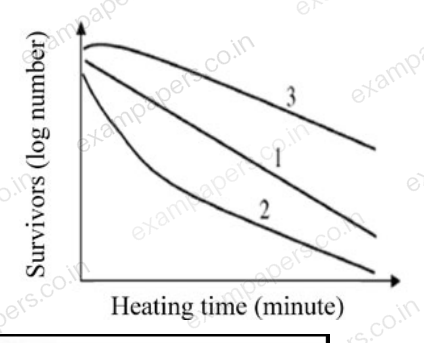
Your answerChoose one option.
Log in to check the answer
You can attempt this question now. Sign in to view the answer key, explanations and discussion.Log in to check answerQuestion 12
Open questionXL-UMCQ2 marksNeeds review
Match the mold in Column I with its asexual/sexual spore shown in Column II.
Column I: P Aspergillus; Q Geotrichum; R Rhizopus; S Oomyces.
Column II: 1 Arthospore; 2 Oospores; 3 Conidia; 4 Sporangiospores
Your answerChoose one option.
Log in to check the answer
You can attempt this question now. Sign in to view the answer key, explanations and discussion.Log in to check answerQuestion 15
Open questionXL-UMCQ2 marksNeeds review
Match the following microbial species in Column I with related disease caused by them as shown in Column II.
Column I: P Vibrio sp.; Q Shigella sp.; R E. coli; S Salmonella typhi.
Column II: 1 Gastroenteritis; 2 Typhoid; 3 Cholera; 4 Bacillary dysentery
Your answerChoose one option.
Log in to check the answer
You can attempt this question now. Sign in to view the answer key, explanations and discussion.Log in to check answerQuestion 4
Open questionXL-UMCQ1 markNeeds review
Which of the following is a Gram positive bacteria?
Your answerChoose one option.
Log in to check the answer
You can attempt this question now. Sign in to view the answer key, explanations and discussion.Log in to check answerQuestion 13
Open questionXL-UMCQ2 marksNeeds review
Match the spoilage symptom in Group I with the causative microorganism in Group II
Group I
P. Green rot of eggs
Q. Putrid smell in canned fish
R. Red bread
S. Yellow discoloration of meat
Group II
Micrococus spp.
Serretia marcescens
Pseudomonas fluorescen
Clostridium sporogens
Your answerChoose one option.
Log in to check the answer
You can attempt this question now. Sign in to view the answer key, explanations and discussion.Log in to check answerQuestion 14
Open questionXL-UMCQ2 marksNeeds review
Match the fermented product in Group I with the base material in Group II
Group I
P. Sake
Q. Churpi
R. Natto
S. Sauerkraut
Group II
Milk
Cabbage
Rice
Soybean
Your answerChoose one option.
Log in to check the answer
You can attempt this question now. Sign in to view the answer key, explanations and discussion.Log in to check answerQuestion 19
Open questionXL-UNAT2 marksNeeds review
A microbial sample taken at 10 AM contained 1x10⁵ CFU/mL. The count reached to 1x10¹⁰ CFU/mL at 8 PM of the same day. The growth rate (h⁻¹) of the microorganism would be ______.(up to two decimal points)
Log in to check the answer
You can attempt this question now. Sign in to view the answer key, explanations and discussion.Log in to check answerQuestion 97
Open questionXL-UMCQ1 markNeeds review
In which of the following products, ‘must’ is used as the substrate for fermentation?
Your answerChoose one option.
Log in to check the answer
You can attempt this question now. Sign in to view the answer key, explanations and discussion.Log in to check answerQuestion 98
Open questionXL-UMCQ1 markNeeds review
Identify the foodborne illness which is not caused by bacteria.
Your answerChoose one option.
Log in to check the answer
You can attempt this question now. Sign in to view the answer key, explanations and discussion.Log in to check answer