
Life Sciences
GATE XL topic:life-sciences PYQs
Build your understanding with focused practice from past exam papers.
Questions 411–420 of 1235. Imported answers require independent review unless marked reviewed.
Question 45
Open questionXL-QNAT2 marksNeeds review
An organism uses only the glycerophosphate shunt pathway to transport cytosolic NADH to mitochondria. For every two electrons transported, complex I, complex III, and complex IV of the electron transport chain in this organism transport 2.5, 1.5, and 2.0 protons (H⁺), respectively. The H⁺ to ATP ratio of F₀F₁-ATPase of this organism is 4.0. Terminal electron acceptor is oxygen.
The number of ATP molecules synthesized by oxidizing NADH from glycolysis is ________ (rounded off to two decimal places).
Log in to check the answer
You can attempt this question now. Sign in to view the answer key, explanations and discussion.Log in to check answerQuestion 46
Open questionXL-QNAT2 marksNeeds review
If the extracellular concentration of sodium ion (Na⁺) is ten times more than its intracellular concentration, then the sodium equilibrium potential at 20 °C in mV is ______________ (rounded off to two decimal places). Assume that the membrane is permeable only to Na⁺ ions. [Use R = 1.987 cal deg⁻¹ mol⁻¹ and F = 23062 cal mol⁻¹ V⁻¹]
Log in to check the answer
You can attempt this question now. Sign in to view the answer key, explanations and discussion.Log in to check answerQuestion 47
Open questionXL-RMCQ1 markNeeds review
Which one of the following statements on Casparian strips is correct?
Your answerChoose one option.
Log in to check the answer
You can attempt this question now. Sign in to view the answer key, explanations and discussion.Log in to check answerQuestion 48
Open questionXL-RMCQ1 markNeeds review
Rotenone is a chemical often used to kill insect pests on crop plants and fishes in lakes. Rotenone acts by inhibiting electron transport from the NADH dehydrogenase enzyme in Complex I to ubiquinone in the mitochondrial electron transport chain. Which one of the following explains why plants can tolerate rotenone application?
Your answerChoose one option.
Log in to check the answer
You can attempt this question now. Sign in to view the answer key, explanations and discussion.Log in to check answerQuestion 49
Open questionXL-RMCQ1 markNeeds review
Although Pseudomonas syringae infection in plants is actively inhibited by the endogenous salicylic acid (SA) of host origin, a successful infection is still established because the bacterium secretes coronatine, an effector molecule. Which one of the following best describes the mode of action of coronatine?
Your answerChoose one option.
Log in to check the answer
You can attempt this question now. Sign in to view the answer key, explanations and discussion.Log in to check answerQuestion 50
Open questionXL-RMCQ1 markNeeds review
The schematic depicts an unexpanded plant cell within a hypocotyl with the arrangement of cellulose microfibrils marked on its cell wall.
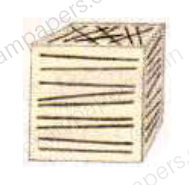
Which one of the following shapes would most likely result from the expansion of this cell if the pattern of the cellulose fibers does not change?
Your answerChoose one option.
Log in to check the answer
You can attempt this question now. Sign in to view the answer key, explanations and discussion.Log in to check answerQuestion 51
Open questionXL-RMSQ1 markNeeds review
Which one or more of the following statements is/are NOT CORRECT with respect to pollen development in angiosperm?
Your answerSelect all correct options. You can choose more than one.
Log in to check the answer
You can attempt this question now. Sign in to view the answer key, explanations and discussion.Log in to check answerQuestion 52
Open questionXL-RMSQ1 markNeeds review
Regulation of phosphoenolpyruvate carboxylase (PEPCase) governs CO₂ fixation in both C4 and CAM (crassulacean acid metabolism) plants. Which one or more of the following statements with respect to PEPCase activity is/are CORRECT?
Your answerSelect all correct options. You can choose more than one.
Log in to check the answer
You can attempt this question now. Sign in to view the answer key, explanations and discussion.Log in to check answerQuestion 53
Open questionXL-RMSQ1 markNeeds review
Which one or more processes listed below DOES NOT/DO NOT produce carbon dioxide during fermentation?
Your answerSelect all correct options. You can choose more than one.
Log in to check the answer
You can attempt this question now. Sign in to view the answer key, explanations and discussion.Log in to check answerQuestion 54
Open questionXL-RNAT1 markNeeds review
The ovule of a diploid species with 2n = 8 undergoes double fertilization. If the pollen is contributed by an individual with meiotic nondisjunction, the chromosome number of the zygote will be __________.
Log in to check the answer
You can attempt this question now. Sign in to view the answer key, explanations and discussion.Log in to check answer