
Life Sciences
GATE XL year:2023 PYQs
Build your understanding with focused practice from past exam papers.
Questions 11–20 of 122. Imported answers require independent review unless marked reviewed.
Question 11
Open questionXL-PMCQ1 markNeeds review
Which one among the following mixtures gives a buffer solution in water?
Your answerChoose one option.
Log in to check the answer
You can attempt this question now. Sign in to view the answer key, explanations and discussion.Log in to check answerQuestion 12
Open questionXL-PMCQ1 markNeeds review
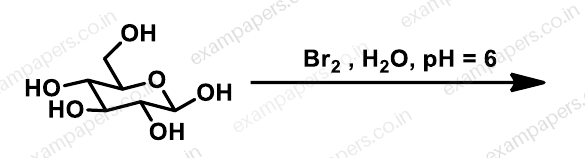
What is the major product formed in the given reaction?
Your answerChoose one option.
Log in to check the answer
You can attempt this question now. Sign in to view the answer key, explanations and discussion.Log in to check answerQuestion 13
Open questionXL-PMCQ1 markNeeds review
The CORRECT order of stability of the given metal oxides is
Your answerChoose one option.
Log in to check the answer
You can attempt this question now. Sign in to view the answer key, explanations and discussion.Log in to check answerQuestion 14
Open questionXL-PMSQ1 markNeeds review
Which of the following is/are CORRECT when two single complementary strands of DNA come together to form a double helix at a given temperature?
(ΔS and ΔH are changes in entropy and enthalpy of the process, respectively.)
Your answerSelect all correct options. You can choose more than one.
Log in to check the answer
You can attempt this question now. Sign in to view the answer key, explanations and discussion.Log in to check answerQuestion 15
Open questionXL-PMSQ1 markNeeds review
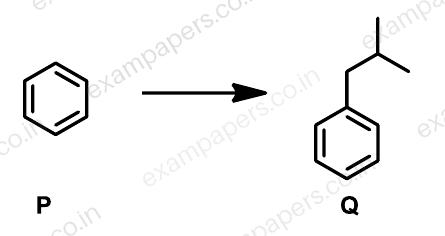
Suitable reagent(s) to bring about the conversion of P to Q in good yield is/are
Your answerSelect all correct options. You can choose more than one.
Log in to check the answer
You can attempt this question now. Sign in to view the answer key, explanations and discussion.Log in to check answerQuestion 16
Open questionXL-PMSQ1 markNeeds review
Choose the CORRECT trend(s) of the first ionization energies among the following.
(Given: Atomic numbers C: 6; N: 7; O: 8; F: 9; Si: 14; P: 15; S: 16; Cl: 17)
Your answerSelect all correct options. You can choose more than one.
Log in to check the answer
You can attempt this question now. Sign in to view the answer key, explanations and discussion.Log in to check answerQuestion 17
Open questionXL-PNAT1 markNeeds review
The depression of freezing point of water (in K) for 0.1 molal solutions of NaCl and Na₂SO₄ are ΔT₁ and ΔT₂, respectively. Assuming the solutions to be ideal, the ratio ΔT₁/ΔT₂ is ____________ (rounded off to two decimal places).
Log in to check the answer
You can attempt this question now. Sign in to view the answer key, explanations and discussion.Log in to check answerQuestion 18
Open questionXL-PNAT1 markNeeds review
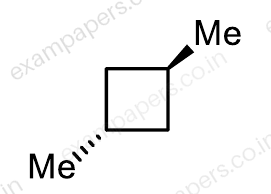
Considering cyclobutane to be planar, the number of planes of symmetry in the following compound is ____________ (in integer).
Log in to check the answer
You can attempt this question now. Sign in to view the answer key, explanations and discussion.Log in to check answerQuestion 19
Open questionXL-PNAT1 markNeeds review
The dipole moment (μ) of BrF is 1.42 D and the bond length is 176 pm. The atomic charge distribution (q) in the molecule is _____ (rounded off to two decimal places). (Given: 1 D = 3.3 × 10⁻³⁰ C m; the factor e (electronic charge) = 1.60 × 10⁻¹⁹ C)
Log in to check the answer
You can attempt this question now. Sign in to view the answer key, explanations and discussion.Log in to check answerQuestion 20
Open questionXL-PMCQ2 marksNeeds review
Consider two different paths in which the volume of an ideal gas doubles isothermally:
i) Reversible expansion (work done =
)
ii) Irreversible expansion, with the external pressure equal to the final pressure of the gas (work done =
)Here,
= ______________.Your answerChoose one option.
Log in to check the answer
You can attempt this question now. Sign in to view the answer key, explanations and discussion.Log in to check answer