
Life Sciences
GATE XL year:2023 PYQs
Build your understanding with focused practice from past exam papers.
Questions 31–40 of 122. Imported answers require independent review unless marked reviewed.
Question 31
Open questionXL-QMSQ1 markNeeds review
Given below are four reactions of the glycolytic pathway catalyzed by the enzymes E1, E2, E3 and E4, as indicated.
(i) Fructose 6-phosphate
Fructose 1,6-bisphosphate(ii) Fructose 1,6-bisphosphate
Dihydroxyacetone phosphate + Glyceraldehyde 3-phosphate(iii) 3-Phosphoglycerate
2-Phosphoglycerate(iv) Phosphoenolpyruvate
PyruvateWhich of these enzymes is/are NOT part of the gluconeogenesis pathway?
Your answerSelect all correct options. You can choose more than one.
Log in to check the answer
You can attempt this question now. Sign in to view the answer key, explanations and discussion.Log in to check answerQuestion 32
Open questionXL-QMSQ1 markNeeds review
Which of the following molecules is/are second messenger(s) produced by the phosphoinositide signaling cascade?
Your answerSelect all correct options. You can choose more than one.
Log in to check the answer
You can attempt this question now. Sign in to view the answer key, explanations and discussion.Log in to check answerQuestion 33
Open questionXL-QNAT1 markNeeds review
A protein has seven cysteine residues. The maximum number of disulfide bonds of different combinations that can possibly be formed by these seven cysteine residues is ______ (in integer).
Log in to check the answer
You can attempt this question now. Sign in to view the answer key, explanations and discussion.Log in to check answerQuestion 34
Open questionXL-QNAT1 markNeeds review
A lyophilized sample of 20 nanomoles of an oligonucleotide is dissolved in water and the volume of the solution is made up to 200 μL. The concentration (in μM) of the oligonucleotide in this solution is ______ (in integer).
Log in to check the answer
You can attempt this question now. Sign in to view the answer key, explanations and discussion.Log in to check answerQuestion 35
Open questionXL-QNAT1 markNeeds review
DNA in a 1 cm long chromatin contains 5 × 10⁹ base pairs. The fold compaction of this DNA within the chromatin is ______ (in integer).
Log in to check the answer
You can attempt this question now. Sign in to view the answer key, explanations and discussion.Log in to check answerQuestion 36
Open questionXL-QMCQ2 marksNeeds review
Intracellular concentrations of ATP, ADP, and inorganic phosphate in four cell types are given below. Which one of these cell types has the most negative
for ATP hydrolysis?Cell type | ATP (mM) | ADP (mM) | Inorganic phosphate (mM) |
|---|---|---|---|
L | 3.0 | 1.8 | 5.0 |
K | 3.9 | 1.3 | 3.0 |
B | 2.7 | 0.7 | 2.7 |
M | 7.2 | 0.9 | 8.0 |
Your answerChoose one option.
Log in to check the answer
You can attempt this question now. Sign in to view the answer key, explanations and discussion.Log in to check answerQuestion 37
Open questionXL-QMCQ2 marksNeeds review
Which one of the following amino acids has more than two acid-base groups?
Your answerChoose one option.
Log in to check the answer
You can attempt this question now. Sign in to view the answer key, explanations and discussion.Log in to check answerQuestion 38
Open questionXL-QMCQ2 marksNeeds review
Enzyme activity profiles as a function of time in the absence or presence of different types of feedback mechanisms are shown in the figure below. Match the following feedback mechanisms with the corresponding profiles in the figure.
(p) No feedback mechanism
(q) Negative feedback mechanism with short delay
(r) Negative feedback mechanism with long delay
(s) Positive feedback mechanism
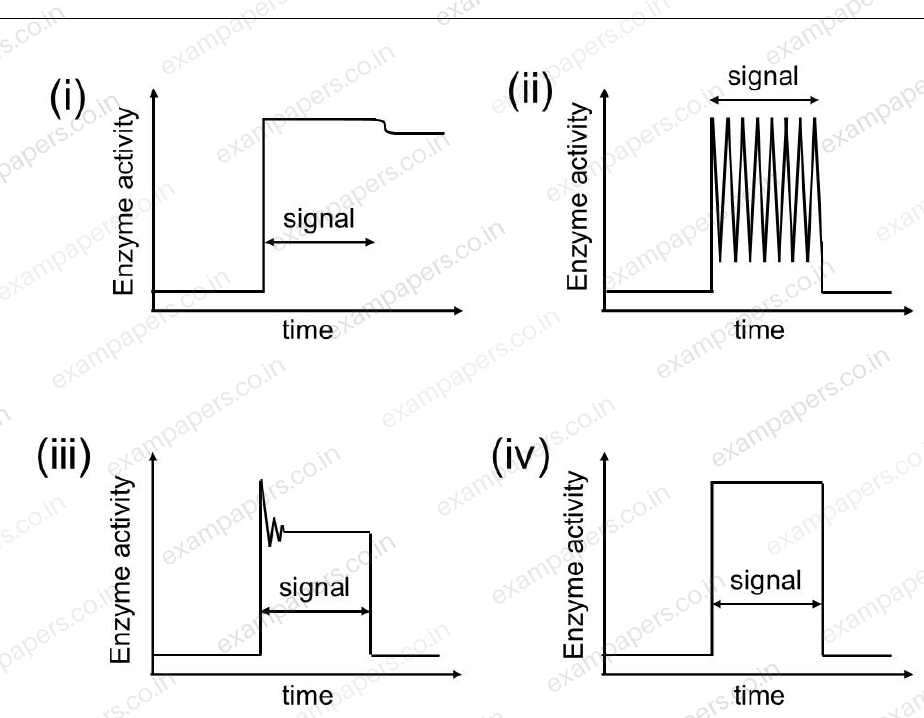
Your answerChoose one option.
Log in to check the answer
You can attempt this question now. Sign in to view the answer key, explanations and discussion.Log in to check answerQuestion 39
Open questionXL-QMCQ2 marksNeeds review
A linear DNA fragment of 5 kilobase (kb) when completely digested with EcoRI produces 2.5 kb, 1.5 kb, and 1 kb fragments. Complete digestion of the same 5 kb fragment with XbaI produces 3.5 kb and 1.5 kb fragments. Which one of the following sets of fragments will be obtained if the 5 kb fragment is fully digested with EcoRI and XbaI simultaneously?
Your answerChoose one option.
Log in to check the answer
You can attempt this question now. Sign in to view the answer key, explanations and discussion.Log in to check answerQuestion 40
Open questionXL-QMCQ2 marksNeeds review
Match the cell types listed in Group I with associated processes listed in Group II.
Group I
(p) NK cells
(q) B cells
(r) Mast cells
(s) Neutrophils
Group II
(i) Antibody production
(ii) First cells to be recruited at the site of infection
(iii) Antibody-dependent cell-mediated cytotoxicity
(iv) Histamine production
Your answerChoose one option.
Log in to check the answer
You can attempt this question now. Sign in to view the answer key, explanations and discussion.Log in to check answer