
Life Sciences
GATE XL year:2025 PYQs
Build your understanding with focused practice from past exam papers.
Questions 11–20 of 122. Imported answers require independent review unless marked reviewed.
Question 11
Open questionXL-PMCQ1 markNeeds review
The rate of solvolysis for the following tertiary halides in 80% aqueous ethanol at 25 °C follows the order
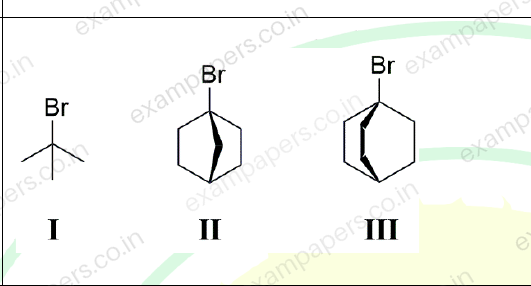
Your answerChoose one option.
Log in to check the answer
You can attempt this question now. Sign in to view the answer key, explanations and discussion.Log in to check answerQuestion 12
Open questionXL-PMCQ1 markNeeds review
The CORRECT order of boiling points for the hydrogen halides is
Your answerChoose one option.
Log in to check the answer
You can attempt this question now. Sign in to view the answer key, explanations and discussion.Log in to check answerQuestion 13
Open questionXL-PMCQ1 markNeeds review
The bond order in
species isYour answerChoose one option.
Log in to check the answer
You can attempt this question now. Sign in to view the answer key, explanations and discussion.Log in to check answerQuestion 14
Open questionXL-PMCQ1 markNeeds review
The standard enthalpy of the reaction,
is found to be
and the
value for CO (g) is
.
The value of
(in
) for H
O (g) is(The standard enthalpies of formation of elements in their reference states are zero at all temperatures)
Your answerChoose one option.
Log in to check the answer
You can attempt this question now. Sign in to view the answer key, explanations and discussion.Log in to check answerQuestion 15
Open questionXL-PMCQ1 markNeeds review
The temperature dependence of reaction rates is generally given by the Arrhenius equation. A plot of
against
is a straight line from which the pre-exponential factor ‘A’ and the activation energy ‘
’ can be determined.The CORRECT option regarding this plot is
Your answerChoose one option.
Log in to check the answer
You can attempt this question now. Sign in to view the answer key, explanations and discussion.Log in to check answerQuestion 16
Open questionXL-PMCQ1 markNeeds review
The isothermal expansion of one mole of an ideal gas from
to
at temperature, T occurs in two ways.Path I: a reversible isothermal expansion;
Path II: free expansion against zero external pressure
The CORRECT option for the values of
,
and
for Path I and Path II isYour answerChoose one option.
Log in to check the answer
You can attempt this question now. Sign in to view the answer key, explanations and discussion.Log in to check answerQuestion 17
Open questionXL-PMSQ1 markNeeds review
The CORRECT statement(s) regarding the given molecules is(are)
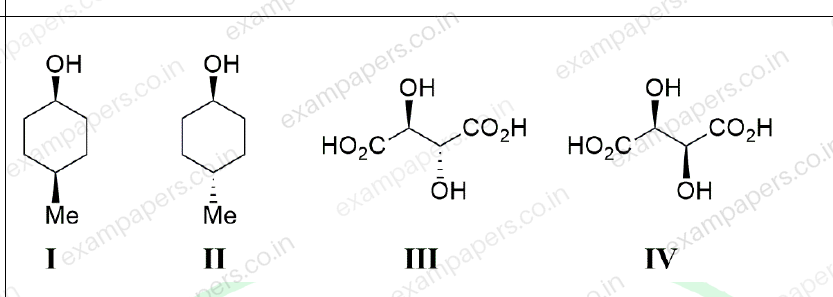
Your answerSelect all correct options. You can choose more than one.
Log in to check the answer
You can attempt this question now. Sign in to view the answer key, explanations and discussion.Log in to check answerQuestion 18
Open questionXL-PMSQ1 markNeeds review
The CORRECT statement(s) about [Ni(CN)₄]²⁻, [Ni(CO)₄] and [NiCl₄]²⁻ is(are) (Given: Atomic number of Ni: 28)
Your answerSelect all correct options. You can choose more than one.
Log in to check the answer
You can attempt this question now. Sign in to view the answer key, explanations and discussion.Log in to check answerQuestion 19
Open questionXL-PNAT1 markNeeds review
Consider the two
values of valine as 2.32 and 9.62. The isoelectric point (pI) of this amino acid is _____. (rounded off to two decimal places)Log in to check the answer
You can attempt this question now. Sign in to view the answer key, explanations and discussion.Log in to check answerQuestion 20
Open questionXL-PMCQ2 marksNeeds review
A few species are given in Column I. Column II contains the hybrid orbitals used by the central atom of the species for bonding.
The CORRECT match for the species to their central atom hybridization is
(Given: Atomic numbers of B: 5; C: 6; O: 8; F: 9; P: 15; Cl: 17; I: 53)
Column I — Species: i. I₃⁻; ii. PCl₃; iii. BF₃; iv. CO₂
Column II — Hybrid orbitals used by the central atom for bonding: a. sp; b. sp²; c. sp³; d. sp³d
Your answerChoose one option.
Log in to check the answer
You can attempt this question now. Sign in to view the answer key, explanations and discussion.Log in to check answer